Morocco Currency Guide (2026): The Ultimate Guide to Money, ATMs & Payments
Morocco runs on a currency you can’t buy before you land, at exchange rates that shift by the week, in a country where cash still wins most everyday transactions despite cards being widely accepted in cities. None of that is complicated once you know the rules this guide covers exactly what you need: what the dirham is, where and how to get it, what ATMs and cards actually cost you, and how much to budget and tip once you’re there.
Currency is one of those trip details that’s easy to underplan and mildly painful to get wrong a bad exchange rate at the airport, an ATM fee you didn’t expect, a taxi you couldn’t pay because you only had large notes. None of these are serious problems on their own, but together they’re the most common source of small, avoidable frustration travelers report in Morocco. This guide is built to prevent all of them.
Morocco Currency Guide: What Is the Official Currency?
What Is the Moroccan Dirham (MAD)?
The Moroccan dirham (MAD, symbol DH or د.م.) is Morocco’s sole official currency, and it’s a closed currency meaning it can’t be legally bought or sold outside the country. That single fact shapes almost everything else in this guide: you can’t arrive with dirhams already in hand, and you’re not meant to leave with a large amount either.
Exchange rates fluctuate daily, but as a rough anchor for 2026, one US dollar has generally traded in the range of 9 to 9.2 dirhams, and one euro in the range of roughly 10.6 to 10.9 dirhams. Treat these as a ballpark rather than a fixed number check a live converter close to your travel dates rather than relying on any figure printed months in advance, this guide included.
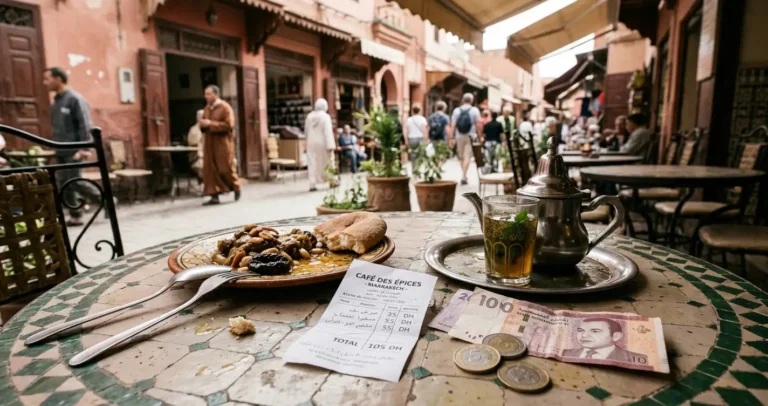
The dirham is issued in both banknotes and coins. Notes commonly run from 20 to 200 MAD, and coins cover smaller denominations down to a single dirham and its fractional centimes. Note that older sellers in some souks and rural markets occasionally quote prices in “rials” (a legacy unit, roughly 20 rials to 1 dirham) rather than dirhams outright if a quoted number sounds unusually high or low, it’s worth simply confirming whether the price is in dirhams.
Can You Use Euros or US Dollars in Morocco?
Not for everyday purchases. Restaurants, taxis, souk vendors, and most businesses expect payment in dirhams, and while a very small number of tourist-facing hotels or shops might informally accept euros, you’ll typically get a worse effective rate than exchanging properly. The practical approach is straightforward: exchange your home currency for dirhams after you land, and spend down your dirhams before you leave, since converting back can mean a worse rate and, past certain amounts, paperwork.
Morocco Currency Guide: Exchange Money Before or After You Arrive?
Where to Exchange Money in Morocco
Because the dirham can’t be bought abroad, exchange happens once you’re in the country at the airport, at banks, at licensed exchange bureaus (bureaux de change), or through hotel front desks in a pinch. Airport exchange counters are convenient for getting your first few hundred dirhams for a taxi and incidentals, but bank branches and dedicated exchange bureaus in the city center typically offer better rates for anything beyond that initial amount.
Licensed exchange bureaus are common in medinas and city centers, clearly marked and generally reliable, since Morocco’s currency exchange market is tightly regulated. It’s worth bringing your passport when exchanging any significant amount, since bureaus and banks routinely ask to see it and record the transaction.
How to Get the Best Exchange Rate
Exchange bureaus and banks generally beat hotel front desks, and comparing two or three nearby options before committing a large sum is worth the ten minutes it takes, since posted rates can vary meaningfully between neighboring bureaus. Keep your exchange receipts if you convert a significant sum, since you may need to show proof of the original transaction if you want to convert unused dirhams back before departure.
A practical rule of thumb: exchange only what you’re confident you’ll spend, plus a small buffer, rather than converting your entire trip’s cash budget on day one. Not only does this reduce how much cash you’re carrying at any given time, it also means less friction if you end up relying more heavily on ATMs or cards than planned.
Morocco Currency Guide: Using ATMs in Morocco
Are ATMs Easy to Find?
Very. Marrakech, Casablanca, Fes, Rabat, and other major cities and towns have ATMs on nearly every commercial street, typically connected to the international CMI network and accepting major international cards without issue. Machines generally offer an English-language option alongside French and Arabic, so navigating the interface isn’t a barrier even on your first withdrawal.
Coverage thins out considerably once you leave the cities, though towns like Merzouga or Imlil may have only one machine, if any, so it’s standard practice to withdraw enough cash in the nearest major city before heading into the Atlas Mountains, the Sahara, or other rural routes. It’s also worth knowing that Moroccan ATMs occasionally run dry, particularly on weekends and around public holidays, so treat an empty machine as routine rather than alarming and simply try a nearby alternative.
ATM Fees and Withdrawal Limits
Most Moroccan ATMs cap withdrawals somewhere between 2,000 and 4,000 MAD per transaction, with 2,000 MAD being the most common limit, and banks generally don’t cap the number of transactions per day, so multiple withdrawals are possible if you need more. On top of that, local ATM fees for foreign cards typically run 20 to 40 MAD per withdrawal, separate from whatever foreign-transaction fee your home bank charges, which commonly adds another 1.5% to 3% of the amount withdrawn.
Because of this stacked fee structure, it’s cheaper to withdraw larger amounts less often rather than making several small withdrawals. Travel-friendly cards from providers like Wise, Revolut, or Charles Schwab (for US travelers) often waive or sharply reduce the home-bank side of these fees, which is worth setting up before you travel if you’ll be making several withdrawals over the trip. A small number of banks, including Al Barid Bank (Morocco’s post office bank), are frequently reported as fee-free for foreign cards, making their machines worth seeking out where available.
Tips for Using ATMs Safely
Favor machines physically attached to a bank branch over standalone units on side streets if a machine swallows your card, walking inside to recover it with your passport is straightforward, while a standalone machine offers no such backup. Withdraw during the day rather than late at night, and skip any machine that looks tampered with, has an unusual card slot, or has people lingering unusually close.
When the screen offers to convert your withdrawal into your home currency instead of dirhams, always decline and choose Moroccan dirhams that “convenience” is Dynamic Currency Conversion, and it applies a worse exchange rate than letting your own bank handle the conversion. It’s also worth giving your bank a heads-up before you travel, since an unexpected international withdrawal can sometimes trigger a fraud hold on your card at the worst possible moment.
Morocco Currency Guide: Paying by Card or Cash
Where Credit and Debit Cards Are Accepted
Hotels, riads, larger supermarkets, and most mid-range-and-up restaurants in cities accept Visa and Mastercard, with American Express far less consistently supported. Card acceptance drops sharply once you’re in the souks, at street food stalls, in petit taxis, or in smaller towns and rural areas, where cash is effectively the only option.
When You Should Carry Cash
Plan to carry cash for taxis, souk shopping and haggling, street food, small cafés, entrance fees at smaller sites, tips, and pretty much anything in a rural area or small town. Even in cities where cards are accepted, it’s worth keeping enough cash on hand to cover a full day’s spending, since a card reader being down or a Wi-Fi outage isn’t unusual and cash is the fallback that never fails.
Contactless Payments in Morocco
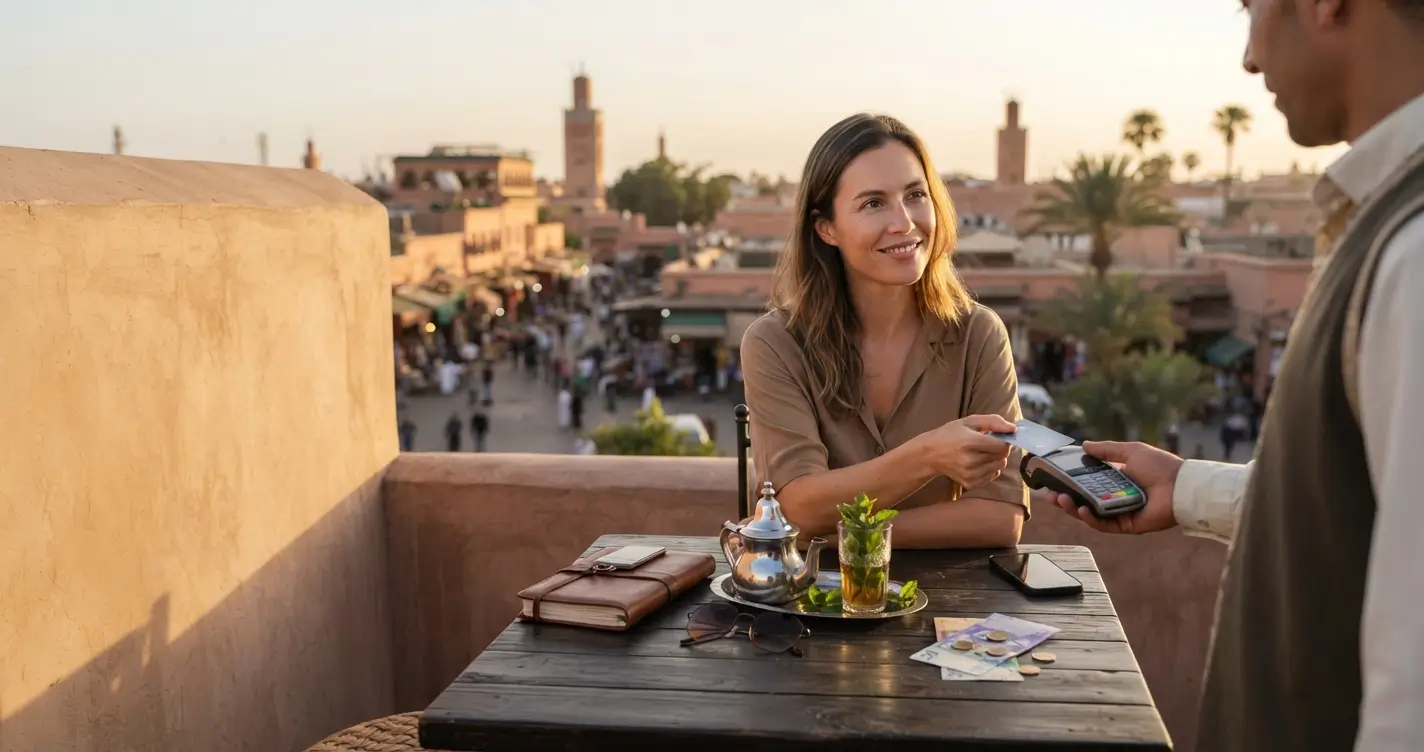
Contactless card payments are increasingly available in Marrakech, Casablanca, and other major cities, particularly at larger retailers, cafés, and hotels, though it’s far from universal plenty of smaller businesses still expect either a chip-and-PIN transaction or cash outright. Mobile payment apps tied to foreign bank accounts (Apple Pay, Google Pay) work at the same limited set of contactless-enabled terminals, so they’re a convenience layer on top of a card, not yet a full substitute for one in Morocco.
Morocco Currency Guide: How Much Cash Should You Carry?
Daily Budget for Budget Travelers
Budget travelers relying on hostels or simple guesthouses, street food, and local buses or shared taxis typically spend somewhere in the range of $30 to $50 (roughly 300-450 MAD) per day. At this level, cash covers nearly everything, since budget accommodation and street food vendors rarely take cards. A bowl of soup or a plate of street-stall tagine can cost as little as 20-40 MAD, and a simple guesthouse room often runs 150-300 MAD a night, which is what keeps this tier so affordable relative to Southern Europe.
Daily Budget for Mid-Range Travelers
Mid-range travelers mixing private riad rooms, a blend of local and sit-down restaurants, first-class trains or occasional private transport, and guided tours or attraction entries generally land around $80 to $150 (roughly 800-1,400 MAD) per day. Riads and restaurants at this tier increasingly take cards, but taxis, tips, and souk purchases still call for cash on hand. This is the range most first-time visitors gravitate toward, since it comfortably covers a well-located riad, restaurant meals, and a couple of guided experiences without requiring constant budget-tracking.
Daily Budget for Luxury Travelers
Luxury travelers staying in high-end riads and hotels, dining at upscale restaurants, and booking private drivers or premium desert camps typically spend $200 to $400 or more per day. Card acceptance is close to universal at this tier’s establishments, though cash is still the norm for tips and any informal purchases along the way. Even at this level, Morocco remains noticeably better value than comparable luxury experiences in Southern Europe, which is part of why the country has become such a popular high-end destination in recent years.
Morocco Currency Guide: Tipping in Morocco
How Much Should You Tip?
Tipping in Morocco is customary but not fixed the way a service charge is elsewhere it’s a small cash courtesy rather than a strict percentage everyone silently agrees on. As a rough guide: round up small bills at cafés and casual eateries or leave 5-10 MAD, tip 10-15% at mid-range and upscale restaurants (checking first whether service is already included, sometimes noted on the bill as “service compris”), round taxi fares up to the nearest 5-10 MAD, leave 10-20 MAD per day for housekeeping, and budget 50-100 MAD per person for a day guide or 100-200 MAD per day for a private multi-day driver-guide.
For multi-day treks in the Atlas Mountains, where a guide, cook, and mule handler may all be part of the team, it’s customary to tip each person separately at the end of the trip rather than lumping everyone into one amount 20-50 MAD per day per crew member is a reasonable range, adjusted for group size and satisfaction with the service.
Keep a stock of small notes 10, 20, and 50 MAD bills specifically since exact change is genuinely hard to come by in Morocco, and running out of small bills is the single most common reason travelers over- or under-tip by accident.
When Tipping Is Expected
Tipping is most expected in restaurants, hotels and riads, taxis, hammams, and on guided tours or with private drivers anywhere the service is personal rather than purely transactional. It’s generally not expected in the souks when haggling over a purchase, since the negotiated price is treated as the complete transaction, and it’s not required at fixed-price shops or self-service settings.
Always tip in Moroccan dirhams rather than foreign currency, since it’s far more convenient for the recipient than a currency they’d then need to exchange themselves, often at a loss. If you receive genuinely poor service, you’re not obligated to tip a polite decline is entirely acceptable and won’t be seen as unusual.
Morocco Currency Guide: Common Money Mistakes to Avoid
Exchanging Money at the Airport
Airport exchange counters are convenient for your first taxi fare, but their rates are consistently among the worst you’ll find in the country, reflecting the premium airport operators charge for that convenience. Exchanging just enough to get into the city, then finding a bank or exchange bureau for anything larger, is a simple habit that adds up to a meaningfully better rate over a full trip.
Forgetting Small Cash for Taxis and Markets
Taxis, souk vendors, and small cafés run almost entirely on cash, and arriving without small notes on hand is one of the most common frustrations travelers report a driver or vendor genuinely may not be able to break a large bill, and insisting on it rarely ends well for either side. Breaking larger notes at a bank, hotel, or supermarket early in your trip saves the awkwardness of hunting for change later, and it’s worth doing this proactively rather than waiting until you’re already short.
Accepting Dynamic Currency Conversion
Whether at an ATM or a card terminal in a shop or restaurant, being offered the choice to pay or withdraw “in your home currency” instead of dirhams is Dynamic Currency Conversion, and it almost always comes with a worse exchange rate baked in than simply letting your own bank convert the charge. The rule is simple and applies everywhere you see this option: always choose to be charged in Moroccan dirhams, even if the home-currency total looks tidier or more familiar on the screen.
Morocco Currency Guide: Frequently Asked Questions
Can You Use Euros in Morocco?
Not for standard purchases — restaurants, taxis, and shops expect dirhams. A small number of very tourist-oriented businesses might informally accept euros, but you’ll typically lose value compared to exchanging properly beforehand, since informal rates rarely match what a bank or exchange bureau would give you.
Can You Pay With US Dollars?
Much the same as euros dollars aren’t accepted for everyday transactions, and exchanging for dirhams at a bank or bureau de change remains the standard, and more favorable, approach. Some higher-end hotels catering heavily to American travelers may quote prices in dollars for booking purposes, but the actual payment on the ground still runs through dirhams.
Are ATMs Safe in Morocco?
Yes, when you use common-sense precautions: favor machines attached to bank branches, withdraw during daylight hours, and decline any Dynamic Currency Conversion offer. Morocco’s ATM network is well developed in cities, and issues are more often about machines running out of cash on busy weekends than about safety.
Is Morocco Mostly Cash or Card?
Cash-dominant outside hotels, larger restaurants, and bigger retailers. Cards work well for accommodation and dining in cities, but taxis, souks, street food, and rural areas remain cash-first, so carrying enough dirhams for each day is the safer default rather than assuming a card will cover you. A practical habit many travelers settle into is withdrawing a few days’ worth of cash at a time and topping up card use for the bigger, planned expenses like riads and guided tours.
Final Thoughts: Morocco Currency Guide
Money in Morocco rewards a little preparation more than most destinations: know that the dirham can’t be bought abroad, budget for ATM and bank fees on top of the sticker price, keep small notes on hand for taxis and markets, and always decline the “pay in your home currency” prompt wherever it appears. Get those habits right in your first day or two, and the rest of the trip is simply a matter of enjoying what remains, genuinely, one of the better-value destinations within reach of Europe.