Best Time to Visit Chefchaouen (2026): When to Go for Perfect Weather, Fewer Crowds & Blue-Medina Magic
Chefchaouen sits at roughly 600 metres in the Rif Mountains, which means its climate behaves differently from the rest of northern Morocco. Tangier can be humid and windy while Chefchaouen stays dry and sunny just two hours south. Finding the best time to visit Chefchaouen comes down to balancing three things: comfortable temperatures for walking the steep medina lanes, manageable crowds around the blue-washed alleys, and clear conditions for day trips to the Akchour waterfalls. This guide breaks the town’s weather down month by month, season by season, and by what you actually plan to do there, so you can pick dates that match your trip rather than someone else’s.
What Is the Best Time to Visit Chefchaouen?
The best time to visit Chefchaouen for most travellers is late spring (May) or early autumn (September). Both months bring warm, dry days without the peak-summer heat that settles into the Rif valleys in July and August. Daytime highs sit in the low-to-mid twenties Celsius, rainfall drops off sharply compared to winter, and the medina is busy without feeling overwhelmed. June is technically the highest-scoring month for pure weather, but it also overlaps with the start of the summer rush, so travellers who want quieter alleys and softer light often lean toward September instead.
That said, “best” depends on what you’re optimising for. Photographers chasing that famous cobalt-blue glow may prefer the low winter sun; hikers heading to Akchour want dry trails and cool mornings; budget travellers care more about hotel prices than temperature. The sections below cover each of these angles separately.
Chefchaouen Weather at a Glance
Chefchaouen has a temperate mountain climate with a clear split between a mild, dry summer and a cooler, wetter winter. Because the town sits at altitude, it runs noticeably cooler than Marrakech or Fez in summer and colder than the coast in winter riads here are rarely built with central heating, which matters more in January than most guides mention.
- Warmest months: July and August, with daytime highs of 33–34°C
- Coldest months: January and December, with daytime highs around 15°C and nights near 5–7°C
- Driest months: July and August, with rain on 1–3% of days
- Wettest month: March, followed closely by December, with rain on roughly a third to 40% of days
- Sunniest months: June and July, with 13+ hours of daylight and mostly clear skies
Best Time to Visit Chefchaouen by Season
Spring in Chefchaouen: March to May
Spring is when Chefchaouen wakes up after winter. March still carries the tail end of the rainy season it’s actually the wettest month of the year by frequency of rain days so pack a light waterproof layer if you’re travelling early in the season. By April the rain tapers off noticeably, wildflowers appear on the hillsides around Talassemtane National Park, and by May the weather turns close to ideal: highs around 24°C, lows near 12°C, and rain on roughly one day in five. May is one of the strongest months on this list for a first visit, combining comfortable hiking conditions with a medina that hasn’t yet filled up with peak-season crowds.
Summer in Chefchaouen: June to August
June is the best-scoring month of the year here, and it’s easy to see why: warm days, cool evenings at altitude, and long stretches of clear sky. July and August push into genuine heat, with afternoons regularly topping 33–34°C in the narrow, sun-trapped medina streets. It’s still markedly cooler than Marrakech or Fez at the same time of year, but midday walking in the blue quarter can feel draining without shade or water. August also happens to be the peak month for domestic Moroccan tourism, so expect the fullest hotels and busiest photo spots of the year alongside the heat.
Autumn in Chefchaouen: September to November
Autumn is arguably the most underrated season here. September carries over summer’s dry, sunny conditions 29°C highs, rain on only about one day in eight while the worst of the crowds have already gone home. October cools further into the low-to-mid twenties and stays largely dry. By November, temperatures drop toward 18°C and rain returns on roughly a third of days, but the golden late-autumn light on the medina walls is a genuine draw for anyone bringing a camera. For travellers weighing the best time to visit Chefchaouen against a tight shoulder-season budget, September through October is hard to beat.
Winter in Chefchaouen: December to February
Winter in Chefchaouen is cool, occasionally damp, and quiet. Daytime highs hover between 15 and 16°C from December through February, nights can drop to 5–7°C, and December is one of the wettest months of the year alongside March. Riads are not always well insulated, so ask about heating (a kanoun or electric heater) before booking if you’re sensitive to cold. On the upside, this is when the medina is at its calmest, hotel prices are at their lowest, and the blue walls under grey winter light have a mood that summer photos rarely capture.
Chefchaouen Weather Month by Month
January
Highs around 15°C, lows near 5°C, with rain on roughly 29% of days and about 9 hours of daylight. Mornings are cold enough for a proper jacket; afternoons in direct sun are manageable for walking.
February
Very similar to January highs of 16°C, lows around 6°C with slightly less rain (about 27% of days) and 10 hours of daylight. Still winter conditions, but the shift toward spring is starting to show.
March
The wettest month of the year by frequency, with rain on around 41% of days. Highs reach 16°C and lows sit near 7°C. Pack a light raincoat and expect some overcast days between the sunny spells.
April
Rain drops sharply from March, down to about 32% of days, while highs climb to 20°C. This is a genuine transition month some days feel like winter, others like early summer.
May
One of the best months on the calendar: highs of 24°C, lows around 12°C, rain on only about a fifth of days, and 13 hours of sunshine. Comfortable for both medina walks and hikes at Akchour.
June
The single best-scoring month for weather in Chefchaouen: highs of 28°C, lows of 16°C, rain on just 12% of days, and over 13 hours of daylight. Crowds are building but haven’t peaked yet.
July
Hot and almost entirely dry highs of 33°C, lows of 19°C, rain on around 1% of days. Great for guaranteed sunshine, tougher for midday walking in the medina’s stone alleys.
August
The hottest month, with highs reaching 34°C and lows of 20°C. Rain is virtually absent (about 3% of days), but this is also the peak month for domestic tourism, so book accommodation early.
September
A strong contender for the best time to visit Chefchaouen: highs of 29°C, lows of 17°C, rain on just 13% of days, and crowds noticeably thinner than August.
October
Highs cool to 25°C, lows to 14°C, and rain returns modestly (around 24% of days). Still a comfortable, good-value month with pleasant light for photography.
November
Highs drop to 18°C, lows to 9°C, with rain on about 31% of days. Golden autumn light and thinning crowds make this a quietly appealing month for a slower visit.
December
The coldest, wettest stretch of the year alongside March: highs of 15°C, lows near 7°C, and rain on roughly 32% of days. The lowest hotel prices of the year, but pack warm layers.
Best Months to Visit Chefchaouen for Comfortable Weather
If comfort is the priority, May, June, and September are your strongest options. All three sit in that sweet spot of warm-but-not-scorching daytime highs (24–29°C), low rainfall, and cool enough evenings to enjoy a rooftop dinner without a jacket. October is a close fourth choice, especially for travellers who prioritise lower prices over the last few degrees of warmth.
Best Time to Visit Chefchaouen for Fewer Crowds
Chefchaouen’s tourist season peaks from June through August, when both international visitors and Moroccan domestic tourists converge on the town August in particular sees the heaviest local tourism of the year. For fewer people in the main square and shorter waits at the most photographed alleyways, aim for late October through April, avoiding the school-holiday weeks around Christmas and Easter. Early May and late September offer a middle ground: noticeably quieter than midsummer, but without the winter chill.
Best Time to Visit Chefchaouen for the Blue Medina
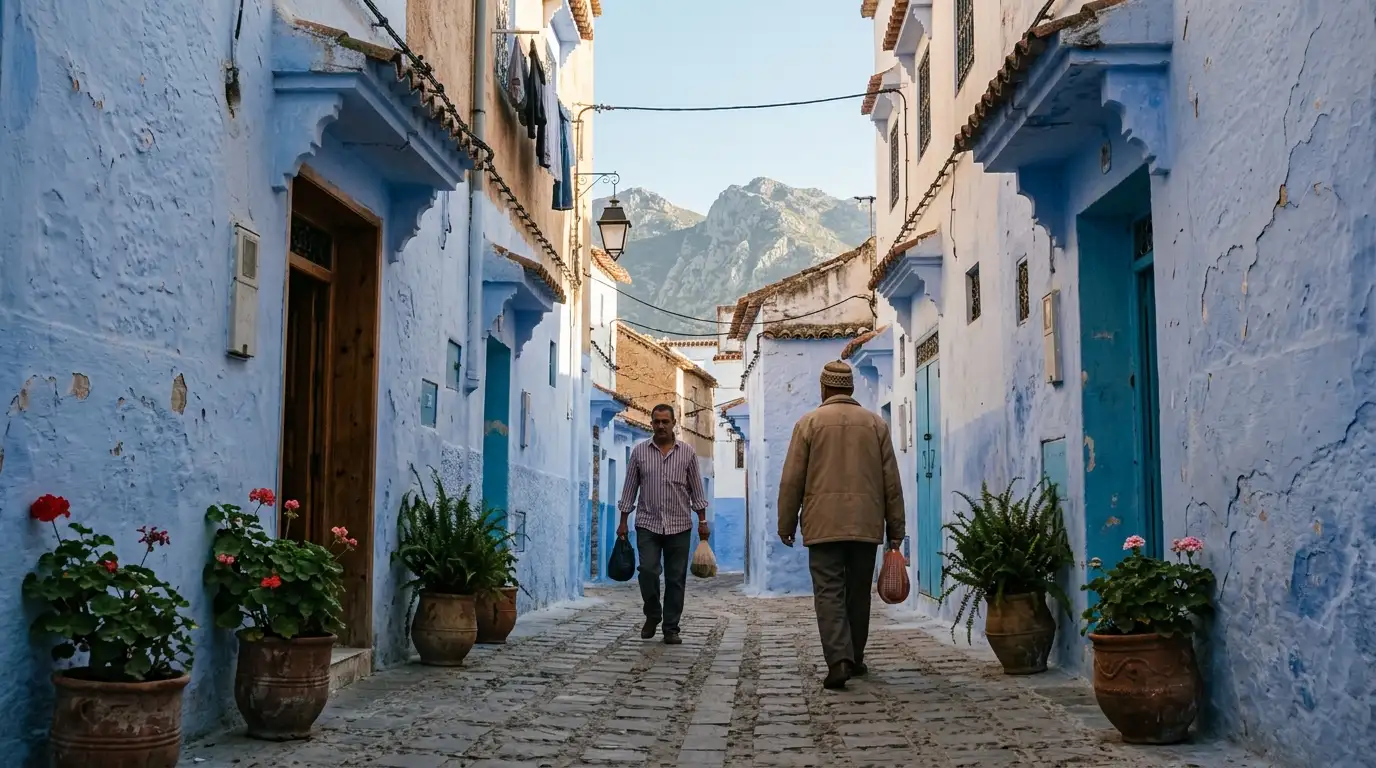
The blue-washed walls look different depending on the light. Soft, low-angle sun in the early morning or late afternoon brings out the deepest indigo tones, which is one reason photographers favour spring and autumn the sun sits lower in the sky for more of the day than in high summer. Overcast winter days, counterintuitively, can produce a moodier, more saturated blue that many photographers specifically seek out. If you want the classic bright, crisp postcard look, aim for a clear morning in May, June, or September.
Best Time to Visit Chefchaouen for Hiking and Akchour
The Akchour waterfalls and the God’s Bridge (Pont de Dieu) rock arch, about 30 minutes from town in Talassemtane National Park, are best tackled in April, May, June, September, or October. These months avoid both the slick, swollen trails of the rainy winter months and the exhausting midday heat of July and August, when the exposed sections of the valley trail offer little shade. Start early regardless of season trailhead parking and the river crossings get busier as the day goes on, and summer heat builds quickly after mid-morning.
Best Time to Visit Chefchaouen for Photography
For photography, the shoulder seasons again come out ahead. April, May, September, and October combine clear skies with a lower sun angle, which means longer golden-hour windows both morning and evening. Winter’s overcast, diffused light suits close-up shots of the painted doors and stairwells, while summer’s harsh midday sun tends to blow out highlights on the whitewashed-blue walls plan summer shoots for the first two hours after sunrise or the last two before sunset.
Cheapest Time to Visit Chefchaouen
Accommodation prices in Chefchaouen generally track the weather and crowd patterns above. The cheapest months tend to fall in January, February, and early March, when demand is lowest and riads discount rooms to fill them. June, by contrast, is often cited as offering some of the best value of the warmer months good weather without full summer pricing. August, at the intersection of peak heat and peak domestic tourism, is typically the most expensive and hardest month to book last-minute.
Is Chefchaouen Worth Visiting in Summer?
Yes, with some planning. Summer brings near-guaranteed sunshine and the liveliest atmosphere of the year, but July and August afternoons can be genuinely hot for walking uphill through the medina’s stepped streets. The practical fix is to shift your schedule: explore in the morning before 11am and again after 5pm, rest or visit indoor sights like the Kasbah museum during the hottest hours, and carry more water than you think you’ll need. Evenings at altitude cool down pleasantly, which is when rooftop terraces come into their own.
Is Chefchaouen Worth Visiting in Winter?
Also yes, for a different kind of trip. Winter trades warmth for near-empty alleyways, low hotel prices, and a slower, more local pace to the town. The trade-offs are real rain is more frequent, nights are cold, and unheated riads mean packing proper layers but for travellers who’ve already seen the summer version of Chefchaouen in photos, winter offers something closer to how the town actually lives outside tourist season.
How Many Days Do You Need in Chefchaouen?
Two full days is enough to see the highlights: the Plaza Uta el-Hammam and Kasbah, the Spanish Mosque viewpoint at sunset, and a wander through the blue lanes at your own pace. Add a third day if you want to hike to Akchour without rushing, since the round trip with time at the waterfalls typically takes most of a day. Chefchaouen also works well as a two- or three-night stop on a longer northern Morocco route linking Tangier, Tetouan, and Fez.
Best Time of Day to Explore Chefchaouen
Early morning, roughly 7–9am, is the best window for photographing the medina without other visitors in frame shopkeepers are still opening up and the light is soft. Late morning through mid-afternoon is busiest, especially near the main square and the most Instagrammed staircases. Late afternoon brings the light back down low for a second good photography window, and sunset from the Spanish Mosque hillside is a near-nightly ritual worth planning around regardless of season.
What to Pack for Chefchaouen by Season
- Spring (Mar–May): Layers for cool mornings, a light rain shell (especially in March), comfortable shoes with grip for cobbled slopes
- Summer (Jun–Aug): Breathable clothing, sun hat, high-SPF sunscreen, a reusable water bottle, and something light to cover shoulders/knees for mosque exteriors and conservative neighbourhoods
- Autumn (Sep–Nov): A light jacket for evenings, layers for temperature swings between morning and midday, rain protection by mid-November
- Winter (Dec–Feb): A proper warm jacket, thermal layers for unheated riads, waterproof shoes, and a scarf evenings and early mornings are colder than the daytime highs suggest
Chefchaouen During Ramadan and Moroccan Holidays
Ramadan shifts roughly eleven days earlier each year on the Gregorian calendar, so it’s worth checking the current dates before you travel. During the month, many local cafés and restaurants close or reduce hours during daylight, the town’s rhythm slows noticeably until the iftar meal at sunset, and some shops in the medina keep shorter opening hours. Visiting during Ramadan is entirely possible and can be a genuinely interesting cultural experience just plan meals around evening hours and be mindful about eating or drinking openly in public during the day out of respect for those fasting. Around Eid al-Fitr and Eid al-Adha, expect brief closures of some businesses and a quieter, family-focused atmosphere in town.
Best Time to Visit Chefchaouen: Month-by-Month Comparison
| Month | Avg. High / Low | Rain Days | Crowds | Best For |
|---|---|---|---|---|
| January | 15°C / 5°C | ~29% | Low | Budget travel |
| February | 16°C / 6°C | ~27% | Low | Budget travel |
| March | 16°C / 7°C | ~41% | Low–Moderate | Fewer crowds |
| April | 20°C / 9°C | ~32% | Moderate | Early hiking |
| May | 24°C / 12°C | ~21% | Moderate | Comfortable weather |
| June | 28°C / 16°C | ~12% | Moderate–High | Best overall weather |
| July | 33°C / 19°C | ~1% | High | Guaranteed sun |
| August | 34°C / 20°C | ~3% | Highest | Avoid if heat-sensitive |
| September | 29°C / 17°C | ~13% | Moderate | Best all-round pick |
| October | 25°C / 14°C | ~24% | Moderate | Photography, value |
| November | 18°C / 9°C | ~31% | Low–Moderate | Quiet, golden light |
| December | 15°C / 7°C | ~32% | Low | Lowest prices |
Best Time to Visit Chefchaouen FAQs
What is the best month to visit Chefchaouen?
September is generally considered the best single month, combining warm, dry weather (around 29°C highs, rain on roughly 13% of days) with noticeably thinner crowds than the summer peak. June scores marginally higher on pure weather data, but it overlaps with the start of the busy season. If you have flexibility, May and September are the two strongest picks for the best time to visit Chefchaouen overall, since both avoid the extremes of summer heat and winter rain while keeping accommodation reasonably priced.
Is spring a good time to visit Chefchaouen?
Spring is a strong choice, particularly from mid-April onward. March can still be rainy it’s actually the wettest month of the year by frequency so travellers arriving early in spring should pack a light waterproof layer. By May, conditions turn close to ideal: warm days, cool nights, low rainfall, and good visibility for day trips to Akchour. Spring also brings green hillsides around Talassemtane National Park, which contrasts nicely with the blue medina in photos and adds a different feel than the dustier late-summer landscape.
Is Chefchaouen too hot in summer?
It can be uncomfortable during peak afternoon hours in July and August, when highs regularly reach 33–34°C, but it’s rarely unbearable. The town sits at altitude, so it stays cooler than Marrakech or Fez at the same time of year, and evenings drop to a pleasant temperature for dining outdoors. The practical approach is to front-load your sightseeing into the morning, rest during the hottest midday hours, and resume exploring in the late afternoon once the sun starts to soften.
Does it rain in Chefchaouen?
Yes, mainly between November and April, with March standing out as the wettest month at around 41% of days seeing rain. Summer, by contrast, is almost entirely dry July sees rain on roughly 1% of days. If you’re travelling in the winter or early spring window, packing a light rain layer is worth it, since showers tend to be brief but can arrive with little warning in the mountains.
Does it snow in Chefchaouen?
Snow in the town itself is uncommon but not impossible during the coldest snaps of January and February, and it’s more frequent on the higher peaks of Talassemtane National Park visible from town. It rarely settles for long at Chefchaouen’s own altitude. If you’re hoping to see snow-dusted mountains, a clear winter morning after a cold front is your best chance, though this shouldn’t be planned around as a guarantee.
Is Chefchaouen worth visiting in winter?
Yes winter offers a genuinely different, quieter version of the town. Hotel prices drop to their lowest point of the year, the medina’s steep lanes are far less crowded, and the blue walls under soft, overcast winter light have an atmosphere that differs from the bright summer postcard shots. The trade-off is real cold at night (lows around 5–7°C) and rain on close to a third of days, plus riads that aren’t always well heated, so pack accordingly.
What is the cheapest month to visit Chefchaouen?
January and February tend to offer the lowest accommodation prices, since this is the quietest stretch of the tourist calendar. Early March can also be good value, though it comes with a higher chance of rain. If you want a balance of decent weather and lower prices, October is a reasonable middle ground meaningfully cheaper than the summer peak while still offering comfortable daytime temperatures.
When is Chefchaouen least crowded?
The quietest months run roughly from November through February, excluding the Christmas and New Year holiday weeks, which draw a smaller but noticeable spike in visitors. August is the busiest month of the year, driven heavily by domestic Moroccan tourism rather than international visitors alone. For a middle path decent weather without peak crowds late September through October is a reliable window.
What is the best time to hike Akchour?
The most comfortable window for hiking to the Akchour waterfalls and God’s Bridge is April through June or September through October. These months avoid the slippery, higher-water trail conditions common in the rainy winter months as well as the draining midday heat of July and August. Starting the hike early in the morning is worth doing in any season, both to beat the heat in summer and to have the trail and river crossings to yourself before later arrivals.
How many days should you spend in Chefchaouen?
Two days covers the essentials comfortably: the main square, the Kasbah, the blue medina lanes, and sunset from the Spanish Mosque viewpoint. A third day is worth adding if you want to hike to Akchour without rushing back for an afternoon departure, since the full round trip with time at the falls generally takes most of a day. Many travellers pair two to three nights in Chefchaouen with stops in Tangier, Tetouan, or Fez as part of a longer northern Morocco itinerary.
Final Thoughts
Chefchaouen rewards travellers who match their dates to what they actually want from the trip rather than chasing a single “perfect” month. If the blue medina and a comfortable pace matter most, aim for May or September; if Akchour and the hiking trails are the priority, build the trip around April, June, or October instead. Whichever window you pick, book your riad a few weeks ahead during May through September rooms in the medina are limited, and the best-located ones fill up quickly once the weather turns good.