Majorelle Garden (2026): The Ultimate Guide to Marrakech’s Stunning Blue Oasis
Behind an unassuming wall in Marrakech’s Gueliz district sits one of the most photographed gardens on earth a single hectare of cobalt-blue walls, towering cacti, and bamboo groves that took a French painter forty years to build and a fashion designer to save from demolition. This Majorelle Garden guide covers the full story behind that unmistakable blue, what’s actually worth seeing inside, and every practical detail for planning a visit that doesn’t get swallowed by the crowds.
Small as it is compared to the medina’s sprawling palaces, this single hectare consistently ranks among the most visited sites in the entire country, and understanding what it actually is and isn’t before you arrive makes the difference between a rushed photo stop and a genuinely memorable morning.
Majorelle Garden: The Short Answer
Is Majorelle Garden Worth Visiting?
Yes, and its status as one of Morocco’s most visited single attractions, drawing several hundred thousand visitors a year to just one hectare of land, speaks for itself. The garden’s dense botanical collection and striking cobalt architecture deliver a genuinely different atmosphere from the medina’s souks and palaces, making it a worthwhile change of pace on almost any Marrakech itinerary.
How Long Does a Visit Take?
The garden itself can be walked in around an hour, though allowing 1.5 to 2 hours lets you add the Berber Museum inside the blue villa without feeling rushed, and closer to 2.5-3 hours if you’re also visiting the adjacent Yves Saint Laurent Museum.
What Is Majorelle Garden?
One of Marrakech’s Most Famous Attractions
Despite being small compared to the medina’s grand palaces, Majorelle Garden consistently ranks as one of the most visited sites in the entire country, a reputation built on its unusual combination of botanical rarity, art history, and fashion legend packed into a compact, walkable space. Its fame has grown well beyond Morocco itself, appearing regularly in international design and travel publications as a shorthand reference for the country’s blend of tradition and modern artistic influence.
Why Is It So Popular?
Part botanical garden, part art installation, part fashion pilgrimage site, the garden draws visitors from genuinely different interests plant lovers, architecture and design fans, and Yves Saint Laurent devotees all find something here, which helps explain why it remains busy nearly every day of the year. Social media has also played a meaningful role in recent years, with the garden’s saturated blue backdrop becoming one of the most recognizable and widely shared images associated with Marrakech.
The Story Behind the Iconic Blue Color
Jacques Majorelle developed his own distinctive cobalt pigment in 1937, applying it to his villa, studio, and garden features so consistently that the color eventually took his name Majorelle Blue and became inseparable from the garden’s identity. The exact formula has since been closely guarded and reproduced by the foundation to maintain consistency, ensuring the color seen today matches what Majorelle originally intended nearly a century ago.
The History of Majorelle Garden
Jacques Majorelle’s Vision
French Orientalist painter Jacques Majorelle, son of the celebrated Art Nouveau cabinetmaker Louis Majorelle of Nancy, bought the land in 1923 and spent nearly four decades transforming it into a personal botanical laboratory, traveling as far as Brazil, Madagascar, and China to bring back rare and unusual plant species. What began as a private retreat gradually grew into an obsessive lifelong project, with Majorelle continuing to add species and refine the grounds well into his final years.
Yves Saint Laurent and Pierre Bergé
Following Majorelle’s death in 1962, the garden fell into disrepair, and by 1980 stood under real threat of demolition for a planned hotel development. Fashion designer Yves Saint Laurent and his partner Pierre Bergé purchased and restored the property that same year, eventually making it their Marrakech home base and, in 2008, the site where Saint Laurent’s ashes were scattered following his death. The couple’s intervention is widely credited with saving not just a garden but a genuine piece of 20th-century design history from being lost entirely.
From Private Garden to International Landmark
Today the garden is maintained by the Fondation Jardin Majorelle, a nonprofit foundation whose proceeds support cultural projects across Morocco, and it has grown from a painter’s private retreat into one of the most internationally recognized gardens in the world. Pierre Bergé formally established the Majorelle Trust in 1997 to secure the garden’s long-term future, a structure that continues to guide its preservation and public access today.
What to See Inside Majorelle Garden
The Exotic Botanical Collection
Around 300 plant species from five continents fill the garden’s relatively compact grounds, a density of botanical variety that’s rare to find packed into such a small footprint anywhere in the world. Majorelle personally sourced many of these specimens during his travels, and the collection today reflects decades of deliberate curation rather than a generic tropical garden assembled for tourist appeal.
Majorelle Blue Buildings
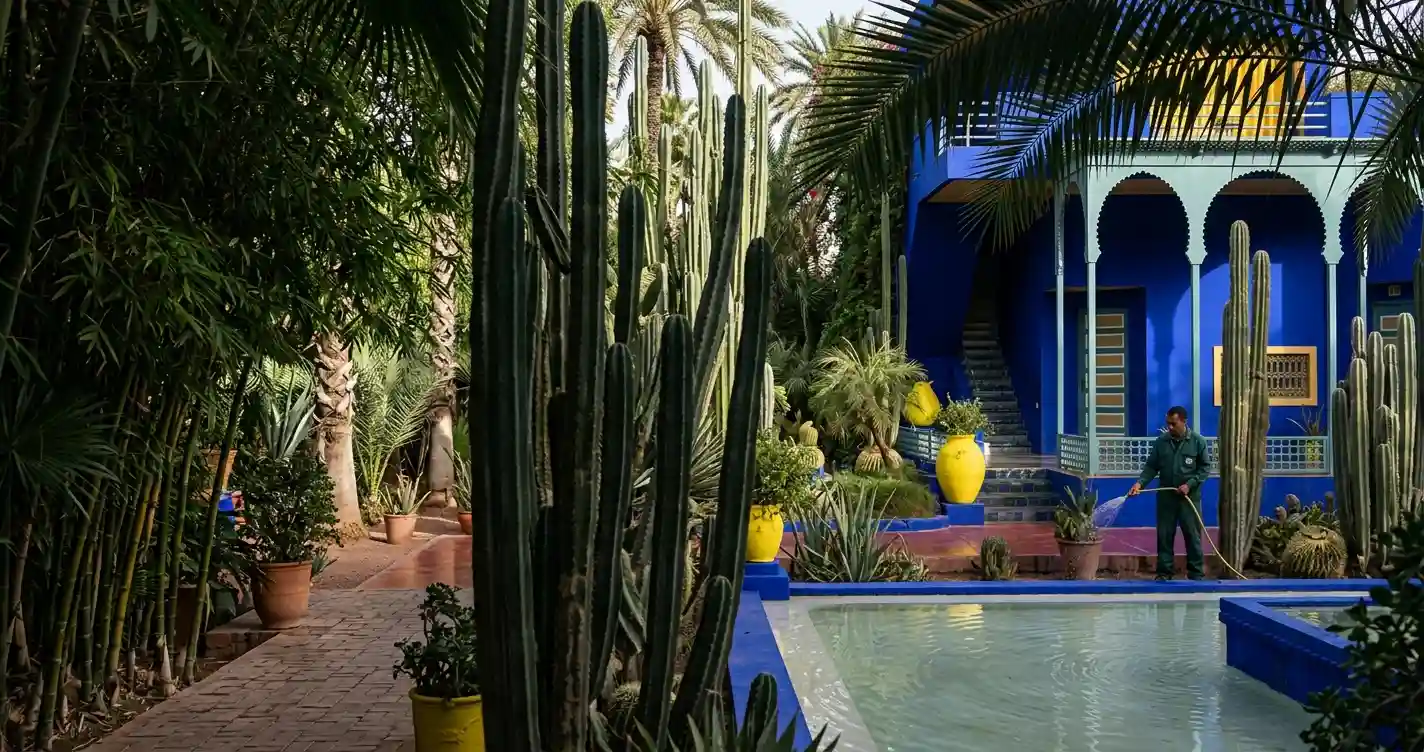
The villa and studio, painted in Majorelle’s signature cobalt pigment and accented with contrasting yellow trim, form the garden’s most photographed backdrop and the clearest physical expression of the color that now bears his name. The buildings’ cubist geometry, softened by decorative Art Deco touches, makes them as much a design landmark as the garden surrounding them.
Reflecting Pools and Fountains
Water features throughout the garden, including lily-covered pools, add both a cooling visual element and a practical microclimate that helps sustain the surrounding plant collection through Marrakech’s dry heat. The gentle sound of moving water also provides a quiet counterpoint to the visual intensity of the blue architecture nearby.
Bamboo Forest and Cactus Garden
Dense bamboo groves and an extensive cactus collection, some specimens towering several meters tall, create dramatically different microenvironments within just a few steps of each other. The contrast between the bamboo’s cool, shaded density and the cactus garden’s stark, sun-exposed silhouettes is one of the more unexpectedly striking transitions within the grounds.
The Berber Museum
Housed inside the former studio building, the Pierre Bergé Museum of Berber Arts displays a substantial collection of Amazigh jewelry, textiles, and artifacts, largely drawn from Bergé’s personal holdings. The collection offers a meaningful counterpoint to the garden’s French and international design influences, grounding the site firmly in Morocco’s own cultural heritage.
The Architecture and Design of Majorelle Garden
Art Deco Influences
The villa’s cubist geometry clean-edged forms with no ornamental excess reflects Majorelle’s Art Deco sensibilities, tempered by decorative details like patterned door panels and contrasting brickwork that keep the structure from feeling cold or purely industrial. This blend of severity and ornament was itself an experiment in applied color theory, with Majorelle using the cobalt pigment specifically to see how such an intense hue would read against Marrakech’s natural light and surrounding greenery.
Islamic and Moroccan Inspiration
Moorish architectural elements run throughout the property, blending with the Art Deco framework to produce a genuinely hybrid style unlike anything else in Marrakech. This fusion reflects Majorelle’s own position as a French painter deeply immersed in Moroccan visual culture, rather than an outsider simply importing a European aesthetic wholesale.
The Famous Majorelle Blue
Majorelle’s custom-mixed ultramarine, patented under his own name, remains the garden’s defining visual signature, its intensity calibrated specifically to stand out against Marrakech’s ochre-toned buildings and intense natural light. The color has since become so closely associated with the garden that “Majorelle Blue” is now used descriptively well beyond Morocco, a rare case of a single garden’s signature color entering broader design vocabulary.
Visiting Majorelle Garden
Opening Hours
According to the garden’s official site, Jardin Majorelle is open daily from 8:00am to 6:30pm, with last entry at 6:00pm; the adjacent Villa Oasis private garden keeps slightly different hours and is closed on Wednesdays. Hours can shift around Ramadan and public holidays, so checking the official site shortly before your visit is worth doing, particularly if you’re planning around a specific opening or closing time.
Entrance Tickets
Garden-only tickets generally run somewhere in the range of 150-170 MAD for adult foreign visitors, with the Berber Museum available as an add-on and the separate Yves Saint Laurent Museum next door priced independently; combined tickets covering multiple sites are also available. Given how often prices shift, booking through the official website the only authorized ticket seller and confirming current pricing there is the most reliable approach, since third-party resellers cannot guarantee valid entry.
Best Time to Visit
Early morning, right at opening, offers the thinnest crowds and the softest light on the blue walls, while mid-morning through early afternoon tends to bring the heaviest tour group traffic and the most congested pathways. Visitors who prioritize photography specifically should treat the first hour after opening as close to essential rather than simply preferable.
How Long Should You Spend Here?
An hour covers the garden itself at a relaxed pace, while 1.5 to 2 hours allows time for the Berber Museum as well, and closer to three hours if the Yves Saint Laurent Museum next door is also on your list. Building in this extra time upfront avoids feeling rushed through what is, despite its small size, a genuinely dense site worth savoring.
Accessibility
The garden and the Pierre Bergé Museum of Berber Arts are listed as wheelchair accessible on the official site, though it’s worth reconfirming directly if accessibility is essential to your visit, since path surfaces and museum layouts can vary in practice and change over time as the site undergoes maintenance or renovation.
Photography Tips for Majorelle Garden
Best Photo Locations
The cobalt villa’s exterior walls, the fountain courtyards, and the dense cactus garden consistently rank as the most photographed spots, with the blue-and-yellow architectural details providing an especially striking backdrop.
Best Time for Soft Light
Early morning light, shortly after the 8:00am opening, tends to illuminate the blue walls most evenly, before the sun climbs high enough to create harsher shadows and before crowds fill the same popular photo spots.
Respecting Other Visitors
Given the garden’s narrow pathways and consistently heavy foot traffic, keeping photo stops brief in the most popular corners helps the overall flow of visitors move smoothly through a relatively compact space.
Attractions Near Majorelle Garden
Yves Saint Laurent Museum
Opened in 2017 in a striking building by architecture firm Studio KO, this museum sits directly next door and offers a deeper look at Saint Laurent’s design legacy beyond the garden itself, including rotating exhibitions drawn from his extensive fashion archive.
Gueliz
The surrounding modern district offers wide boulevards, art galleries, and international restaurants, a genuinely different atmosphere from the medina worth exploring before or after a garden visit. Its café culture in particular makes for a pleasant place to unwind after the garden’s crowds and heat.
Koutoubia Mosque
Marrakech’s most iconic minaret sits a taxi ride away toward the medina, making it a natural stop when combining a Gueliz morning with an afternoon in the old city, particularly around sunset when its silhouette is at its most photogenic.
Jemaa el-Fnaa
The medina’s main square lies a short taxi ride from Gueliz, allowing an easy combination of a Majorelle Garden morning with an evening in the square, when its food stalls and performers reach their full evening energy.
Le Jardin Secret
This restored historic garden riad inside the medina offers a very different, more traditionally Moroccan garden experience worth comparing against Majorelle’s modernist, botanical approach, making the two gardens an interesting study in contrasting design philosophies within the same city.
Practical Tips Before Visiting Majorelle Garden
Book Tickets Online
Booking through the official website in advance is the most reliable way to secure entry and avoid line delays, particularly for the first morning slots, which sell out quickly given the garden’s consistent popularity. This also protects you against the fake ticket sites that occasionally surface online, since the foundation is explicit that only its own site issues valid entry codes.
Arrive Early
Arriving at or near opening delivers both the thinnest crowds and the most comfortable temperatures, especially valuable during Marrakech’s hotter months. The difference between an 8am arrival and one even an hour later can be substantial once tour buses begin arriving in force.
Wear Comfortable Shoes
While the garden’s paths are relatively short, they include some uneven surfaces and steps, so comfortable walking shoes make the visit noticeably easier, particularly if you’re combining it with a longer day of sightseeing elsewhere in Marrakech.
Visit During Cooler Hours
Given the garden’s limited shade in some sections, visiting during the cooler morning hours rather than midday is worth prioritizing, particularly in summer, when direct sun in the more open cactus garden areas can become genuinely intense by late morning.
Combine It with the YSL Museum
Since the Yves Saint Laurent Museum sits immediately next door, pairing both visits in a single outing makes efficient use of the trip to Gueliz, particularly for anyone with a specific interest in Saint Laurent’s design legacy, since the two sites together tell a more complete story than either does alone.
Majorelle Garden: Frequently Asked Questions
Is Majorelle Garden Worth Visiting?
Yes, and its enduring popularity drawing several hundred thousand visitors annually to just one hectare of land reflects a genuinely unusual combination of botanical rarity, art history, and design legacy rarely found together in a single small site. The garden rewards visitors with different interests in different ways: plant enthusiasts appreciate its five-continent botanical collection, design fans admire the Art Deco and Moorish architectural fusion, and Yves Saint Laurent’s admirers find a meaningful connection to his life and legacy.
Even visitors without a specific interest in any of these threads tend to find the sheer visual impact of Majorelle Blue against the greenery worth the modest entrance fee and the crowds.
How Much Does It Cost?
Garden-only tickets generally run in the range of 150-170 MAD for adult foreign visitors as of 2026, with additional fees for the Berber Museum and the separate Yves Saint Laurent Museum next door, or combined tickets covering multiple sites at a bundled rate. Because ticket pricing has shifted somewhat in recent years and can vary by season, checking the official website the only authorized source for tickets shortly before your visit gives the most accurate current figure rather than relying on any single published price.
Can You Visit Without Booking?
Walk-up tickets are generally available, but given the garden’s consistent popularity and the narrow pathways that limit how many visitors can comfortably move through at once, booking online in advance is strongly recommended, particularly for the earliest and most desirable morning slots. Arriving without a booking during peak season risks a longer wait or, in some cases, sold-out timed entry slots for the day, so treating advance booking as a near-essential step rather than an optional convenience is the safer approach.
Is Photography Allowed?
Yes, photography is permitted throughout the garden’s public areas, and it’s one of the most photographed sites in Marrakech for exactly that reason. Being mindful of other visitors in the narrowest, most popular corners keeping photo stops reasonably brief helps maintain a pleasant experience for everyone sharing the same compact space, particularly around the most iconic cobalt-wall backdrops where a queue for photos can form during busier hours.
Can You Visit with Children?
Yes, though it’s worth keeping the visit relatively simple and not overly long unless your children have a genuine interest in gardens or cultural museums specifically. Going early, before the heat and crowds build, and treating the Berber Museum as optional rather than mandatory, tends to make for a smoother family visit than an ambitious, multi-site itinerary attempted all at once.
Final Thoughts on Majorelle Garden
Majorelle Garden distills an unusual amount of history, art, and horticultural ambition into a genuinely small space, and its enduring popularity is well earned rather than simply a product of social media. Book your ticket online, arrive right at opening to beat both the heat and the tour groups, and give yourself enough time to actually notice the botanical detail rather than just the blue walls everyone photographs.
Pair it with the Yves Saint Laurent Museum next door or an afternoon exploring Gueliz, and this single hectare becomes a genuinely full, memorable morning rather than a quick photo stop on the way to somewhere else. Few gardens anywhere manage to compress this much design history, botanical ambition, and sheer visual drama into so small a footprint, which is exactly why it continues to draw visitors back decades after Majorelle first began planting.