Bahia Palace Guide (2026): The Ultimate Visitor’s Guide to Marrakech’s Most Beautiful Palace
Few places capture the elegance of Marrakech quite like Bahia Palace. Hidden behind high ochre walls on the edge of the historic Medina, this nineteenth-century masterpiece is a celebration of Moroccan craftsmanship, where intricate zellige mosaics, carved cedar ceilings, peaceful gardens, and marble courtyards come together to create one of the country’s most beautiful architectural landmarks. Unlike Marrakech’s bustling souks or lively Jemaa el-Fnaa, Bahia Palace offers a slower, quieter experience, allowing visitors to step into a world of luxury that once belonged to Morocco’s most powerful nobles.
Every year, hundreds of thousands of travelers pass through its magnificent gates, yet many arrive without fully understanding the palace’s remarkable story. Bahia Palace was never built for a king. Instead, it was created as the extravagant residence of Grand Vizier Si Moussa and later expanded by his son Ba Ahmed, who transformed it into one of the grandest private palaces ever constructed in Morocco. The result is a complex of beautifully decorated riads, lush gardens, elegant reception halls, and secluded courtyards designed to impress both political allies and distinguished guests.
Today, Bahia Palace remains one of Marrakech’s most visited attractions, offering visitors an extraordinary glimpse into Morocco’s royal lifestyle during the late nineteenth century. Whether you’re passionate about history, architecture, photography, or simply looking for one of the city’s most peaceful places to explore, this guide covers everything you need to know before your visit, from the palace’s fascinating history and architectural highlights to practical tips that will help you make the most of your time here.
Bahia Palace Guide: The Short Answer
If you’re wondering whether Bahia Palace deserves a place on your Marrakech itinerary, the answer is an easy yes. It is widely regarded as one of Morocco’s finest examples of traditional Moroccan-Andalusian architecture and consistently ranks among the city’s most rewarding cultural attractions. Unlike museums that rely primarily on exhibits, Bahia Palace tells its story through architecture itself. Every courtyard, fountain, carved ceiling, and mosaic reflects the extraordinary artistry of Moroccan craftsmen whose work continues to impress visitors more than a century later.
The palace also provides a welcome contrast to the intensity of Marrakech’s Medina. After navigating the busy souks or the crowds of Jemaa el-Fnaa, entering Bahia Palace feels like stepping into a completely different world. The sounds of the city fade behind thick walls, replaced by birdsong, flowing fountains, and shaded gardens that encourage visitors to slow their pace and appreciate the remarkable attention to detail found throughout the complex.
Because of its central location, Bahia Palace is easy to combine with several of Marrakech’s other major attractions, including the Mellah, El Badi Palace, the Saadian Tombs, and Jemaa el-Fnaa. Many travelers include it as one of the highlights of their first full day exploring the historic city.
Is Bahia Palace Worth Visiting?
Absolutely. While Marrakech offers countless historic monuments, Bahia Palace stands apart because it remains exceptionally well preserved and remarkably accessible. Rather than simply displaying artifacts behind glass, the palace allows visitors to walk through the very rooms where Morocco’s political elite once lived, entertained guests, and managed affairs of state.
The beauty of Bahia Palace isn’t limited to a single grand hall or famous courtyard. Instead, it reveals itself gradually. As you move through interconnected riads, elegant reception rooms, orange-tree gardens, and marble courtyards, you’ll notice how every space was carefully designed to balance symmetry, privacy, light, and decoration. Even visitors who know little about Islamic architecture often find themselves stopping repeatedly to admire handcrafted ceilings, colorful tilework, and beautifully proportioned spaces.
For photographers, Bahia Palace is equally rewarding. The combination of natural light, geometric patterns, and lush gardens creates countless opportunities for memorable photographs without feeling overly crowded, particularly if you arrive early in the morning.
How Long Does a Visit Take?
Most visitors spend between one and two hours exploring Bahia Palace. This allows enough time to appreciate the architecture, wander through the gardens, photograph the main courtyards, and read the information provided throughout the complex without rushing.
Travelers with a strong interest in architecture or Moroccan history may wish to stay longer, while those following a busy sightseeing schedule can comfortably explore the palace in around an hour before continuing to nearby attractions.
Many visitors choose to combine Bahia Palace with El Badi Palace and the Saadian Tombs, creating an enjoyable half-day itinerary focused on Marrakech’s imperial history.
What Is Bahia Palace?
Bahia Palace is one of Morocco’s finest surviving examples of nineteenth-century palace architecture. Covering approximately eight hectares, the complex consists of more than 150 rooms connected by elegant courtyards, tranquil gardens, private apartments, ceremonial halls, and shaded walkways. Although often referred to as a palace, it is more accurate to think of Bahia as a small city within the city, carefully designed to accommodate family members, servants, officials, guests, and administrative functions while maintaining complete privacy from the outside world.
Unlike many European palaces, where monumental façades dominate the exterior, Bahia Palace presents a deliberately modest appearance from the street. High walls reveal almost nothing of the beauty hidden behind them. This reflects a long-standing tradition in Moroccan architecture, where wealth and elegance were intended to be experienced from within rather than displayed publicly.
Inside, however, visitors discover a remarkable world of craftsmanship. Intricately carved cedar wood, hand-cut zellige mosaics, painted ceilings, marble floors, decorative stucco, and lush gardens demonstrate the extraordinary skills of Moroccan artisans during the late nineteenth century. Every element was created by hand, resulting in an architectural masterpiece that continues to inspire architects and designers around the world.
A Masterpiece of Moroccan Architecture
One of the reasons Bahia Palace attracts visitors from across the globe is its extraordinary architectural harmony. Rather than relying on monumental scale alone, the palace achieves its beauty through proportion, craftsmanship, and carefully balanced design.
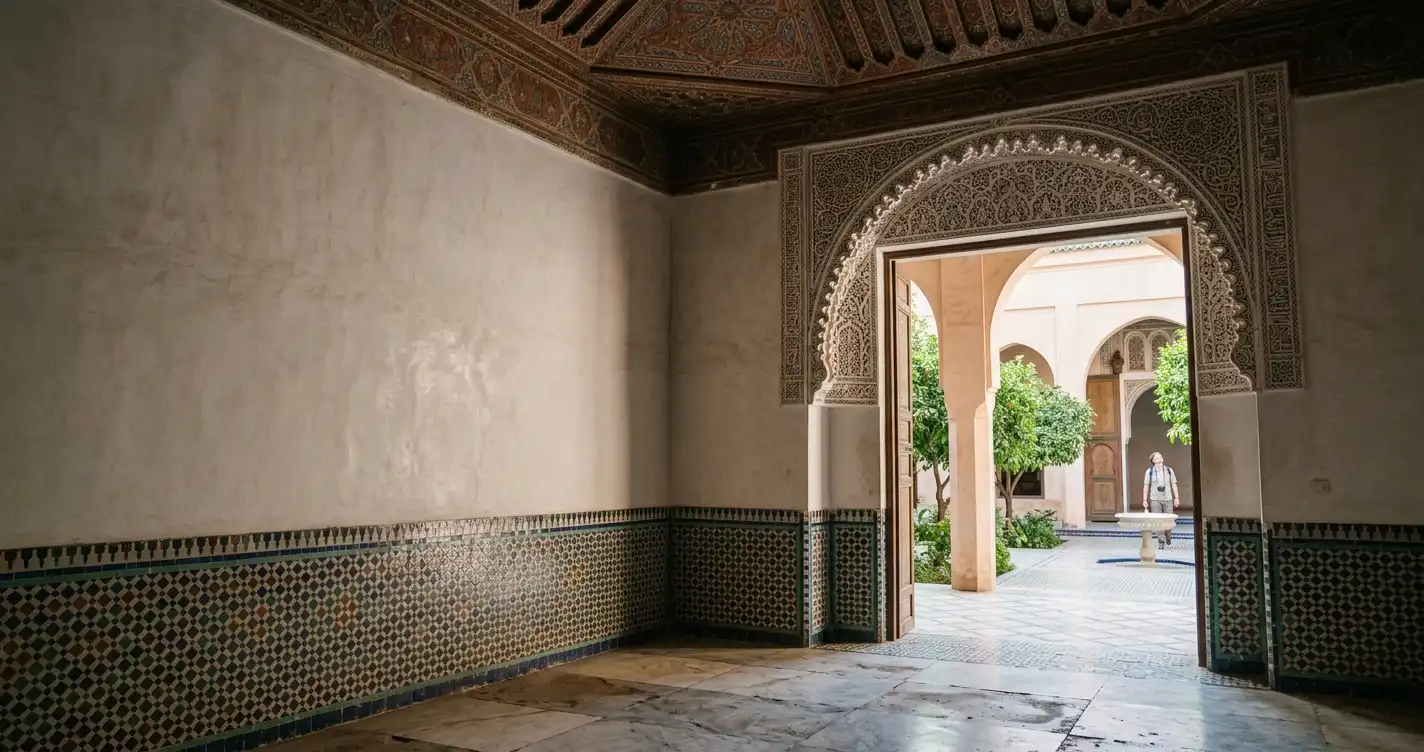
Sunlight filters into open courtyards surrounded by elegant arcades. Fountains provide both decoration and cooling, while orange trees, jasmine, and palms soften the geometry of the stone architecture. Rich cedar ceilings display intricate painted patterns in deep reds, blues, and golds, while colorful mosaic floors create striking visual contrasts throughout the palace.
These features reflect centuries of Moroccan-Andalusian architectural traditions, blending Islamic geometry with practical responses to Morocco’s climate. Thick walls provide natural insulation, shaded courtyards encourage airflow, and gardens create cool microclimates that made the palace remarkably comfortable long before modern air conditioning.
Walking through Bahia Palace today feels less like visiting a museum and more like entering a beautifully preserved work of art.
Why Is It Called Bahia Palace?
The name “Bahia” comes from the Arabic word for “brilliance,” “beauty,” or “splendor.” According to popular accounts, the palace was named after Ba Ahmed’s favorite wife, Bahia, although historians continue to debate the exact origin of the name. Regardless of its historical accuracy, the title perfectly reflects the extraordinary ambition behind the palace’s design.
Everything about Bahia Palace was intended to represent prestige, refinement, and power. It wasn’t merely a family residence it served as an architectural statement demonstrating the wealth and influence of one of Morocco’s most powerful political figures during the late nineteenth century.
More than a century later, the palace continues to live up to its name. Even visitors who have explored famous monuments throughout Europe or the Middle East often describe Bahia Palace as one of the most beautiful historic residences they have ever visited.
Why It Is One of Marrakech’s Top Attractions
Marrakech offers countless historic sites, but Bahia Palace consistently ranks among the city’s must-see landmarks because it appeals to such a wide variety of travelers.
History enthusiasts appreciate its connection to Morocco’s political past. Architecture lovers admire its exceptional craftsmanship. Photographers are drawn to its elegant courtyards and natural light. Garden enthusiasts enjoy its peaceful outdoor spaces, while first-time visitors simply appreciate escaping the busy streets of the Medina for a quieter, more contemplative experience.
Its location also makes it exceptionally convenient. Situated between the Mellah and the southern Medina, Bahia Palace is within walking distance of several of Marrakech’s most important attractions, making it easy to include in almost any sightseeing itinerary.
For many travelers, it becomes one of the defining highlights of their visit to Marrakech not because it is the city’s largest monument, but because it offers one of its most beautiful and memorable experiences.
The History of Bahia Palace
To truly appreciate Bahia Palace, it helps to understand the remarkable story behind its construction. Unlike Morocco’s medieval palaces built for sultans, Bahia Palace reflects a different chapter in the country’s history, when powerful royal advisors accumulated enormous wealth and influence within the Alaouite dynasty.
Construction began during the 1860s under Si Moussa, Grand Vizier to Sultan Hassan I. As one of the kingdom’s most influential political figures, Si Moussa commissioned an elegant residence worthy of his position. After his death, his son Ba Ahmed inherited both the property and his father’s political authority, eventually becoming Grand Vizier himself.
Ba Ahmed dramatically expanded the palace over the following years, employing hundreds of Morocco’s finest craftsmen from Marrakech, Fes, Meknes, and other imperial cities. Their task was ambitious: create the most magnificent private residence in Morocco, combining the very best examples of Moroccan-Andalusian architecture with luxurious gardens, reception halls, and private living quarters.
By the end of the nineteenth century, Bahia Palace had grown into one of the grandest residences in North Africa, housing Ba Ahmed’s family, wives, servants, guards, administrators, and distinguished guests within an intricate network of beautifully designed buildings.
Its story, however, changed dramatically after Ba Ahmed’s death a chapter that transformed the palace from an exclusive private residence into one of Morocco’s most treasured historic monuments.
The History of Bahia Palace
Built During the 19th Century
The story of Bahia Palace begins during one of Morocco’s most fascinating historical periods. In the second half of the nineteenth century, the country remained an independent kingdom ruled by the Alaouite dynasty, but political influence often extended beyond the royal family itself. Powerful grand viziers senior advisors to the sultan controlled much of the kingdom’s administration, and among the most influential of them was Si Moussa.
Around the 1860s, Si Moussa commissioned the construction of what would become Bahia Palace. His vision was ambitious but elegant: to create a residence that reflected both his political status and Morocco’s finest artistic traditions. Rather than building a fortress-like palace designed for defense, he envisioned a luxurious home centered around peaceful gardens, private courtyards, and exquisitely decorated reception halls where diplomacy and hospitality could flourish.
Following Si Moussa’s death, his son Ba Ahmed inherited both the property and his father’s position as Grand Vizier under Sultan Moulay Abdelaziz. Ba Ahmed possessed even greater political power than his father and immediately began transforming the residence into an architectural masterpiece unlike anything Morocco had seen before.
For more than a decade, hundreds of master craftsmen from Marrakech, Fes, Meknes, Tetouan, and other imperial cities worked continuously to expand the palace. Every addition demonstrated extraordinary attention to detail, from hand-cut mosaics and carved cedar ceilings to delicate plasterwork and lush Andalusian-inspired gardens. Rather than following a single rigid architectural plan, Bahia Palace grew organically, with new courtyards, private apartments, ceremonial halls, and gardens added over time as Ba Ahmed’s influence continued to expand.
By the end of the nineteenth century, Bahia Palace had become one of the largest and most luxurious private residences in North Africa, symbolizing both political authority and the extraordinary craftsmanship of Morocco’s finest artisans.
Si Moussa and Ba Ahmed
Understanding the personalities behind Bahia Palace helps explain why it remains such an extraordinary monument today.
Si Moussa earned a reputation as one of the kingdom’s most capable political figures. As Grand Vizier, he managed many of Morocco’s governmental affairs while serving Sultan Hassan I. Although highly respected, his original residence remained relatively modest compared with what his son would eventually create.
Everything changed under Ba Ahmed.
Following his father’s death in 1894, Ba Ahmed became one of the most powerful men in Morocco, effectively governing the country during the early reign of the young Sultan Moulay Abdelaziz. His enormous wealth and influence allowed him to expand Bahia Palace on an unprecedented scale.
Ba Ahmed recruited master craftsmen from across Morocco, giving them remarkable freedom to showcase their skills. Unlike European palaces that often emphasized grand façades, Bahia Palace celebrated craftsmanship through intimate spaces filled with intricate decoration. Every carved ceiling, every marble fountain, every mosaic floor, and every painted doorway reflected the work of artisans whose techniques had been refined over centuries.
At its height, the palace accommodated not only Ba Ahmed’s family but also wives, children, servants, guards, administrators, musicians, cooks, and distinguished guests. It functioned almost like a self-contained city, where political meetings, lavish celebrations, and everyday life unfolded within beautifully designed surroundings.
Ba Ahmed’s sudden death in 1900 marked the end of the palace’s golden age. According to historical accounts, many of its valuable furnishings were removed soon afterward as political power shifted, leaving behind the magnificent architectural shell visitors admire today.
From Royal Residence to National Monument
Although Bahia Palace lost much of its original furniture and decorative objects after Ba Ahmed’s death, the building itself survived remarkably well.
During the French Protectorate, parts of the palace were used by Resident-General Hubert Lyautey and the colonial administration. Rather than abandoning the complex, French authorities recognized its architectural importance and maintained many of its historic structures.
Following Morocco’s independence in 1956, Bahia Palace gradually evolved into one of the country’s most important cultural landmarks. Restoration projects have carefully preserved its gardens, courtyards, painted ceilings, cedar woodwork, and intricate tile mosaics, ensuring future generations can continue to experience one of Morocco’s greatest architectural achievements.
Today, Bahia Palace welcomes visitors from around the world while occasionally hosting official ceremonies and cultural events. Unlike many historic monuments that feel disconnected from modern life, the palace continues to serve as a living symbol of Morocco’s artistic heritage and national identity.
What to See Inside Bahia Palace
One of the greatest pleasures of visiting Bahia Palace is that every section reveals something different. Instead of guiding visitors through a fixed route, the palace invites exploration. Narrow passageways suddenly open into magnificent courtyards, peaceful gardens appear behind carved wooden doors, and beautifully decorated reception rooms seem to emerge unexpectedly around every corner.
Unlike European palaces filled with paintings and royal furniture, Bahia Palace impresses primarily through its architecture. The building itself is the masterpiece. Every surface demonstrates extraordinary craftsmanship, encouraging visitors to slow down and notice details that might otherwise go unnoticed.
The Grand Courtyard
The Grand Courtyard is undoubtedly the palace’s most iconic space and one of the most photographed locations in Marrakech.
Covering more than 1,500 square meters, this enormous marble courtyard immediately creates a sense of openness after walking through the palace’s narrower corridors. White Carrara marble contrasts beautifully with colorful zellige mosaics decorating the surrounding walls, while elegant arches frame views toward richly decorated reception rooms.
Standing in the center of the courtyard, it’s easy to appreciate the symmetry that defines traditional Moroccan architecture. Every doorway, fountain, and decorative element appears carefully balanced, creating an atmosphere of harmony rather than extravagance.
Because the courtyard receives abundant natural light throughout the day, photographers often spend considerable time here experimenting with different angles and perspectives. Early morning usually provides the softest light and the fewest crowds, allowing visitors to appreciate the remarkable craftsmanship without interruption.
Intricate Zellige Tilework
Perhaps no architectural feature represents Moroccan craftsmanship better than the palace’s extraordinary zellige mosaics.
Rather than using painted ceramic panels, Moroccan artisans individually cut thousands of tiny glazed tiles by hand before assembling them into intricate geometric compositions. Each piece must fit perfectly with its neighbors, requiring immense precision and years of specialized training.
Throughout Bahia Palace, these colorful mosaics decorate walls, fountains, floors, columns, and courtyards using shades of emerald green, cobalt blue, ochre, white, and deep black. Although the patterns appear effortless, every design reflects sophisticated mathematical principles developed over centuries within Islamic art.
Visitors often find themselves looking downward as much as upward because the floors themselves are among the palace’s greatest artistic achievements.
Painted Cedar Wood Ceilings
While the mosaics capture immediate attention, many visitors eventually discover that the ceilings are equally remarkable.
Master craftsmen transformed fragrant Atlas cedar into elaborate works of art using carving, painting, and gilding techniques passed down through generations. Rich reds, blues, golds, and greens combine with floral motifs and geometric designs to create ceilings that resemble enormous handcrafted paintings.
Unlike modern decorative finishes, every detail was completed by hand using traditional materials and natural pigments. Looking upward inside the reception halls reveals layer upon layer of astonishing craftsmanship that many visitors initially overlook.
These beautifully preserved ceilings remain among the finest surviving examples of nineteenth-century Moroccan woodwork anywhere in the country.
Elegant Riads and Gardens
At the heart of Bahia Palace are a series of peaceful riads, traditional Moroccan houses built around interior gardens.
These gardens were never simply decorative. They played an essential role in creating comfort within Marrakech’s hot climate. Orange trees, jasmine, banana plants, palms, and fragrant flowers combined with fountains to cool the surrounding air naturally while providing quiet places for relaxation and conversation.
Even today, these gardens create a striking contrast with the busy streets just outside the palace walls. Birds sing among the trees, fountains gently ripple in marble basins, and sunlight filters through carefully planted vegetation, producing an atmosphere that feels almost timeless.
Many visitors describe these gardens as the most relaxing part of their visit, offering a welcome opportunity to pause before continuing through the palace’s many rooms.
Private Apartments and Reception Rooms
Beyond the grand courtyards lie dozens of rooms that once served very different purposes.
Some functioned as lavish reception halls where Ba Ahmed welcomed political allies, diplomats, and distinguished guests. Others were private family quarters designed to provide comfort and privacy away from public ceremonies. Decorative details vary from room to room, ensuring that no two spaces feel identical.
Although most original furnishings disappeared after Ba Ahmed’s death, the architecture alone allows visitors to imagine the extraordinary lifestyle once enjoyed within these walls. Sunlight enters through carved windows, intricate plasterwork frames elegant doorways, and richly decorated ceilings create an atmosphere of refinement that remains impressive more than a century later.
Walking through these interconnected rooms reveals the remarkable scale of Bahia Palace while also demonstrating how Moroccan architecture balanced grandeur with intimacy. Rather than overwhelming visitors with monumental spaces, the palace continually alternates between expansive courtyards and smaller, beautifully detailed interiors, making every section feel unique.
The Architecture of Bahia Palace
One of the main reasons Bahia Palace continues to fascinate architects, historians, and travelers is the extraordinary quality of its design. Rather than relying on monumental size alone, the palace impresses through harmony, craftsmanship, and meticulous attention to detail. Every courtyard, doorway, fountain, and ceiling was designed to create balance between beauty and functionality, following architectural traditions that had evolved across Morocco and Al-Andalus for centuries.
Unlike many European palaces, where grand façades dominate the exterior, Bahia Palace hides its greatest treasures behind modest walls. This reflects an important principle of traditional Moroccan architecture: true beauty is meant to be discovered gradually from within. Visitors move through a sequence of intimate spaces that continually reveal new perspectives, making the palace feel surprisingly dynamic despite its age.
Natural light also plays a central role in the palace’s design. Open courtyards illuminate surrounding rooms throughout the day, while thick walls, shaded galleries, fountains, and gardens naturally cool the interior during Marrakech’s hot summers. Long before electricity or air conditioning existed, Moroccan architects had already mastered techniques that made buildings comfortable while creating spaces of remarkable elegance.
Today, many contemporary architects continue to study Bahia Palace as one of the finest surviving examples of Moroccan-Andalusian design.
Moroccan-Andalusian Design
Bahia Palace beautifully illustrates the fusion of Moroccan and Andalusian architectural traditions.
Following the fall of Muslim Spain, many skilled artisans settled in Morocco, bringing sophisticated decorative techniques that blended seamlessly with local craftsmanship. Over the following centuries, this artistic exchange produced one of North Africa’s most distinctive architectural styles, characterized by geometric symmetry, intricate ornamentation, elegant courtyards, and an exceptional balance between indoor and outdoor living.
Throughout Bahia Palace, visitors encounter horseshoe arches, colorful mosaics, carved cedar ceilings, delicate plasterwork, and lush gardens arranged around central courtyards. Every element contributes to an atmosphere of serenity while demonstrating extraordinary technical skill.
Unlike architecture designed simply to impress through scale, Moroccan-Andalusian buildings invite visitors to appreciate details that reveal themselves gradually the longer they explore.
Islamic Geometric Patterns
One of the most striking aspects of Bahia Palace is its extensive use of geometric decoration.
Instead of relying heavily on figurative artwork, traditional Islamic architecture celebrates mathematics, symmetry, and repetition. Complex stars, polygons, floral motifs, and interlocking patterns appear across walls, floors, ceilings, and fountains, creating visual harmony that feels both elegant and timeless.
These patterns are not merely decorative. They reflect centuries of artistic and mathematical knowledge passed from master craftsmen to apprentices through generations. Looking closely, visitors soon realize that almost no surface has been left undecorated.
The result is architecture that rewards careful observation. Every doorway, arch, and column contains intricate details that many visitors only notice after slowing down and taking their time.
Handcrafted Stucco and Woodwork
Alongside its mosaics, Bahia Palace is renowned for its exquisite carved stucco and cedar woodwork.
Master craftsmen transformed simple materials into intricate decorative masterpieces using hand tools and remarkable precision. Walls feature delicate floral carvings framed by elegant Arabic calligraphy and geometric motifs, while richly painted cedar ceilings display vibrant colors that have survived for more than a century.
The craftsmanship becomes even more impressive when considering that every decorative element was completed entirely by hand without modern machinery.
These extraordinary details are among the palace’s greatest treasures and help explain why Bahia Palace is widely regarded as one of Morocco’s architectural masterpieces.
Visiting Bahia Palace
Planning your visit in advance can make a noticeable difference to your experience. Although Bahia Palace is one of Marrakech’s most popular attractions, arriving at the right time allows you to enjoy its courtyards and gardens in a much more peaceful atmosphere.
Because the palace sits just a short walk from the Mellah, El Badi Palace, and Jemaa el-Fnaa, many visitors combine several nearby attractions into a single day of sightseeing.
Opening Hours
Bahia Palace is generally open every day throughout the year, although opening hours may vary slightly during public holidays or religious celebrations.
The palace usually opens in the morning and remains accessible until early evening, allowing visitors plenty of flexibility when planning their itinerary.
If you’re visiting Marrakech during Ramadan or other major holidays, it’s always worth checking the latest opening times before your visit.
Entrance Fee
An entrance ticket is required to visit Bahia Palace.
Ticket prices are affordable compared with many major international attractions, making the palace excellent value considering its historical importance and architectural beauty.
Payment is typically made directly at the entrance, and it’s helpful to carry some cash in case electronic payment options are temporarily unavailable.
Best Time to Visit
The best time to visit Bahia Palace is early in the morning, shortly after it opens.
At this time, temperatures remain pleasant, tour groups are smaller, and photographers benefit from soft natural light illuminating the courtyards without creating harsh shadows.
Late afternoon can also be enjoyable, although visitor numbers often increase after lunch as guided tours begin arriving.
If possible, avoid visiting during the middle of hot summer afternoons, when temperatures throughout Marrakech can become uncomfortable.
How Long Should You Spend Here?
Most travelers find that 90 minutes to two hours provides enough time to appreciate Bahia Palace without feeling rushed.
Photography enthusiasts or architecture lovers may wish to spend even longer exploring the palace’s many courtyards and decorative details, while visitors following a packed sightseeing schedule can comfortably complete a visit in around an hour.
Because the palace encourages slow exploration, it’s worth allowing yourself extra time rather than treating it as a quick stop between attractions.
Accessibility
While many sections of Bahia Palace are relatively easy to explore, visitors should be aware that the historic nature of the monument presents certain accessibility challenges.
Uneven stone floors, steps between courtyards, and narrow passageways may make navigation difficult for travelers with limited mobility or those using wheelchairs.
Comfortable walking shoes are highly recommended, particularly during warmer months.
Photography Tips for Bahia Palace
Few places in Marrakech are as photogenic as Bahia Palace. The combination of colorful mosaics, carved wood, elegant courtyards, and natural light creates endless opportunities for memorable photographs.
The Grand Courtyard remains the palace’s signature image, but don’t overlook the quieter gardens, intricately painted ceilings, and peaceful riads tucked away deeper inside the complex.
Morning light generally produces the most balanced conditions for photography, while arriving early also allows you to capture many spaces before they become crowded.
Although photography for personal use is generally permitted, visitors should always remain respectful of other guests. Avoid blocking passageways or occupying popular viewpoints for extended periods, allowing everyone the opportunity to enjoy the palace.
Attractions Near Bahia Palace
One of Bahia Palace’s greatest advantages is its location within Marrakech’s historic center. Several of the city’s most important landmarks can easily be reached on foot, making it simple to build an enjoyable full-day itinerary.
After leaving the palace, many visitors explore the nearby Mellah, where local markets and the historic Jewish Quarter provide fascinating cultural insights. A few minutes away stands El Badi Palace, whose monumental ruins tell the story of one of Morocco’s greatest imperial palaces.
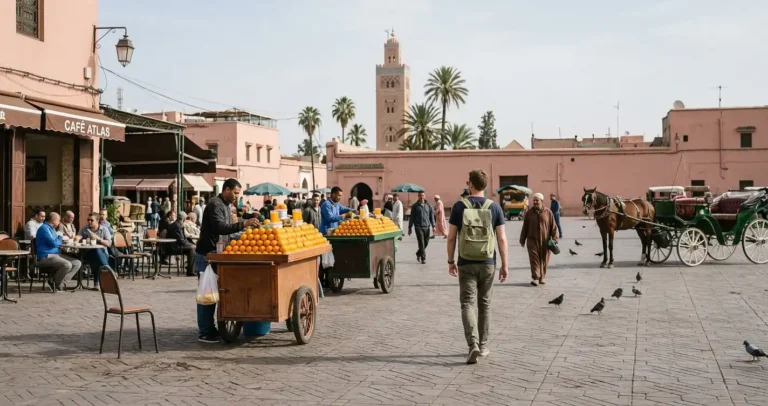
Continuing north brings you to Jemaa el-Fnaa, Marrakech’s legendary main square, where street performers, food stalls, musicians, and rooftop cafés create one of the world’s most vibrant public spaces. Along the way, you can also wander through the Medina’s famous souks or visit the beautiful Koutoubia Mosque, whose iconic minaret has watched over Marrakech for centuries.
Together, these attractions form one of the richest concentrations of historic sites anywhere in Morocco.
Practical Tips Before Visiting Bahia Palace
A little preparation goes a long way toward making your visit more enjoyable.
Arriving early not only helps you avoid the largest crowds but also allows you to appreciate the palace’s peaceful atmosphere before temperatures rise. Comfortable shoes are essential, as you’ll spend most of your visit walking across stone courtyards and uneven pathways.
While hiring a licensed guide can provide valuable historical context, independent visitors will also enjoy exploring at their own pace, especially after reading about the palace beforehand.
During summer, carrying a bottle of water and wearing a hat are sensible precautions, as some sections receive direct sunlight despite the shaded gardens.
Finally, remember that Bahia Palace is a historic monument rather than a museum filled with exhibits. The true beauty lies in observing its architecture carefully, so take your time and don’t rush through the courtyards.
Bahia Palace Guide: Frequently Asked Questions
Is Bahia Palace worth visiting?
Yes. Bahia Palace is widely considered one of Marrakech’s most beautiful landmarks and offers an outstanding introduction to Moroccan architecture, history, and craftsmanship.
Can you visit without a guide?
Absolutely. Many visitors explore independently, although guided tours can provide additional historical background and architectural insights.
How much does it cost?
An entrance ticket is required. Prices occasionally change, so it’s best to check the latest official rates before your visit.
Is Bahia Palace suitable for children?
Yes. Families often enjoy the open courtyards, gardens, and spacious layout, although younger children should be supervised around fountains and uneven surfaces.
Can you take photos?
Yes. Photography for personal use is generally allowed, making Bahia Palace one of Marrakech’s most rewarding attractions for photographers.
Final Thoughts on Bahia Palace
A visit to Bahia Palace is about far more than admiring a beautiful historic building. It offers a rare opportunity to step inside one of Morocco’s greatest architectural achievements and experience the remarkable craftsmanship that has defined the country’s artistic heritage for centuries.
From its magnificent marble courtyards and colorful zellige mosaics to its fragrant gardens and elaborately painted cedar ceilings, every corner of the palace reflects extraordinary attention to detail. Unlike many historic monuments that impress through sheer size, Bahia Palace captivates visitors through elegance, harmony, and the quiet beauty of its design.
Whether you’re spending three days in Marrakech or enjoying a longer Moroccan adventure, Bahia Palace deserves a place near the top of your itinerary. Combined with nearby attractions such as the Mellah, El Badi Palace, and Jemaa el-Fnaa, it provides one of the most memorable cultural experiences the Red City has to offer and one that continues to leave visitors inspired long after they leave its peaceful courtyards behind.