Fes Medina Walking Guide (2026): The Ultimate Self-Guided Route & Map
Fes is the kind of city that rewards walking, but it does not always make walking easy.
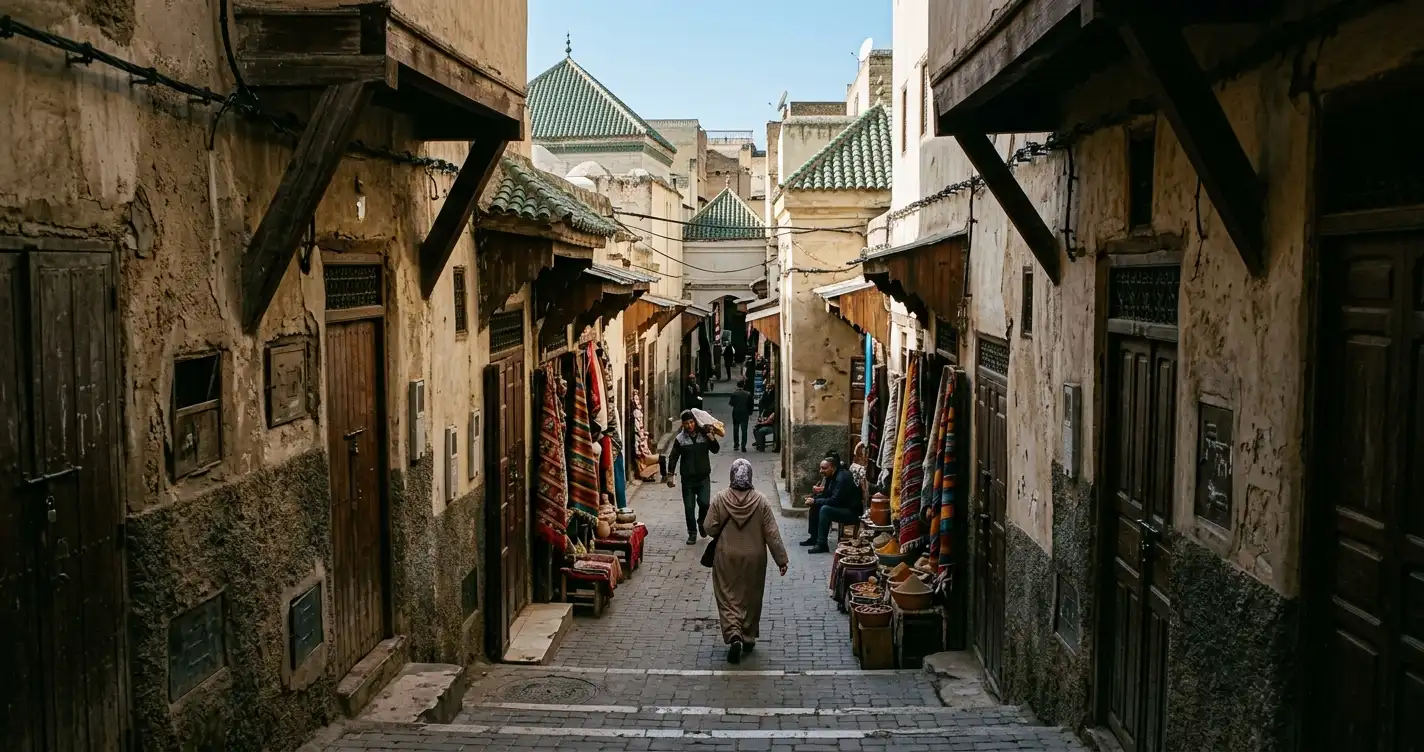
Inside Fes el-Bali, the old medina, streets narrow into passages, passages turn into covered souks, and a route that looked obvious on your phone five minutes ago can suddenly disappear behind a doorway or bend. That is part of what makes Fes so fascinating. The medina is not a museum arranged for visitors. It is a living part of the city, with workshops, bakeries, mosques, shops and homes woven into the same maze.
The good news is that you do not need to spend the entire day following a guide with an umbrella to experience it.
With a sensible route, an offline map and a little patience, you can explore much of Fes el-Bali independently. This Fes Medina walking guide follows a practical route from Bab Bou Jeloud through the historic heart of the medina, passing Bou Inania Madrasa, Talaa Kebira, Al-Attarine, Al-Qarawiyyin, Nejjarine and the Chouara Tanneries.
The route is designed to leave room for the thing that makes Fes special: getting distracted.
Fes Medina Walking Route at a Glance
Start: Bab Bou Jeloud (Blue Gate)
Finish: Chouara Tanneries, with options to continue toward the eastern side of the medina or return toward the center
Main route: Bab Bou Jeloud → Talaa Kebira → Bou Inania Madrasa → souks → Al-Attarine Madrasa → Al-Qarawiyyin → Place Seffarine → Nejjarine → Chouara Tanneries
Walking time: Around 3–4 hours without long sightseeing or shopping stops. Allow most of a day if you want to enter monuments, stop for food, browse workshops and explore side streets.
Difficulty: Moderate. The route is not physically extreme, but the uneven paving, steps, crowds and occasional steep sections make comfortable footwear important.
Fes el-Bali is part of the UNESCO-listed Medina of Fez, a historic urban area whose development goes back to the Idrisid period and which contains an unusually dense collection of religious, commercial, residential and craft architecture.
The Moroccan National Tourist Office also identifies Bab Bou Jeloud as one of the easiest entrances to the old medina, making it a logical starting point for a first walk.
Where to Start Your Fes Medina Walk
Start at Bab Bou Jeloud, commonly called the Blue Gate.
The gate stands at the western edge of Fes el-Bali and is probably the easiest landmark to use when orienting yourself before entering the maze. From the open area outside, take a moment before going through. The contrast between the open modern city behind you and the compressed streets ahead is striking.
Once you pass through the gate, you have two obvious routes into the medina. For this walking itinerary, follow Talaa Kebira, the main descending route.
Do not worry if you immediately feel as though you have lost the route.
You have not.
The trick with Fes is not trying to memorize every turn. Instead, learn a handful of major landmarks and use the main streets between them as your backbone. Talaa Kebira is particularly useful because it carries you deeper into the historic center while giving you frequent opportunities to branch off and look around.
Download your map before entering the medina. Mobile reception can vary, and a map that works offline is much more useful than standing in a busy alley trying to load a route.
The Ultimate Fes Medina Walking Route
Bab Bou Jeloud
Begin at Bab Bou Jeloud and walk through the gate into Fes el-Bali.
The present gate dates from the early 20th century, but its design deliberately reflects the architectural character of the old city. Its blue exterior and green interior have made it one of the most recognizable symbols of Fes.
The best way to appreciate it is not to rush through.
Take your photographs outside first, then enter the medina and turn around. The view from inside gives you a different perspective, with the gate framing the busy entrance area.
From here, continue along Talaa Kebira.
Talaa Kebira
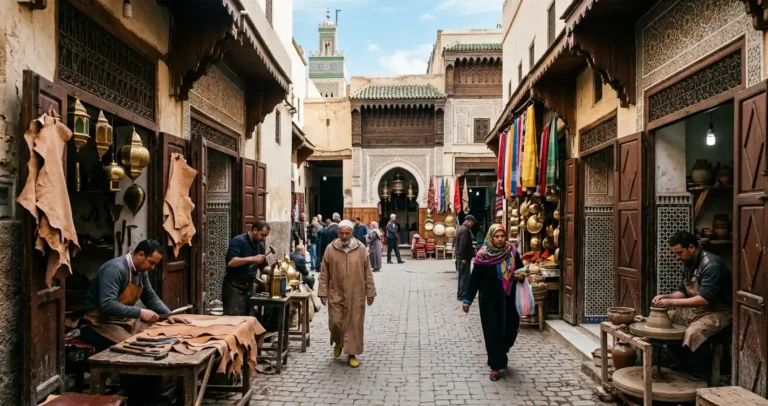
Talaa Kebira is where the walk starts to feel properly like Fes.
The name translates roughly as “the big slope,” and the street leads downhill through a dense succession of shops, workshops, food stalls and small businesses. It is one of the principal routes through Fes el-Bali and forms a useful navigation backbone for first-time visitors.
Do not treat it simply as a road between attractions.
This is one of the places where you should slow down.
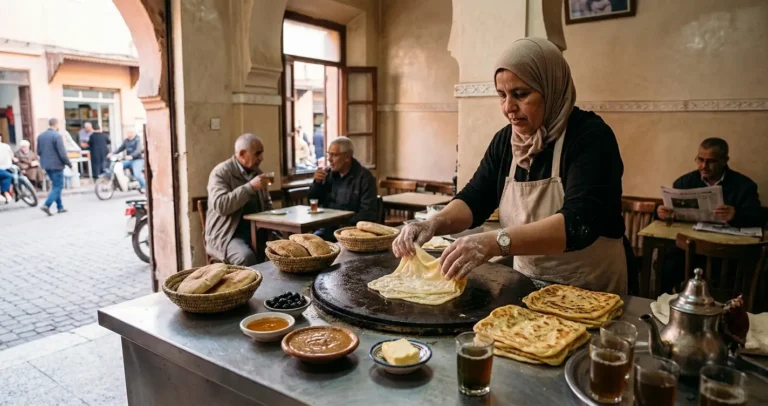
Look into the small workshops. Notice the bread being carried through the streets, the metalwork, the textiles and the changing rhythm of the shops as you move deeper into the medina. Fes remains a working city, and many of the people you see here are going about their ordinary routines rather than performing for tourists. The Moroccan National Tourist Office specifically highlights the concentration of traditional craftspeople within the medina, including tanners, weavers and metalworkers.
You will also encounter handcarts, bicycles and pack animals in places where a modern city would normally have cars.
When someone calls “balak!”, move toward the side and let them pass.
It is one of the most useful words you will hear during your walk.
Bou Inania Madrasa
A short distance down Talaa Kebira, stop at Bou Inania Madrasa.
This Marinid-era religious school is one of the architectural highlights of Fes. Its courtyard is a concentrated display of Moroccan craftsmanship: zellige tilework, carved plaster, cedar wood and geometric decoration come together in a relatively compact space.
This is a place where it is worth putting the phone away for a few minutes.
Look closely at the details rather than trying to photograph every surface. The workmanship becomes more impressive the longer you look at it.
If the madrasa is open when you arrive, allow around 20–30 minutes for the visit. Opening arrangements and admission conditions can change, so check locally on the day rather than relying on an old blog post.
After leaving, return to Talaa Kebira and continue downhill.
Fes Souks
From here, the walking route becomes less about individual monuments and more about the medina itself.
The souks unfold around you as you continue toward the historic center. You will pass shops selling leather, textiles, spices, ceramics, lamps, clothing and everyday goods.
This is a good point to stop trying to follow your map turn by turn.
Use the major direction of Talaa Kebira as your reference, then allow yourself to take short detours.
Some of the best moments in Fes happen when you notice something you were not looking for: a craftsman working behind an open doorway, a tiny bakery, a courtyard glimpsed through a passage or a shop filled from floor to ceiling with traditional goods.
If you plan to buy something, take your time. Compare prices and do not feel obliged to purchase simply because you have accepted an invitation to look.
Al-Attarine Madrasa
Continue toward Al-Attarine Madrasa, near the historic spice and perfume souk.
It is smaller than Bou Inania, but that is part of its appeal. The courtyard feels intimate, and the combination of zellige, carved stucco, cedar and marble makes it one of the most rewarding short stops along the route.
The name is associated with the nearby spice and perfume market, which gives you a useful geographical clue while navigating.
Allow around 20 minutes if you visit.
From here, the route heads toward the spiritual center of the medina.
Al-Qarawiyyin
The area around Al-Qarawiyyin is one of the most historically significant parts of Fes.
The institution was founded in the 9th century and became a major center of Islamic learning. UNESCO’s description of the Medina of Fez places the development of the old city within a much broader history beginning with the Idrisid foundation and continuing through successive dynasties.
For visitors, there is an important practical point: access to religious spaces can be restricted.
Do not attempt to enter areas that are closed to non-Muslim visitors. Instead, appreciate the complex from the accessible streets and viewpoints around it, and be especially respectful when people are entering or leaving for prayer.
This is not a place to stand in the middle of a doorway trying to get the perfect photograph.
Place Seffarine
From the Qarawiyyin area, make your way toward Place Seffarine.
The square sits near the Bou Khrareb river and is associated with Fes’s traditional metalworking quarter. The sound of craftsmen working metal is part of the character of this section of the medina.
It is also a useful moment to pause.
After the compressed lanes around the central medina, the open space of the square gives you a chance to breathe, check your map and decide whether you want to continue directly or explore a little more.
Nejjarine Square
Continue toward Place Nejjarine.
This is one of the most attractive small spaces in the medina, centered around its ornate fountain and surrounded by traditional architecture.
The Nejjarine Museum of Wooden Arts and Crafts occupies a restored fondouk, or traditional inn, and provides another opportunity to step away from the crowded streets.
If you have the time, the museum is worth entering. The building itself is part of the experience, and its rooftop provides a useful elevated perspective over the surrounding medina.
This is also a good place to look at the craftsmanship of the city without the pressure of a busy shopping street immediately around you.
Chouara Tanneries
The final major stop on this version of the route is Chouara Tanneries.
The approach can be confusing, so this is where your offline map becomes particularly useful.
The tannery is one of the most recognizable sights in Fes: rows of stone vats used in traditional leather production, viewed from terraces above the working area.
The reality is less polished than the photographs.
There can be a strong smell, especially in warmer weather. You may be offered mint as you enter one of the viewing terraces, which helps make the experience more comfortable.
You will also encounter people offering to show you the tanneries.
Some are connected to leather shops, so do not assume that an enthusiastic invitation to a “free terrace” is entirely disinterested. You can politely decline, compare viewpoints and decide for yourself whether you want to enter a shop or simply see the tannery from an accessible viewpoint.
The tanneries are still part of the working craft economy of Fes, rather than simply an archaeological attraction. The official Moroccan tourism site identifies leatherworking and tanning among the traditional crafts associated with the medina.
Fes Medina Walking Route Map
The simplest way to navigate this route is to think of it as a sequence of landmarks rather than a collection of hundreds of tiny streets:
Bab Bou Jeloud → Bou Inania → Talaa Kebira → Al-Attarine → Al-Qarawiyyin → Place Seffarine → Nejjarine → Chouara Tanneries
The exact path between these points may change slightly depending on which lanes are open, how crowded the medina is and whether you stop to explore.
Do not expect a GPS route to behave like one through a modern European city.
Fes el-Bali’s streets form a dense historic network, and UNESCO’s documentation emphasizes the complexity and historic character of its urban fabric.
For a first visit, your phone should be used to answer one question:
Which major landmark am I heading toward?
It does not need to tell you which tiny alley to take every ten seconds.
How Long Does It Take to Walk Fes Medina?
The basic route can be walked in around 3–4 hours, depending on your pace.
That estimate changes dramatically once you start entering monuments, shopping, taking photographs and stopping for food.
A realistic first-time schedule is closer to half a day or a full day.
A quick walk might look like this:
Morning
Bab Bou Jeloud
→ Bou Inania
→ Talaa Kebira
→ souks
→ Al-Attarine
→ Al-Qarawiyyin
Midday
Lunch or café break
Afternoon
Place Seffarine
→ Nejjarine
→ Chouara Tanneries
If you want to visit several monuments and museums without rushing, give yourself the entire day.
Current self-guided routes published in 2026 similarly structure the experience around a half-day to full-day walk through the main landmarks, with additional time for food and navigation.
How to Navigate Fes Medina Without Getting Lost
This is the question almost every first-time visitor eventually asks.
The honest answer is that you probably will get slightly lost.
That is not necessarily a problem.
The important thing is knowing how to get yourself back to a recognizable point.
Use landmarks, not tiny streets
Remember:
Bab Bou Jeloud → Talaa Kebira → central medina → tanneries
Those broad landmarks are more useful than trying to memorize every turn.
Download an offline map
Do this before entering.
Save your accommodation and the major landmarks you intend to visit.
Keep your phone accessible
A small crossbody bag is much more practical than repeatedly taking your phone out of a backpack.
Don’t follow strangers automatically
Someone offering directions may genuinely be trying to help. Someone else may expect money or be leading you toward a shop.
If you need assistance, ask staff at a museum, café or established business when possible.
Don’t panic when the map looks wrong
GPS can behave strangely in narrow streets surrounded by tall buildings.
Stop, step into a wider area and orient yourself again.
If you are completely disoriented, return toward a major landmark rather than continuing deeper into increasingly unfamiliar residential lanes.
Self-Guided vs Guided Fes Medina Walking Tour
You can explore Fes Medina without a guide.
A self-guided walk gives you more freedom. You can stop whenever you want, spend twenty minutes watching a craftsman work, skip a museum or sit down for coffee without worrying about keeping up with a group.
A guide, however, adds context that a map cannot provide.
A good licensed guide can explain the history of the medina, identify architectural details you would otherwise walk past and help with navigation. They can also make the experience easier for travelers who are uncomfortable with the maze-like layout.
The best choice depends on what you want from the walk.
If your priority is freedom and exploration, use this route independently.
If your priority is history, architecture and deeper cultural context, a guided tour can be worthwhile.
There is also a middle ground: walk independently but hire a licensed guide for a few hours rather than committing to a full-day tour.
Best Time to Walk Through Fes Medina
The best time of day is generally morning.
Starting earlier means cooler temperatures, fewer visitors in some of the busiest areas and better energy for a route that involves a lot of walking.
Late afternoon can also be pleasant, particularly when the heat begins to drop.
Summer requires more planning. The medina provides shade in many places, but that does not eliminate the heat, and the physical effort of walking on uneven streets adds up.
Spring and autumn are particularly comfortable periods for spending long hours outdoors in Fes, while winter can be cool, especially in the mornings and evenings.
Whatever the season, avoid building your entire day around a rigid schedule. Fes is a city where stopping for ten minutes can easily become thirty.
What to Wear and Bring
Wear shoes that you can comfortably walk in for several hours.
This is not the place for brand-new dress shoes.
The paving can be uneven, some streets are steep, and certain sections can become slippery.
Bring:
- Comfortable walking shoes
- A reusable water bottle
- Sunglasses
- Sun protection
- A small crossbody bag
- Small amounts of Moroccan dirhams
- Your phone with an offline map
- A light layer in cooler months
Dress respectfully, particularly around religious buildings and residential areas.
You do not need to dress like you are attending a formal ceremony, but modest, comfortable clothing is the sensible choice.
Fes Medina Walking Tips
Start with a full phone battery. Navigation and photography can drain it quickly.
Carry small notes and coins. They are useful for small purchases, snacks and occasional tips.
Don’t rush through the souks. The commercial streets are part of the experience, not simply something between monuments.
Watch where you step. The medina has uneven paving, steps and constant pedestrian traffic.
Move aside when you hear “balak.” Someone is trying to get through.
Don’t assume every “shortcut” is actually a shortcut. The medina has plenty of routes that make sense only if you already know where they lead.
Ask before photographing people. Especially artisans at work.
Compare leather shops before buying. The first shop you enter does not have to be the one where you purchase.
Keep your valuables secure. The same basic precautions you would use in any busy tourist area apply here.
Leave room for spontaneity. The route is a framework, not a military operation.
Where to Stop for Food and Coffee
You will find plenty of places to eat around the medina, from simple local cafés to more polished restaurants inside traditional riads.
For this walking route, lunch around the central medina makes the most sense rather than waiting until you reach the end.
If you are tired, take a proper break.
There is no prize for walking continuously for five hours.
A rooftop or courtyard restaurant can also give you a completely different view of the city. From street level, Fes can feel enclosed and almost claustrophobic. From above, the scale of the old city becomes much easier to understand.
Is Fes Medina Safe to Walk Around?
For most visitors, walking through the main tourist areas of Fes Medina is a normal part of visiting the city.
The bigger challenge is usually navigation, not physical danger.
Busy areas require the same precautions you would take in any crowded historic center: keep valuables secure, pay attention to your surroundings and be cautious about unsolicited assistance.
At night, the experience changes. Some parts of the medina become quieter, and unfamiliar side streets are harder to navigate. If you are visiting for the first time, there is little reason to deliberately wander deep into unfamiliar areas after dark.
If you get lost, return toward a major landmark or ask staff at an established business for directions.
Fes Medina Walking Guide FAQs
How long does it take to walk through Fes Medina?
The main route can take around three to four hours of actual walking, but a realistic sightseeing day is closer to half a day or more. Entering monuments, shopping, eating and taking photographs will significantly extend the time.
Can you explore Fes Medina without a guide?
Yes. The main sights can be explored independently with an offline map and a sensible route. A licensed guide is useful if you want deeper historical context or would rather not deal with navigation yourself.
Is Fes Medina easy to navigate?
Not at first. Fes el-Bali has a dense network of narrow, interconnected streets, so it is easy to lose your bearings. Using major landmarks such as Bab Bou Jeloud, Talaa Kebira, Al-Qarawiyyin and the tanneries makes independent navigation much easier.
Where should you start a Fes Medina walking tour?
Bab Bou Jeloud is the most practical starting point for a first-time visitor. It is one of the easiest entrances to the old medina and gives you a clear starting landmark.
What are the must-see places in Fes Medina?
For a first walk, prioritize Bab Bou Jeloud, Bou Inania Madrasa, Talaa Kebira, Al-Attarine Madrasa, the Al-Qarawiyyin area, Nejjarine and the Chouara Tanneries.
Do you need a guide for Fes Medina?
No. You can explore independently. However, a good licensed guide can add historical and architectural context that is difficult to get from a map alone.
What is the best time to walk through Fes Medina?
Morning is usually the easiest time to begin, particularly during warmer months. Spring and autumn are generally comfortable seasons for spending several hours walking around the city.
How do you avoid getting lost in Fes Medina?
Use an offline map, keep major landmarks as your reference points and avoid relying entirely on GPS in narrow lanes. If you become completely disoriented, return toward a recognizable main route rather than continuing deeper into unfamiliar streets.
Final Thoughts
The best way to experience Fes Medina is not to treat it as a checklist.
Yes, you should see Bou Inania. You should stand above the Chouara Tanneries. You should find Al-Attarine and walk through the streets around Al-Qarawiyyin.
But the reason to walk Fes is what happens between those places.
It is the sound of a metalworker striking a piece of brass somewhere down a side street. It is the smell of bread coming from a neighborhood bakery. It is a doorway opening onto a quiet courtyard when the lane outside is crowded. It is the sudden change from a busy commercial street to an almost silent residential passage.
Follow the route when you need it.
Ignore it for a while when something interesting catches your attention.
Then find your way back to the next landmark.
That is probably the most enjoyable way to walk through Fes.