Morocco Packing List for Women (2026): The Ultimate Travel Checklist
Morocco is one of the most rewarding destinations a woman can visit solo or with friends vibrant souks, stunning riads, and landscapes that shift from coastline to desert to mountain within a few hours’ drive. Packing well here means less about restriction and more about comfort: the right clothing keeps you cooler in the heat, more at ease in medinas and rural towns, and ready for whatever a multi-region itinerary throws at you.
This checklist covers the dress code context, season-by-season and destination-by-destination clothing, and every accessory, health item, and electronic worth bringing, so you can pack with confidence rather than guesswork. Nothing here is about restriction for its own sake it’s about building a wardrobe that’s genuinely more comfortable in Morocco’s heat and dust, and that lets you move through medinas, souks, and rural towns with the same ease as everywhere else on your trip.
Morocco Packing List for Women: Understanding the Dress Code
Is Morocco Conservative?
Morocco is a majority-Muslim country with a culture that blends conservative and cosmopolitan influences depending on the setting. Major cities like Marrakech, Casablanca, and Rabat are used to a wide range of dress, including from international visitors, while smaller towns and rural areas tend to be noticeably more traditional. There’s no single national dress code enforced by law for tourists, but modest dress is the cultural norm most Moroccan women themselves follow, and matching that norm generally makes for a smoother, more comfortable trip.
This variation by setting is worth keeping in mind when planning a multi-stop itinerary: what feels entirely unremarkable in Marrakech’s Gueliz district or a Casablanca café might draw more attention in a small Atlas Mountains village or a rural market town, so it’s worth packing with the more conservative legs of your trip in mind rather than just the cities.
What Do Local Women Wear?
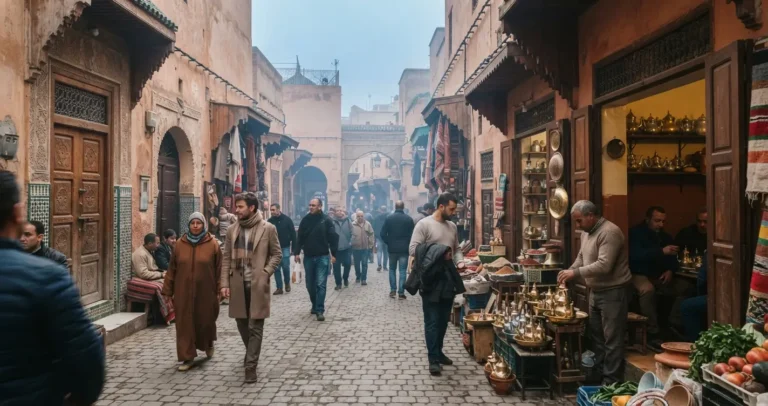
Moroccan women’s clothing varies widely by region, generation, and personal choice some wear the traditional djellaba (a loose, hooded robe) or a headscarf, while many others, particularly in cities, wear modern Western clothing that still tends toward looser fits and more coverage than typical European or North American summer wear. There’s no single “correct” local look to imitate; the common thread across most everyday Moroccan women’s fashion is simply looser, more covered clothing than a typical beach or gym outfit elsewhere.
It’s also worth noting that Moroccan women themselves dress in a genuinely wide range of styles, from fully traditional to entirely contemporary, often within the same family or even the same day there’s no expectation that a visitor adopt traditional dress specifically, just that everyday clothing lean toward coverage and looseness.
Do Tourists Have to Dress Modestly?
There’s no legal requirement for tourists to dress modestly in Morocco, and enforcement isn’t a real concern no one will stop you at the border for wearing shorts. That said, dressing with reasonable modesty (covering shoulders and knees, avoiding particularly tight or low-cut clothing) in public spaces, and especially in medinas, markets, and rural areas, tends to draw noticeably less unwanted attention and generally makes daily life easier, from browsing the souks in peace to being treated more like a respected guest than a curiosity.
Riad pools, resort areas, and beach clubs are the clear exception, where swimwear and more relaxed dress are entirely normal. The practical rule most experienced travelers settle into is simple: dress modestly by default for everyday sightseeing, and reserve more relaxed clothing for spaces specifically set up for it, like a hotel pool deck or a private riad courtyard.
Morocco Packing List for Women: Essential Clothing
Lightweight Tops
Breathable cotton or linen tops with sleeves capped, elbow-length, or long handle Morocco’s sun and heat far better than tank tops while still keeping you cool. Loose, flowy cuts are more comfortable in the heat than fitted ones and tend to draw less attention in conservative settings, making them the most versatile single category in a Morocco packing list. Packing four or five in a mix of colors and light patterns gives enough rotation for a week-long trip without needing to do laundry mid-way.
Long Dresses and Skirts
Maxi dresses and long skirts are a genuine sweet spot for Morocco: they’re cool in the heat, easy to move in, appropriate for nearly every setting from medina wandering to a nice riad dinner, and require far less thought than coordinating separate tops and bottoms each morning. A couple of versatile maxi dresses can realistically anchor an entire week’s wardrobe, especially in a breathable fabric that doesn’t wrinkle badly when packed.
Loose Trousers and Linen Pants
Wide-leg or loose-fitting trousers in linen or lightweight cotton are the practical alternative to a skirt or dress, particularly useful for days involving a hike, a camel ride, or simply more active movement than a flowing dress allows comfortably. They pair well with the same lightweight tops and layer easily if evenings turn cool, and they hold up better than a dress for anything involving climbing in and out of a 4×4 or scrambling over uneven ground.
Comfortable Walking Shoes
Medina streets mean cobblestones, uneven steps, and hours on your feet, so well broken-in, closed-toe shoes with real support matter more here than in most destinations. Save sandals for riad courtyards and beach towns, and bring real walking shoes for any day involving a medina, a souk, or a guided city tour. Breaking new shoes in before the trip, rather than wearing them for the first time on day one, avoids one of the more common and entirely avoidable travel frustrations.
Light Jacket or Sweater
Even warm-weather itineraries benefit from a packable layer, since evenings cool down noticeably almost everywhere in Morocco, and this swing becomes dramatic in the desert and mountains. A lightweight cardigan or packable jacket also doubles as an easy modesty layer over a tank top or lower-cut dress when moving between a pool and a public street, making it one of the more quietly useful items on this whole list.
Morocco Packing List for Women by Season
Spring Packing List
Spring (March-May) calls for breathable layers that flex through a wide daily temperature range: lightweight dresses or tops, a cardigan or light jacket for cooler mornings and evenings, comfortable walking shoes, and a scarf that doubles as sun protection and a quick modesty layer. This is generally considered Morocco’s most comfortable season for sightseeing, so pack for full days on your feet. Spring is also windier than other seasons in the Sahara, so if a desert leg is part of your trip, a scarf that wraps fully around the face and neck is genuinely useful for the dustier stretches.
Summer Packing List
Summer (June-August) means serious heat, particularly inland, so loose, breathable fabrics in light colors, a wide-brimmed hat, and high-SPF sunscreen all matter more than usual. If your itinerary includes the coast, pack swimwear plus a lightweight cover-up for walking to and from the beach, since swimwear alone isn’t appropriate once you’re off the sand or away from the resort itself. A cooling towel or small handheld fan is worth considering for inland cities and any desert stretch, given how far daytime temperatures climb.
Autumn Packing List
Autumn (September-November) largely mirrors spring, with warm days easing into cooler evenings as the season progresses, particularly by late October and November. The same layering approach works well breathable daywear with a light jacket or cardigan for evenings, and slightly warmer layers if a desert or mountain leg is on the itinerary. October tends to draw the largest crowds of the autumn window, so packing versatile layers gives more flexibility if your itinerary shifts around busier sites.
Winter Packing List
Winter (December-February) surprises a lot of first-time visitors: daytime city and coastal temperatures stay relatively mild, but evenings turn genuinely cold, and a desert overnight or Atlas Mountains visit calls for real warmth, not just a light sweater. A proper jacket, plus a scarf, hat, and gloves for any desert or mountain leg, makes a real difference, since riads and older buildings generally aren’t centrally heated the way many travelers expect. Warm sleepwear and an extra indoor layer are worth including too, not just outdoor gear for daytime sightseeing.
Morocco Packing List for Women by Destination
Marrakech and Imperial Cities
Marrakech, Fes, Meknes, and Rabat call for the core wardrobe above modest, breathable clothing, comfortable walking shoes, and a scarf for quick coverage plus a crossbody bag for navigating crowded souks with your hands free and your belongings secure. A portable phone charger is genuinely useful too, since a full day of medina navigation by map drains a battery faster than expected. Earplugs are worth considering for riad stays near a mosque, since the call to prayer happens at set times including before dawn, and light sleepers occasionally prefer the option to block it out.
Sahara Desert
The desert asks for the widest range of any single destination: breathable, sun-protective clothing and a proper scarf or shesh for daytime dust and glare, paired with a genuinely warm layer, hat, and gloves for overnight camps, where temperatures can swing more than 20°C between afternoon heat and pre-dawn cold. A headlamp is worth packing too, since desert camps run on generator or solar power with limited lighting after dark. A small separate overnight bag is also worth packing if your desert excursion includes an overnight camp, since most tours transfer guests by 4×4 for the final stretch and appreciate lighter, more compact bags than a full suitcase.
Atlas Mountains
A day hike or multi-day trek toward Mount Toubkal calls for proper hiking boots rather than casual walking shoes, moisture-wicking layers, and a warm jacket for higher elevations, where temperatures drop noticeably compared to the valleys below. Winter and early spring visits should factor in real snow at higher elevations, which changes footwear and layering needs considerably from a summer trek. Sunglasses rated for high-altitude glare are worth adding for any trek above the tree line, along with a hydration system that’s easy to access without stopping at every water break.
Coastal Destinations
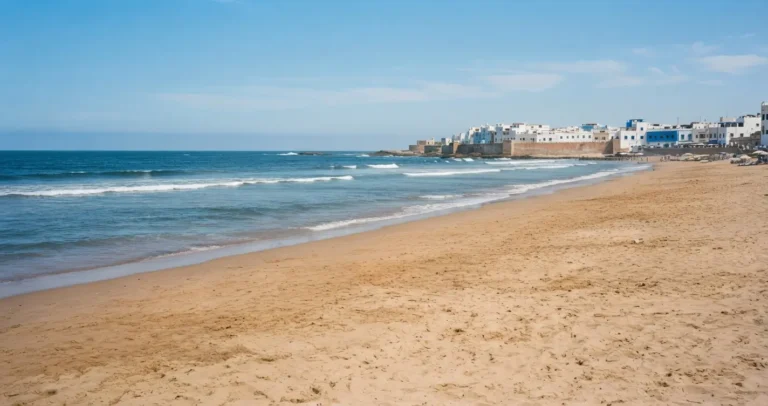
Essaouira, Agadir, and Taghazout run cooler and windier than inland Morocco year-round, so pack a windbreaker or light jacket alongside swimwear, even in summer. A rash guard or long-sleeve swim top is worth considering for extended beach or surf time, given how persistent the coastal sun and wind can be. Essaouira in particular is known for its strong Alizé trade winds, which can make an unprotected afternoon on the ramparts considerably chillier than the daytime temperature alone would suggest.
Morocco Packing List for Women: Accessories
Scarf or Shawl
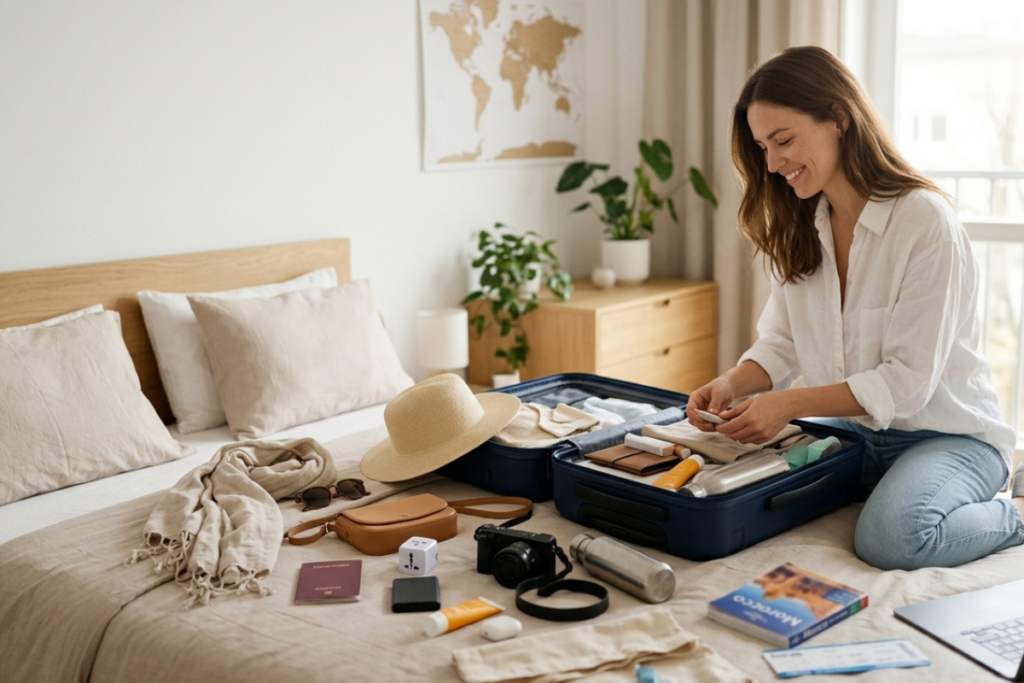
A lightweight scarf is arguably the single most versatile item on this entire list sun protection, dust protection in the desert, a quick modesty layer over a tank top, and a way to cover your head briefly if you step into a religious site that requests it. Pack at least one large, breathable scarf that can genuinely double as all of the above, and consider a second lighter one purely for warm-weather sun protection if you have room.
Sunglasses and Hat
Between desert glare, coastal sun, and generally intense Moroccan sunlight most of the year, real sunglasses and a wide-brimmed hat or cap are close to essential rather than optional, particularly for extended time in the Sahara or on the coast. A hat with a chin strap or cord is worth considering for windier towns like Essaouira, where a loose hat has a habit of ending up airborne.
Crossbody Bag
A crossbody bag that zips closed and sits in front of you is a smart choice for navigating busy souks and medinas, keeping your hands free while making your belongings harder to access than an open tote or a bag worn on one shoulder. It’s a practical choice on most trips involving crowded markets, not a Morocco-specific precaution, and it’s worth choosing one large enough for a water bottle, sunscreen, and a scarf without feeling overstuffed.
Reusable Water Bottle
Tap water is treated in most Moroccan cities, but many travelers prefer bottled or filtered water regardless, particularly in rural areas, which makes a reusable bottle with a built-in filter a genuinely useful upgrade over buying single-use plastic throughout the trip. It also simply makes it easier to stay hydrated through long medina walking days and desert heat, where it’s easy to underestimate how much water a full day of sightseeing requires.
Morocco Packing List for Women: Toiletries and Health Essentials
Sunscreen
Morocco’s sun is intense across nearly every season and region, so a high-SPF sunscreen and SPF lip balm are worth packing generously rather than relying on local availability, particularly given how much reflection off desert sand and mountain altitude can add to daily UV exposure. Reapplying more often than you would at home is worth building into the daily routine, since the combination adds up faster than most travelers expect.
Personal Medication
Any personal prescription medication should travel in its original packaging, ideally with a copy of the prescription, since some medications legal at home are restricted in Morocco. It’s also worth packing enough for the full trip plus a few extra days as a buffer, since pharmacies thin out considerably once you’re outside major cities. Any women’s health items you rely on regularly are worth bringing in sufficient supply too, since specific brands aren’t always easy to find outside larger cities.
Basic First-Aid Kit
A compact kit covering pain relievers, anti-diarrheal medication, rehydration salts, and adhesive bandages is worth assembling before you travel rather than relying on finding everything locally, particularly for any stretch of the trip in the Atlas Mountains or the Sahara where the nearest pharmacy can be a genuine distance away. Motion sickness tablets are worth adding too if your itinerary includes the winding mountain roads toward the Sahara or the Atlas passes.
Hand Sanitizer
Hand sanitizer and a small pack of tissues or wet wipes are worth including, since public restrooms particularly in more remote areas or older medina buildings don’t always supply their own soap or paper. This is a small addition that consistently proves useful across nearly every day of a Morocco itinerary.
Morocco Packing List for Women: Electronics
Universal Travel Adapter
Morocco uses Type C and Type E plugs at 220V, 50Hz, the same standard used across most of continental Europe. Travelers from the US, UK, Canada, or other regions with different plug shapes will need an adapter a universal one covering Type C/E is the simplest option and works throughout Europe on future trips too. Most modern electronics are dual-voltage and work fine with just a plug adapter, though higher-wattage items like hair tools should be checked for their voltage rating before assuming they’ll work without a separate converter, since devices built for 120V markets can be damaged on Morocco’s 220V supply.
Power Bank
A charged power bank is genuinely useful for long medina days, overnight trains, or a desert camp with limited charging access. A mid-capacity bank able to recharge a phone two or three times over covers most single-day gaps comfortably pack the matching cable rather than assuming one will be easy to borrow.
Camera and Phone Accessories
Morocco is an unusually photogenic country, so it’s worth packing enough memory card capacity and a spare battery that a full day of shooting in Chefchaouen or the Sahara doesn’t leave you scrambling. A local SIM or eSIM from Maroc Telecom, Orange, or inwi is inexpensive and genuinely useful for navigation and staying connected tourist packages typically run 30-200 MAD ($3-20) depending on data allowance and provider, with Maroc Telecom and inwi offering the strongest coverage outside major cities.
Morocco Packing List for Women: Items to Avoid Bringing
Revealing Clothing
Very short shorts, low-cut tops, and tight, sheer, or otherwise revealing pieces aren’t illegal, but they draw noticeably more attention in medinas, markets, and rural towns than they would at home, and most women find the trip simply more comfortable dressing more modestly outside resort and pool settings. These pieces are entirely fine for a riad pool or a private resort, just less suited to everyday sightseeing, so it’s worth packing a couple for that specific context rather than leaving them out entirely.
Expensive Jewelry
Leaving fine jewelry at home is standard advice for travel to any bustling, crowded destination, and Morocco’s souks and medinas are no exception a busy market is simply not the place to be managing valuable, hard-to-replace items. Costume jewelry lets you dress up for an evening out without the same worry, and it packs lighter besides.
Heavy Luggage
A large, hard-sided suitcase is genuinely difficult to manage on Morocco’s cobblestone medina streets, up riad staircases, and in and out of shared taxis and desert 4×4 transfers. A mid-sized soft-sided bag or a backpack, ideally one you can carry yourself over uneven ground, makes every leg of a multi-region Morocco trip noticeably easier, particularly on days involving multiple transfers between cities, the desert, and the mountains.
Morocco Packing List for Women: Frequently Asked Questions
Can Women Wear Shorts in Morocco?
Shorts are generally fine in resort areas, riad courtyards, and by the pool, but they draw more attention in medinas, religious sites, and more conservative towns. Knee-length or longer bottoms are the more comfortable default for daily sightseeing, with shorts reserved for beach or poolside settings specifically. Longer, looser shorts tend to draw less attention than short ones, if a full skirt or dress isn’t what you’d normally reach for.
Do Women Need to Cover Their Hair?
No covering your hair isn’t required for female travelers in Morocco, except when entering a mosque as a Muslim worshipper or at certain religious sites that may request it. It’s still worth carrying a light scarf, since it’s a genuinely versatile item for sun protection, dust, and the occasional situation where covering up is appropriate or simply more practical.
Is It Safe to Wear Dresses?
Yes , long, loose dresses are actually one of the most practical and widely worn clothing choices for women traveling in Morocco, combining comfort in the heat with a modest, culturally appropriate silhouette. Fitted or very short dresses draw more attention outside resort settings, but a flowing maxi dress is close to a uniform among women travelers here for good reason, and it’s genuinely one of the easiest categories of clothing to pack light while still having a fresh option most days.
What Shoes Are Best for Morocco?
Comfortable, closed-toe walking shoes with real support are the best all-around choice, given how much time most itineraries spend on medina cobblestones and uneven historic streets. Save sandals for riad courtyards and beach days, and bring proper hiking boots if the Atlas Mountains are part of your route. A single well-cushioned pair, broken in before the trip, will do more for your comfort over a week-long itinerary than almost anything else on this list.
Final Thoughts: Morocco Packing List for Women
Packing for Morocco as a woman comes down to the same principle as packing for the country generally, with one added layer of consideration: dress modestly and comfortably as your default, layer for the country’s genuinely wide temperature swings, and add the destination-specific extras real hiking boots for the Atlas, a warm layer for the desert, a windbreaker for the coast based on exactly where your trip takes you.
Get that mix right, and you’ll spend far less time thinking about your suitcase and far more time enjoying a country that consistently exceeds what first-time visitors expect of it. The travelers who come back most satisfied with their packing almost always mention the same thing: a handful of versatile, breathable pieces that worked everywhere, rather than a bag full of single-purpose items that only suited one leg of the trip.