
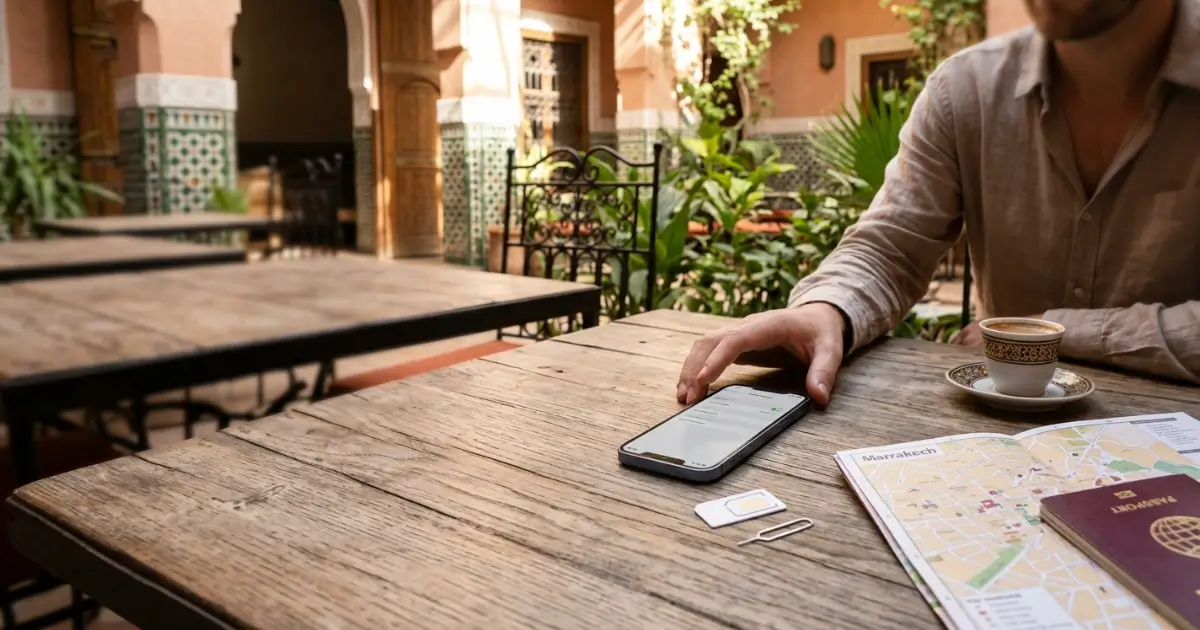
SIM Card vs eSIM in Morocco (2026): Which Option Is Better for Your Trip?
Sorting out mobile data is one of the first practical decisions in planning a Morocco trip, and the SIM card vs eSIM in Morocco question doesn’t have a single right answer , it depends on how long you’re staying, where you’re headed, and whether you need a local number at all. Both options work well across the country’s cities and main tourist routes, but they solve slightly different problems, and picking the wrong one mostly costs you convenience or a bit of extra money, not a working connection.
This guide walks through exactly how each option works, compares them side by side on price, coverage, and setup, and matches the right choice to your specific trip. By the end, you should know exactly which format fits your itinerary , and, just as usefully, which of Morocco’s three mobile networks to prioritize regardless of which format you pick.
SIM Card vs eSIM in Morocco: The Quick Answer
Which Option Is Best for Most Travelers?
For a first-time visitor spending a week or two in Morocco, an eSIM edges out a physical SIM card mostly on convenience , you land already connected, with no queue, no passport check at a kiosk, and no small plastic card to lose. A physical SIM, bought after arrival, tends to win on raw value: local tourist packages regularly deliver 40-50GB for around 200 MAD (roughly $20), which beats most international eSIM plans gigabyte for gigabyte. Neither option is wrong for a standard trip; the eSIM buys you time and simplicity, the SIM card buys you cheaper data and a working Moroccan number.
The honest answer, if you want one single recommendation, leans slightly toward the eSIM for anyone landing after a long-haul flight who’d rather not deal with logistics on arrival, and slightly toward the physical SIM for anyone who’s already comfortable navigating an airport in an unfamiliar country and wants the better deal.
When Should You Choose a Physical SIM Card?
A physical SIM makes more sense once your trip stretches past two weeks, if you’re planning to use large amounts of data (uploading video, video-calling regularly, working remotely), or if you specifically need a Moroccan phone number to coordinate with a driver, riad, or tour operator who’ll want to reach you locally. It’s also the better economic choice for anyone genuinely price-sensitive, since the per-gigabyte cost of a local SIM undercuts nearly every eSIM plan on the market.
When Is an eSIM the Better Choice?
An eSIM wins for short trips, for travelers who don’t want to touch their phone’s physical SIM tray at all, and for anyone who’d rather sort out connectivity from their sofa at home than in an airport arrivals hall after a long flight. It’s also the more practical pick if you’re combining Morocco with other countries on the same trip, since several eSIM providers cover multiple destinations on one plan.
What Is a Physical SIM Card?
A physical SIM card is the small plastic chip that’s slotted into your phone to connect it to a local mobile network , in Morocco’s case, one of three operators: Maroc Telecom, Orange, or inwi. Buying one means physically swapping it in for your home SIM, which gives you a genuine Moroccan number for the duration of your trip. It’s the same basic technology travelers have used for over two decades, and Morocco’s three operators all sell tourist-oriented packages specifically designed for short-stay visitors rather than only long-term residents.
How Does a SIM Card Work?
Once inserted, the SIM card registers your device on the local network, and Moroccan law requires real-name registration for every SIM sold , meaning you’ll show your passport at the point of sale, whether that’s an airport kiosk or a shop in the city. Registration itself is quick, usually just a couple of minutes, and staff will typically activate the plan and test the connection with you before you leave the counter. This registration requirement applies equally to visitors and residents, so it’s a legal formality rather than anything specific to tourists.
Where Can You Buy a SIM Card in Morocco?
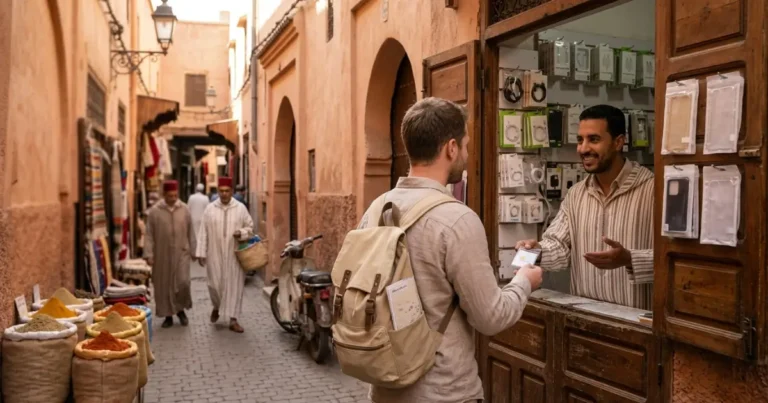
Tourist SIM cards are available at official kiosks in the arrivals halls of Morocco’s main international airports , Casablanca Mohammed V, Marrakech Menara, Agadir Al Massira, and Fes-Saïss among them , as well as at operator-branded shops in every major city and, less reliably, from independent electronics stores and supermarkets. Airport prices run close to city prices in most cases, so there’s little financial penalty to buying the moment you land rather than waiting. It’s worth sticking to official Maroc Telecom, Orange, or inwi outlets rather than informal street vendors, since an unofficial seller’s activation can be unreliable and harder to resolve if something goes wrong.
What Is an eSIM?
An eSIM is a digital SIM profile built into your phone’s hardware rather than a physical card you insert. Instead of a plastic chip, you install a data plan by scanning a QR code, and the profile lives permanently on your device until you delete it, ready to be topped up or replaced for a future trip. Because there’s no physical component, an eSIM can also sit alongside your regular home SIM on dual-SIM phones, rather than replacing it entirely.
How Does an eSIM Work?
You purchase a data plan through a provider’s app or website, receive a QR code, and scan it while connected to Wi-Fi , this installs the eSIM profile without needing to be in Morocco yet. On arrival, you switch your phone’s active data line to the new eSIM and enable data roaming for that profile, and it connects automatically to whichever local network the provider uses, no manual configuration or in-person visit required. Most travelers find the entire process, from purchase to installation, takes well under ten minutes.
Which Phones Support eSIM?
Most iPhones from the XS and XR generation onward support eSIM, as do many recent Android flagships from Samsung, Google, and other major manufacturers. Support varies by exact model and sometimes by the region a phone was originally sold in, so it’s worth checking your specific device before committing to this route , a phone bought carrier-locked in some markets may also have eSIM functionality disabled even on otherwise compatible hardware.
SIM Card vs eSIM in Morocco: Side-by-Side Comparison
Price
A physical SIM generally wins on raw price per gigabyte. Tourist packages from Maroc Telecom or inwi commonly deliver around 50GB for roughly 200 MAD ($20), while Orange offers smaller validity-based bundles starting around 120 MAD ($12) for a week. International eSIM plans typically run higher per gigabyte ,expect $20-35 for 10-20GB from most providers , though the gap narrows on shorter trips where you’re not using much data either way.
Convenience
This category belongs to the eSIM. There’s no queue, no counter, no passport check on arrival , you install the profile before you fly and it’s ready the moment your phone detects a Moroccan network. A physical SIM requires finding a kiosk or shop, waiting for registration, and physically removing your home SIM, which is a small but real inconvenience after a long flight.
Setup Time
An eSIM installs in a few minutes at home, well before departure, meaning zero setup time is needed once you land. A physical SIM purchase, including the passport check and registration, typically takes five to fifteen minutes at an airport kiosk, longer if there’s a queue during a busy arrivals period.
Coverage
Coverage is essentially tied to the network a provider connects through rather than the SIM format itself. A physical Maroc Telecom SIM and a Maroc Telecom-based eSIM will perform identically in the same location, since both are riding the same underlying infrastructure.
Speed
Speeds are comparable between formats on the same network, though most eSIM providers currently cap out at 4G in Morocco even where local 5G exists, since Maroc Telecom and Orange largely reserve 5G capacity for local subscribers. A physical SIM bought directly from an operator may get access to 5G in cities where it’s available, depending on your phone and plan.
Local Phone Number
A physical SIM comes with a genuine Moroccan number, usable for local calls, SMS, and any situation where a Moroccan business or contact needs to reach you directly. No major eSIM provider currently issues a real Moroccan number alongside their data plans , you’re getting data only, with voice handled through apps like WhatsApp instead.
Calls and SMS
Physical SIMs generally include some calling minutes and SMS allowance bundled into tourist packages, useful for booking restaurants or coordinating logistics with people who don’t use WhatsApp. Most eSIM plans are data-only, which is rarely a problem in a country where WhatsApp is the default communication tool for nearly everyone, tourists and locals alike.
Data Plans
Physical SIM data plans in Morocco tend to be generous and flexible, with easy top-ups available at any shop if you run low. eSIM plans are fixed at purchase , you buy a set amount of data for a set validity window, and running out mid-trip means buying a second plan rather than a quick top-up at a corner shop. For travelers with unpredictable data needs, this flexibility is one of the more underrated advantages of going the physical SIM route.
Mobile Network Coverage in Morocco
Maroc Telecom
Maroc Telecom is Morocco’s largest and longest-established operator, and it consistently comes up as the strongest choice for rural coverage, the Atlas Mountains, and routes toward the Sahara. If your itinerary leaves the main cities and highways, Maroc Telecom is the safer network to be on, whether through a physical SIM or an eSIM that connects through it. Its long history in the country means its infrastructure reaches many smaller towns and valley routes that newer competitors haven’t fully built out yet.
Orange Morocco
Orange performs well across cities, the coast, and major tourist corridors, and it’s often the most competitively priced option for urban-focused trips. Its rural and mountain coverage isn’t quite as consistent as Maroc Telecom’s, which matters less if your trip stays close to Marrakech, Fes, Casablanca, and the coastal towns. For a classic imperial-cities-and-coast itinerary, Orange holds up perfectly well and often comes in slightly cheaper.
Inwi
Inwi rounds out Morocco’s three operators and is frequently cited as offering strong overall value and reliable coverage, including for road trips between cities. It’s a common pick at airport kiosks and tends to be competitively priced against both of its rivals, and several travelers report it as the most consistent choice specifically for longer overland routes that mix cities with stretches of highway driving.
Which Option Is Better for Different Travelers?
Short Trips (1–5 Days)
For a quick trip, an eSIM’s convenience usually outweighs the SIM card’s better value, since the time saved not queuing at a kiosk matters more than a modest price difference on a small amount of data. A long weekend in Marrakech is a textbook case for an eSIM.
One-Week Vacations
A week-long trip sits in genuinely comparable territory , either option works well, and the choice comes down to whether you’d rather save a bit of money (SIM card) or a bit of hassle (eSIM). Most travelers in this bracket end up choosing based on how they feel about their arrival day rather than the numbers alone.
Two-Week Holidays
At two weeks, the physical SIM’s value advantage becomes harder to ignore, particularly for travelers who’ll be using data heavily for navigation, photos, and staying in touch. The gap in total cost between the two options widens noticeably at this length, often by $15-20 or more.
Digital Nomads
Anyone working remotely from Morocco for an extended stretch should lean toward a physical SIM, both for the better data value at scale and for the local number that makes booking appointments and services considerably easier. A Moroccan number also simplifies things like setting up a co-working space membership or a longer-term rental agreement.
Budget Travelers
Cost-conscious travelers should default to a physical SIM card, since the per-gigabyte savings are substantial and the extra ten or fifteen minutes at a kiosk is a small price for the difference. Pairing a local SIM with free riad Wi-Fi wherever available stretches a tight data budget even further.
Business Travelers
Business travelers who need a working local number for calls, meetings, or client contact should choose a physical SIM, since eSIMs currently don’t offer this in Morocco, while those purely checking email and using apps may find an eSIM’s convenience worth the premium. Some business travelers end up using both , a physical SIM for the local number and an eSIM as a backup data line.
Pros and Cons
Advantages of a Physical SIM Card
- Meaningfully cheaper per gigabyte of data
- Includes a genuine Moroccan phone number
- Easy to top up data at any shop if you run low
- Bundled calling minutes and SMS in most tourist packages
Disadvantages of a Physical SIM Card
- Requires finding a kiosk or shop and showing your passport
- Takes your phone’s physical SIM slot, meaning you remove your home SIM
- Setup happens after you land, not before
- Risk of losing a small SIM card during the swap
Advantages of an eSIM
- Installs before you fly, so you land already connected
- No queue, no passport check, no in-person purchase
- No physical card to lose or damage
- Easy to keep your home SIM active for calls while data runs on the eSIM
Disadvantages of an eSIM
- Generally more expensive per gigabyte than a local SIM
- No Moroccan phone number included
- Fixed data allowance with no easy local top-up
- Requires an eSIM-compatible, unlocked phone
Tips Before Buying
Check If Your Phone Is Unlocked
Whichever option you choose, your phone needs to be carrier-unlocked to accept a Moroccan network , a locked phone won’t work with either a physical SIM or a third-party eSIM. Check with your home carrier before you travel if you’re not certain.
Verify eSIM Compatibility
If you’re leaning toward an eSIM, confirm your exact phone model and region variant supports it, since eSIM availability isn’t universal even across recent phone generations.
Buy Before You Travel
For an eSIM, install the profile at home on reliable Wi-Fi rather than waiting until you land, so it’s ready to activate the moment you touch down. For a physical SIM, there’s nothing to prepare in advance beyond bringing your passport, though checking your carrier’s unlock status and confirming which airport you’re landing at has a kiosk open on arrival removes any last-minute surprise.
Keep Offline Maps Ready
Regardless of which option you choose, download offline maps for your route before you travel. Coverage in the Atlas Mountains and deep in the Sahara can be patchy or nonexistent on any network, so offline navigation is worth having as a backup either way.
SIM Card vs eSIM in Morocco: Frequently Asked Questions
Is an eSIM Better Than a SIM Card in Morocco?
Neither is universally better , it depends on your priorities. An eSIM is better if convenience and pre-trip setup matter most to you, since it lets you land already connected without visiting a kiosk or showing your passport at the airport. A physical SIM is better if value and a local phone number matter more, since Moroccan tourist SIM packages consistently offer more data per dollar than international eSIM plans.
Most travelers on a standard one-to-two-week trip find either option works perfectly well, and the decision often comes down to whether you’d rather save time or save money. If you’re still undecided, weigh how you feel about arrival-day logistics: if the idea of a kiosk queue after a long flight sounds tiring, take the eSIM; if a better deal is worth ten extra minutes, take the SIM card.
Is a Local SIM Card Cheaper?
Yes, generally. A Moroccan tourist SIM package commonly delivers around 40-50GB of data for roughly 200 MAD (about $20), while a comparable eSIM plan from an international provider typically costs more for less data. The gap is smaller on short trips where you’re not using much data regardless of format, and it grows more noticeable the longer your stay or the heavier your data use. The trade-off for the lower price is the time spent buying and registering the SIM in person, plus the loss of your phone’s physical SIM slot for the trip.
Can I Keep My Home Number with an eSIM?
Yes, and this is one of an eSIM’s genuine advantages. Because it doesn’t require removing your physical SIM card, you can keep your home number active for calls and texts while your data runs through the Moroccan eSIM profile, provided your phone supports dual-SIM functionality (nearly all eSIM-capable phones do). This setup lets you receive calls and messages on your regular number throughout your trip without paying international roaming rates for data.
Which Option Has Better Coverage?
Coverage depends on which network you’re connected to, not whether you’re using a physical SIM or an eSIM. Maroc Telecom offers the strongest rural and desert coverage of Morocco’s three operators, so a physical Maroc Telecom SIM and a Maroc Telecom-based eSIM perform identically in the same location. If your trip includes the Atlas Mountains or the Sahara, prioritize a Maroc Telecom connection specifically, regardless of which format you choose. For city-only trips, all three networks perform reliably enough that the coverage difference rarely matters.
Can I Use WhatsApp with Both?
Yes, WhatsApp works fine on both a physical SIM and an eSIM in Morocco, and it’s genuinely the default way most people , tourists and locals alike , communicate day to day in the country. Since most eSIM plans are data-only with no calling or SMS included, WhatsApp effectively becomes your phone and messaging app for the trip if you go the eSIM route. A physical SIM’s bundled minutes are mainly useful for calling businesses, restaurants, or contacts who aren’t reachable through WhatsApp.
Final Thoughts: SIM Card vs eSIM in Morocco
There’s no wrong choice between a SIM card and an eSIM in Morocco , both connect you reliably across the country’s cities and main routes, and the decision genuinely comes down to how you’d rather spend your first hour after landing. If saving money and having a local number matter more than saving time, head for a Maroc Telecom, Orange, or inwi kiosk with your passport in hand.
If you’d rather skip the queue entirely and land already online, install an eSIM before you fly and keep your offline maps ready for the moments neither option can reach. Whichever you choose, prioritize Maroc Telecom for any leg of the trip that heads into the Atlas or the Sahara , that single detail matters more to your overall experience than the SIM-versus-eSIM decision itself.



One Comment
Comments are closed.