Best eSIM for Morocco (2026): The Complete Guide to Staying Connected
The best eSIM for Morocco depends less on brand loyalty and more on where your trip actually takes you , a Marrakech-and-coast itinerary has very different connectivity needs than a route through the Atlas Mountains or a Sahara desert camp. This guide compares the five providers travelers ask about most, breaks down how much data different trip lengths actually need, and walks through exactly how coverage holds up once you leave the cities.
Pricing and network details for eSIM providers shift fairly often, so every figure below reflects current 2026 offerings, but it’s worth double-checking the exact plan and network on the provider’s own page before you buy, since providers do occasionally swap which local carrier a given plan connects through.
Best eSIM for Morocco: The Quick Answer
For most travelers spending a week to two weeks in Morocco’s main cities and along the coast, Nomad or Airalo offer the best combination of price and reliable data, both running on Orange’s network. If your route includes the Atlas Mountains or the Sahara, Ubigi or Holafly are the stronger picks, since both connect through Maroc Telecom, which has noticeably better rural and desert coverage than Orange. If uninterrupted, uncapped data matters more to you than price, Holafly or Saily’s unlimited plans remove the need to monitor usage, though “unlimited” in practice usually means a daily high-speed cap before throttling kicks in.
None of the five providers below is a bad choice on a purely technical level , the differences that actually matter come down to which network they use, how their pricing scales with data volume, and whether unlimited genuinely means unlimited or comes with a fine-print fair-use cap.
Why Use an eSIM in Morocco?
An eSIM lets you land in Morocco already connected ,no hunting for a phone shop, no language barrier at a counter, and no risk of losing a physical SIM card tray in transit. You install the eSIM profile before you fly, and it activates the moment your phone connects to a Moroccan network on arrival, giving you working data for maps, translation apps, and ride-hailing from the moment you step off the plane.
Is an eSIM Better Than a Physical SIM Card?
For most tourists, yes, though it depends on trip length and how much data you’ll actually use. An eSIM wins on convenience and setup speed, while a physical SIM bought locally from Maroc Telecom, Orange, or inwi often works out cheaper per gigabyte for longer stays or heavy data use, and can include a real Moroccan phone number, which no major eSIM provider currently offers for Morocco.
Best eSIM for Morocco Compared
Airalo
Airalo is one of the world’s largest eSIM marketplaces and a dependable choice for short, city-focused Morocco trips. Plans run on Orange’s network, starting around $6-8 for 1GB over 7 days and scaling up to larger data packages, including an “unlimited” option priced around $35 for 10 days. That unlimited plan carries a fair-use cap of 3GB of high-speed data per day, after which speeds drop to roughly 1Mbps , still usable for maps and messaging, but not for streaming.
Airalo’s strength is its polished app and broad brand recognition among travelers who already use it in other countries, and its per-gigabyte pricing improves meaningfully at larger tiers, dropping to around $2 per GB at the 20GB level compared to $4+ per GB at the smallest plans.
Airalo also stands out for its sheer plan variety , its Morocco catalog spans 15 single-country options and dozens of regional multi-country plans, which makes it a practical choice for travelers combining Morocco with a wider North Africa or Europe trip on the same eSIM.
Holafly
Holafly positions itself around simplicity: unlimited data plans priced by day, starting around $5.90 per day, with no data caps to track. It’s meaningfully more expensive than capped alternatives for shorter trips, but it connects through Maroc Telecom, which gives it a real edge for travelers heading into the Atlas Mountains or toward the Sahara, where Orange’s rural coverage thins out. Holafly suits travelers who’d rather pay a premium than think about data limits at all, especially on longer, more remote itineraries.
The day-rate pricing structure also makes Holafly easy to budget for regardless of trip length , a 10-day Morocco trip runs a predictable, calculable cost rather than requiring a guess at how many gigabytes will actually get used, which some travelers find worth the premium on its own.
Nomad
Nomad consistently earns strong reviews as the best overall value for Morocco, with a 20GB plan priced around $25-29 that comfortably covers a two-week trip of normal data use, maps, WhatsApp, social media, and occasional uploads. It runs on Orange’s network, making it a strong pick for city and coastal itineraries, less so for deep rural or desert routes. Nomad’s pricing curve improves noticeably at higher data tiers, making it a poor fit only for very short trips needing just 1-2GB, where its per-gigabyte cost isn’t as competitive as Airalo’s smallest plans.
Nomad also offers a genuinely useful unlimited 7-day option for shorter, data-heavy trips, priced competitively enough to be worth considering even against its own capped plans if your visit is concentrated into a single week.
Saily
Saily, built by the team behind NordVPN, leans on security features alongside its data plans , a built-in ad blocker and web protection layered on top of standard eSIM connectivity. Its unlimited plans are considered among the more transparent in the market, with a clearly disclosed fair-use policy rather than vague marketing language, and it offers a wider range of unlimited plan lengths than Airalo, giving more flexibility for trips that don’t neatly fit a 7-day or 10-day box.
Saily is worth considering for travelers who value the added privacy tools as much as the connectivity itself, particularly anyone who regularly uses public Wi-Fi at riads and cafés and wants a layer of protection built into their mobile data as well.
Ubigi
Ubigi stands out as the only major provider offering genuine dual-network coverage in Morocco, connecting through both Maroc Telecom and Orange on the same eSIM profile. Plans run from around $8 for 1GB over 7 days up to $36 for 10GB over 30 days, with pricing that stays competitive even at the larger data tiers. This dual-network setup makes Ubigi the strongest single choice for travelers whose itinerary mixes cities with the Atlas Mountains, rural routes, or a Sahara excursion, since it hedges against either network having a rural dead zone.
Ubigi’s app-based activation is also considered one of the more straightforward in the category, and its plans don’t currently support 5G in Morocco — a minor limitation given that Maroc Telecom and Orange largely reserve 5G infrastructure for local subscribers anyway, so most travelers won’t notice the difference in day-to-day use.
Which Mobile Networks Do eSIMs Use?
Maroc Telecom
Maroc Telecom is Morocco’s largest and most established carrier, with the strongest overall rural and desert coverage of the country’s three networks. Providers connecting through Maroc Telecom, Ubigi and Holafly among them, are the safer choice for any itinerary that leaves the main cities and highways. Its infrastructure advantage comes from being the longest-established operator in the country, with base stations reaching many smaller towns and valley routes that newer competitors haven’t fully built out.
Orange Morocco
Orange is Morocco’s second-largest network and the backbone for several popular eSIM providers, including Airalo and Nomad. It performs well across cities, tourist routes, and the coast, but its rural and mountain coverage isn’t as consistently strong as Maroc Telecom’s. For the vast majority of tourist itineraries — Marrakech, Fes, Chefchaouen, Essaouira, and the drive between them , this distinction rarely matters in practice, since Orange’s coverage along Morocco’s main highways and tourist corridors is solid.
Inwi
Inwi is Morocco’s third major carrier and currently used by fewer major international eSIM providers than Maroc Telecom or Orange. It’s a common choice for locally purchased physical SIM cards and tends to offer competitive data pricing for travelers willing to buy in person after arrival. Travelers planning an extended stay who want to compare all three networks directly often find inwi’s physical SIM offers among the most affordable per-gigabyte once you’re buying locally rather than through an international eSIM marketplace.
How Much Data Do You Need?
3–5 Day Trips
A short city-focused trip , Marrakech alone, or Marrakech plus a quick desert overnight , typically needs 2-5GB, enough for maps, messaging apps, social media, and occasional photo uploads without heavy streaming. This is where Airalo’s or Ubigi’s smallest tiers make the most financial sense, since paying for a larger plan you won’t finish rarely pays off on such a short trip.
One Week
A standard week-long itinerary covering two or three destinations generally calls for 5-10GB, giving enough headroom for regular navigation, ride-hailing apps, hotel and tour bookings, and moderate social media use without needing to ration data. Travelers who plan to post regularly to social media or make frequent video calls home should lean toward the higher end of this range.
Two Weeks
A fuller two-week trip spanning cities, the coast, and possibly the Atlas or Sahara typically needs 10-20GB, which is where providers like Nomad and Ubigi’s larger tiers become noticeably better value per gigabyte than smaller plans. This is also the trip length where an unlimited plan from Holafly or Saily starts to make more financial sense than a capped plan, particularly if data use is genuinely unpredictable across the trip.
One Month or Longer
Extended stays of a month or more usually make more sense with either a large fixed-data eSIM plan (30-50GB) or a switch to a locally purchased physical SIM, since per-gigabyte costs drop substantially at that scale and a local SIM often works out cheaper overall for genuinely long stays. Digital nomads or long-term visitors specifically tend to find that a Maroc Telecom or Orange physical SIM, purchased after arrival, beats even the best-value eSIM once monthly data needs climb into the tens of gigabytes.
How to Install an eSIM Before You Arrive
Check Phone Compatibility
Confirm your phone supports eSIM before purchasing , most iPhones from the XS/XR generation onward and many recent Android flagships do, but it’s worth checking your specific model, since not every regional phone variant includes eSIM hardware even when the general model line does. Phones purchased carrier-locked in some countries may also have eSIM functionality disabled even on otherwise compatible hardware, so it’s worth confirming with your carrier if you’re unsure.
Buy Your eSIM
Purchase your plan through the provider’s app or website before you fly, selecting a data tier based on your trip length and planned regions from the guidance above. Most providers accept standard payment cards and deliver the eSIM details within minutes of purchase, so there’s rarely a reason to leave this until the last day before departure, though doing so a few days ahead rather than at the airport avoids any last-minute stress.
Activate Your eSIM
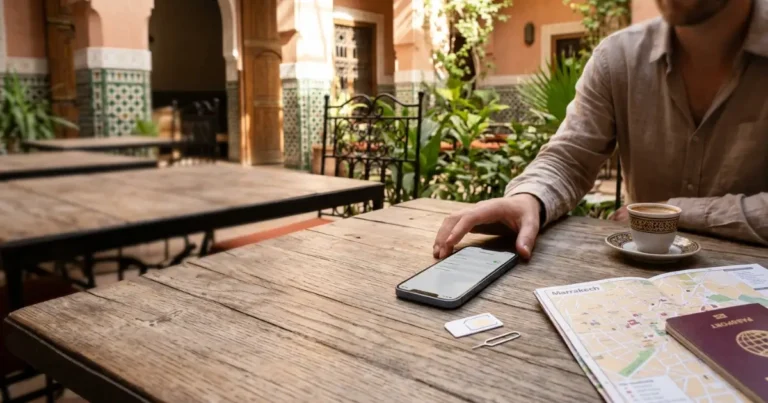
Once purchased, you’ll receive a QR code by email or in-app. Scan it while still connected to Wi-Fi at home , this installs the eSIM profile on your phone, though it typically won’t start counting against your data allowance until you activate it on arrival. Installing before departure rather than waiting until you land means one less thing to figure out once you’re jet-lagged and navigating an unfamiliar airport.
Switch to Mobile Data
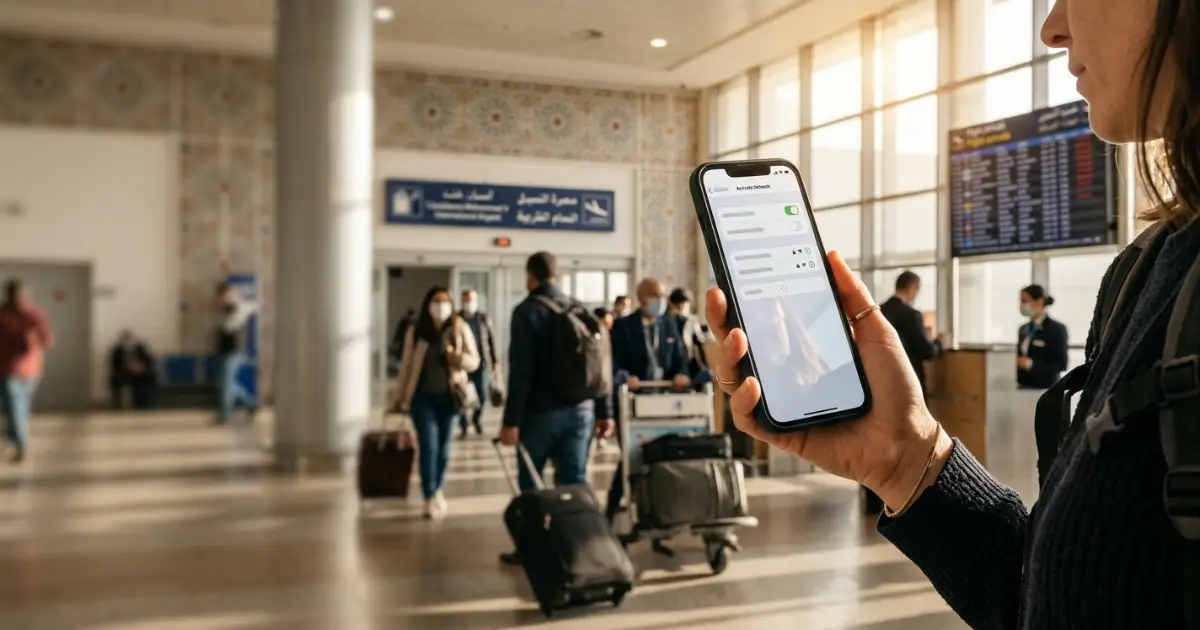
After landing in Morocco, go into your phone’s settings, set the new eSIM as your active data line (keeping your home SIM active for calls and texts if you’re using a dual-SIM setup), and enable data roaming for that specific eSIM profile, this last step trips up more first-time eSIM users than any other, since roaming is usually off by default even after the profile is installed correctly. If data doesn’t connect within a few minutes of landing, toggling airplane mode on and off often forces the phone to re-register with the local network.
eSIM vs Physical SIM Card in Morocco
Advantages of eSIM
An eSIM installs before you fly, meaning you land already connected with no need to find a phone shop, navigate a purchase in French or Arabic, or risk losing a small SIM card during the swap. It’s also the more convenient option for short trips where the setup time of a physical SIM purchase isn’t worth the marginal savings, and it avoids any risk of damaging your phone’s SIM tray or losing your home SIM card while it’s removed and stored somewhere during the trip.
Advantages of Local SIM Cards
A physical SIM bought from a Maroc Telecom, Orange, or inwi shop after arrival is often noticeably cheaper per gigabyte, particularly for data-heavy or longer trips, and it can include a real Moroccan phone number for local calls and texts, which eSIM providers generally don’t offer. The trade-off is time spent finding a shop, a language barrier at the counter in less touristy areas, and needing your passport for the mandatory registration , a legal requirement for any SIM purchase in Morocco, regardless of carrier. For travelers who need a local number to coordinate with a tour operator, riad, or driver, this advantage alone can outweigh the eSIM’s convenience.
Coverage Across Morocco
Marrakech
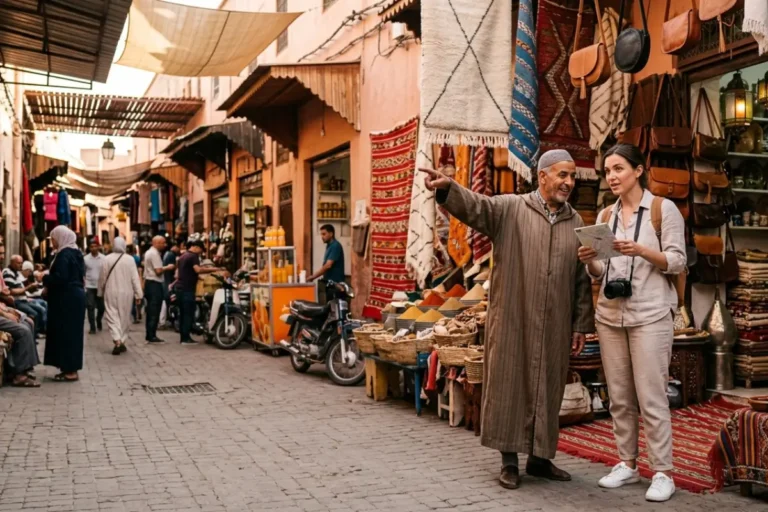
Coverage in Marrakech is excellent across all major providers and networks, including deep inside the medina and souks, where 4G holds up reliably throughout the day. Even in the narrowest alleyways of the old city, signal drops are rare and brief rather than a genuine connectivity problem.
Casablanca
As Morocco’s largest city and commercial hub, Casablanca has the country’s strongest and most consistent network coverage on all three carriers, including growing 5G availability in parts of the city, though as noted earlier, most eSIM plans currently cap out at 4G regardless of local 5G infrastructure.
Fes
Fes performs similarly well to Marrakech, with reliable 4G throughout the city and medina on Orange and Maroc Telecom alike. Fes el-Bali’s dense, ancient street layout doesn’t meaningfully affect signal the way it can disorient GPS accuracy, so navigation apps generally work well even in the medina’s tightest corners.
Chefchaouen
Chefchaouen’s blue medina has surprisingly strong 4G coverage despite its mountain setting, making it one of the more reliably connected smaller cities on a typical Morocco itinerary. The town’s relatively compact size and its position along a well-served mountain corridor both help explain why coverage here outperforms what its remote-feeling setting might suggest.
Atlas Mountains
Coverage in the Atlas becomes noticeably patchier once you leave main roads and larger towns, with Maroc Telecom generally holding a stronger signal than Orange in valley villages and along trekking routes. Dead zones are common on remote trail sections regardless of provider, and travelers on a multi-day trek toward Mount Toubkal should expect stretches of a full day or more with no signal at all, particularly above the tree line.
Sahara Desert
The desert is where coverage becomes most unpredictable. Popular desert camps and gateway towns like Merzouga typically have workable signal, but genuinely remote dune areas between settlements frequently have no coverage at all, on any network or provider. Downloading offline maps before leaving paved roads is essential for any Sahara excursion, regardless of which eSIM you’re using, and it’s worth telling your riad or accommodation ahead of time if you’ll be unreachable for a stretch of the desert leg of your trip.
Tips for Using an eSIM in Morocco
Download Offline Maps
Download offline Google Maps or Maps.me sections for your full route before you travel, since desert and mountain dead zones are common enough that relying entirely on live data for navigation is a real risk on certain legs of a trip. This takes only a few minutes at home on Wi-Fi and removes one of the more genuinely stressful scenarios a traveler can face , losing navigation in an unfamiliar area with no signal to fall back on.
Monitor Your Data Usage
For capped plans, checking usage periodically through the provider’s app avoids an unwelcome surprise mid-trip, particularly if your itinerary includes heavier data days like uploading photos or video from a desert camp with a rare good connection. Most providers send a notification as you approach your data limit, but checking manually every few days is a good habit regardless.
Enable Data Roaming
This is the single most common eSIM setup mistake , the profile installs correctly, but data roaming stays switched off for that specific eSIM line, leaving travelers with no connection until they dig into settings to find the toggle. On iPhone, this is typically found under Settings > Cellular > [eSIM line] > Data Roaming, while Android’s exact menu path varies slightly by manufacturer.
Keep Wi-Fi Enabled
Most riads and hotels offer Wi-Fi, and leaving it enabled alongside your eSIM lets your phone automatically switch to Wi-Fi when available, preserving your mobile data allowance for the moments you’re actually out and about. This simple habit alone can meaningfully stretch a smaller data plan across a longer trip, since a surprising amount of daily data use happens passively through background app updates and syncing that Wi-Fi handles for free.
Best eSIM for Morocco: Frequently Asked Questions
Does Morocco Support eSIM?
Yes, Morocco’s three major networks (Maroc Telecom, Orange, and inwi) all support eSIM-based connections, and every provider covered in this guide operates reliably across the country’s cities and main tourist routes. eSIM adoption among Moroccan carriers themselves is still less developed than among international travel eSIM providers, so most Moroccans still use physical SIMs, but this has no bearing on how well a visiting traveler’s eSIM performs.
Can I Use My eSIM Immediately After Landing?
Yes, provided you installed the profile and enabled data roaming before or shortly after arrival , most eSIMs connect automatically the moment your phone detects a Moroccan network, without needing to visit a shop or activate anything in person. If it doesn’t connect within the first few minutes, restarting your phone or toggling airplane mode usually resolves it.
Which eSIM Has the Best Coverage?
Ubigi currently offers the broadest coverage thanks to its dual-network setup on both Maroc Telecom and Orange, making it the strongest single choice for a trip that mixes cities with rural or desert legs. For city-only itineraries, coverage differences between providers are minimal, and the choice comes down more to price and data allowance than any meaningful gap in signal quality.
Is an eSIM Worth It in Morocco?
For most short-to-medium trips, yes , the convenience of landing already connected outweighs the modest savings a physical SIM might offer for a week or two of typical use. For longer stays or heavy data needs, comparing the cost against a locally purchased SIM is worth the extra ten minutes of research, particularly once a trip stretches past two or three weeks and the per-gigabyte math starts to favor a local option.
Final Thoughts: Best eSIM for Morocco
The right eSIM for your Morocco trip comes down to two questions: how much data you’ll realistically use, and which regions your itinerary actually covers. City-and-coast trips have the luxury of choosing on price alone, since Orange-based providers like Nomad and Airalo perform well there.
Anything touching the Atlas or the Sahara is worth paying slightly more for Maroc Telecom coverage through Ubigi or Holafly, since a cheaper plan with no signal isn’t actually cheaper once you’re standing in a mountain village unable to find your riad. Match the provider to the route, download your offline maps regardless of which you choose, and connectivity becomes one less thing to think about for the rest of the trip.