Chefchaouen Budget Guide (2026): How Much a Trip Really Costs + Ways to Save
Chefchaouen is consistently one of the more affordable stops on a Morocco itinerary, and its best-known attraction the blue medina itself happens to be completely free to enjoy. That combination makes it a genuinely easy place to travel on almost any budget, though costs still shift noticeably depending on where you sleep, eat, and how you get around.
Chefchaouen Budget Guide breaks down real prices for accommodation, food, transport, and activities, along with sample trip costs for one, two, and three nights, and concrete ways to save without cutting out the experiences that actually make Chefchaouen worth visiting.
How Much Does Chefchaouen Cost Per Day?
Daily costs in Chefchaouen split fairly cleanly into three familiar tiers, and unlike some Moroccan destinations, the gap between them isn’t dramatic a mid-range day here still feels genuinely affordable by international standards.
Budget Travel: Around 300–400 MAD a Day
A budget day covers a hostel dorm or simple guesthouse room, mostly local cafés and street food, walking rather than taxis, and free sightseeing. It’s a realistic, comfortable figure rather than a bare-minimum survival budget, and it still leaves a little room for the occasional treat like a fresh orange juice on the walk up to the Spanish Mosque.
Mid-Range Travel: Around 600–900 MAD a Day
Mid-range travel adds a private room in a proper riad, a mix of local and nicer restaurants, occasional taxis, the Kasbah entrance fee, and a shared taxi to Akchour for a day of hiking. This is where most first-time visitors comfortably land, since it covers a genuinely nice riad without stretching into luxury pricing.
Luxury Travel: 1,500 MAD+ a Day
At the top end, this covers a boutique riad or the town’s small handful of higher-end properties, dining at the better rooftop restaurants, a private driver for day trips, and any spa or hammam add-ons. Even at this tier, Chefchaouen remains considerably cheaper than an equivalent luxury stay in Marrakech.
Chefchaouen Travel Costs Explained
Breaking costs down by category makes it easier to see exactly where your money goes on a typical Chefchaouen trip, and which categories offer the most room to adjust up or down.
Accommodation: What You’ll Pay Per Night
Hostel dorm beds generally run 80–120 MAD, basic private rooms in simple guesthouses 200–350 MAD, mid-range riads with a rooftop terrace 350–700 MAD, and the town’s boutique or luxury properties 1,000 MAD or more. Chefchaouen’s riads are consistently cited as some of the best value in the country, often delivering courtyard architecture and rooftop views well above what the price would suggest elsewhere, since the town’s smaller tourist footprint hasn’t yet pushed prices up the way Marrakech’s medina has.
Food: From Local Cafés to Rooftop Restaurants
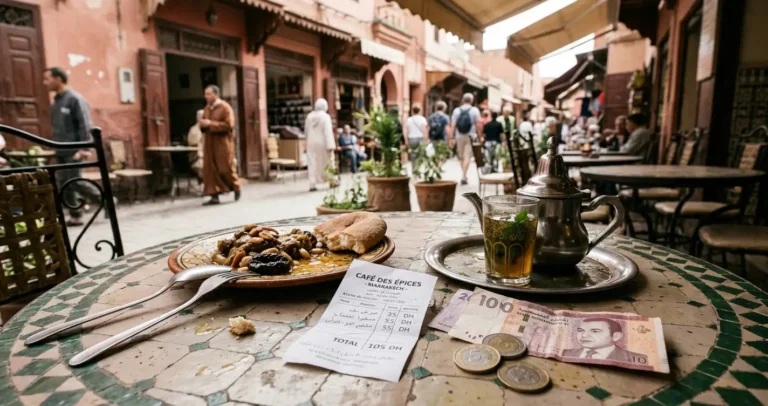
A simple local breakfast or a street food snack costs 10–25 MAD, a full meal at a local café or casual restaurant runs 40–80 MAD, and dinner at one of the rooftop restaurants overlooking the medina typically costs 80–180 MAD per person. Moving even one or two streets away from Plaza Uta el-Hammam tends to cut prices noticeably for a very similar meal, since the premium at the busiest tables is mostly for the view rather than dramatically different food.
Transportation: Buses, Taxis and Getting Around
The medina itself is entirely walkable and free. A shared grand taxi seat to Akchour typically costs 15–25 MAD each way, while chartering a full taxi privately runs 150–250 MAD round trip. Intercity travel by CTM bus to Tangier, Fes, or Rabat generally costs 50–120 MAD depending on distance, and booking a day or two ahead during peak season helps secure a seat on the more popular routes. Shared taxis for the Akchour route depart from a fixed stand near the edge of the medina, and drivers typically wait until the car fills before leaving, so building a little flexibility into your morning schedule avoids frustration.
Attractions and Activities: What Is Free and What Costs Money
Nearly everything that makes Chefchaouen worth visiting the medina, Plaza Uta el-Hammam, the walk to the Spanish Mosque, Ras El Maa costs nothing. The Kasbah museum is the main paid attraction, at around 60–70 MAD, and a hammam visit typically runs 50–150 MAD depending on the level of service, with the more basic local hammams sitting well below the spa-style versions attached to boutique riads. A guided hike to Akchour, if you’d rather not navigate the trails independently, typically adds another 100–250 MAD per person on top of the shared taxi fare.
Shopping and Souvenirs: How Much to Set Aside
Handwoven wool blankets and rugs, Chefchaouen’s signature craft, range from around 150 MAD for a small piece to 500 MAD or more for a larger, more detailed weaving. Setting aside 300–600 MAD covers a reasonable amount of souvenir shopping without a major splurge, and prices are generally negotiable, particularly for larger purchases or when buying more than one item from the same shop. Small leather goods, ceramics, and spices also make lightweight, inexpensive souvenirs, typically costing 20–80 MAD depending on size and quality.
How Much Does a Trip to Chefchaouen Cost?
These totals combine accommodation, food, local transport, and a typical mix of free and paid activities, giving a realistic all-in figure for a short stay rather than just a per-night room rate.
One Night in Chefchaouen
A single night, including accommodation, food, and a bit of sightseeing, typically totals 400–1,200 MAD depending on comfort level, though a one-night stay leaves little time for anything beyond the medina itself and is generally considered too rushed to see the town properly. Travelers passing through on a tight itinerary sometimes still choose this option purely to break up a long drive between Tangier and Fes, even knowing it means skipping Akchour entirely.
Two Nights in Chefchaouen
Two nights, the realistic sweet spot for most travelers, typically runs 900–2,500 MAD, covering the medina at a relaxed pace and a half-day trip to Akchour, which most travelers consider the minimum needed to get a genuine feel for the town. This is also the length of stay most riads and guesthouses seem set up for, with many offering a small discount for a second consecutive night.
Three Nights in Chefchaouen
Three nights, allowing a slower pace and more time in the surrounding mountains, generally totals 1,400–3,800 MAD, scaling with whichever comfort tier you’re traveling at, and gives enough flexibility to split the Akchour hikes across two separate outings rather than rushing both in one day. This length also leaves room for a genuinely unhurried day with no fixed plan, simply wandering the medina’s quieter upper streets.
What Can You Do for Free in Chefchaouen?
Unusually for a well-known tourist destination, most of what draws people to Chefchaouen in the first place doesn’t cost anything at all.
Exploring the Blue Medina
Simply wandering the blue-washed lanes costs nothing and is genuinely the best thing to do in Chefchaouen, free or otherwise, since much of the town’s appeal comes from the walking itself rather than any single paid attraction. Setting aside a couple of unstructured hours, without a fixed destination in mind, tends to produce the most memorable part of a visit here.
Walking to the Spanish Mosque
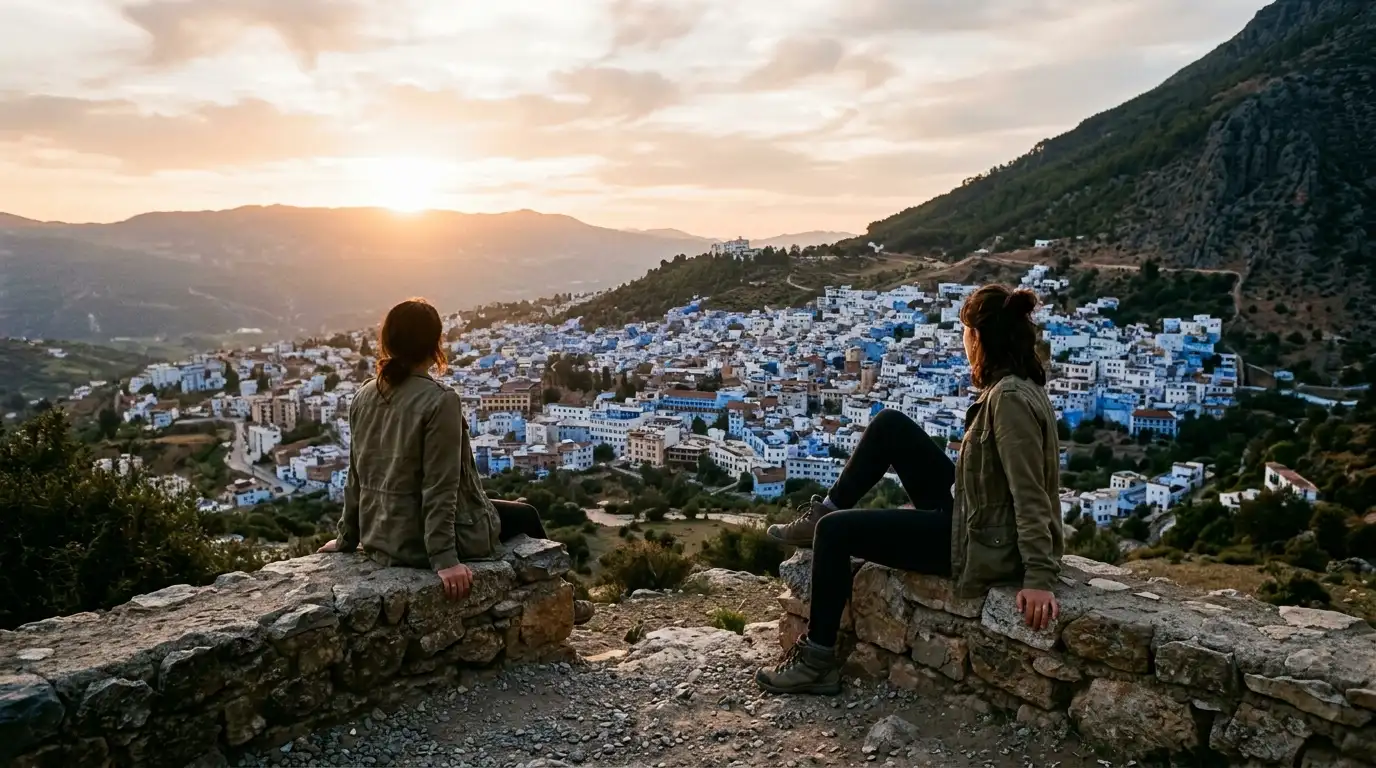
The roughly 20-minute uphill walk to this sunset viewpoint is free, with only the optional orange juice from stalls along the way as a cost worth budgeting for, and the view at the top rivals anything a paid attraction in the country could offer. Timing the walk to arrive 20–30 minutes before sunset gives enough time to find a good spot along the low wall before the crowd builds.
Visiting Ras El Maa
The spring and cascades at the medina’s edge cost nothing to visit and make a peaceful, low-cost stop between other sightseeing, particularly in the warmer months when the sound of moving water offers a genuine break from the heat.
Exploring the Medina’s Streets and Squares
Plaza Uta el-Hammam, the exterior of the Grand Mosque, and the countless quieter blue alleys throughout the medina are all free to wander and photograph, and spending an unhurried afternoon simply sitting with a mint tea and watching daily life go by costs little more than the tea itself.
10 Smart Ways to Save Money in Chefchaouen
Most of the real savings here come from a handful of simple habits rather than any dramatic sacrifice in comfort or experience.
Book Accommodation Outside Peak Periods
Rates drop noticeably outside the busiest spring and summer months, so traveling in the shoulder or winter months can meaningfully cut accommodation costs, sometimes by as much as a third compared to peak spring pricing.
Eat Away From the Most Tourist-Focused Squares
Restaurants directly on Plaza Uta el-Hammam charge a premium for the view; walking a street or two away typically gets a similar meal for considerably less, often served to a room full of locals rather than mostly visitors.
Walk Whenever You Can
The medina is compact enough that walking covers nearly everything within it, so taxis are rarely necessary except for trips beyond the town itself, and the savings add up quickly over a multi-day stay.
Use Shared Taxis for Longer Trips
A shared grand taxi seat to Akchour or a nearby town costs a fraction of chartering a private vehicle, and it’s the standard way locals get around too, so there’s no need to feel like you’re missing out on comfort by choosing it.
Choose Free Sights and Walks
Since Chefchaouen’s best experiences the medina, the Spanish Mosque, Ras El Maa are already free, prioritizing them over paid extras naturally keeps costs down without sacrificing much of the real experience, and in many cases these free sights are exactly what draws people to the town in the first place.
Is Chefchaouen Expensive Compared With Other Moroccan Destinations?
No Chefchaouen is consistently one of the more affordable stops on a Morocco itinerary, generally cheaper than Marrakech and roughly comparable to or slightly below Fes for similar quality accommodation and food. Its small scale and lower tourist density compared to the bigger imperial cities also mean less of the persistent, premium pricing found around Marrakech’s busiest medina squares. Travelers moving between cities on a longer Morocco trip often notice the difference immediately once they arrive from Marrakech, with similar riads and meals costing noticeably less in Chefchaouen.
Chefchaouen Budget Guide FAQ
How much money do you need per day in Chefchaouen?
Budget travelers can manage on roughly 300–400 MAD a day, mid-range travelers around 600–900 MAD, and luxury travelers 1,500 MAD or more, depending mainly on accommodation choice.
Is Chefchaouen cheap to visit?
Yes, it’s consistently regarded as one of the more affordable towns in Morocco, with genuinely free highlights and lower accommodation costs than Marrakech or Fes for a comparable level of comfort.
How much does accommodation cost in Chefchaouen?
Hostel dorms run 80–120 MAD, budget private rooms 200–350 MAD, mid-range riads 350–700 MAD, and luxury properties 1,000 MAD or more per night.
How much does food cost in Chefchaouen?
A local café meal typically costs 40–80 MAD, while a rooftop restaurant dinner overlooking the medina generally runs 80–180 MAD per person, with street food and simple breakfasts costing considerably less than either.
Can you visit Chefchaouen on a tight budget?
Yes between free sightseeing, inexpensive local food, and affordable guesthouses, a genuinely comfortable trip is realistic on 300–400 MAD a day, without feeling like you’re missing out on the town’s main appeal.