Can You Pay in Euros or Dollars in Morocco? 9 Essential Currency Tips
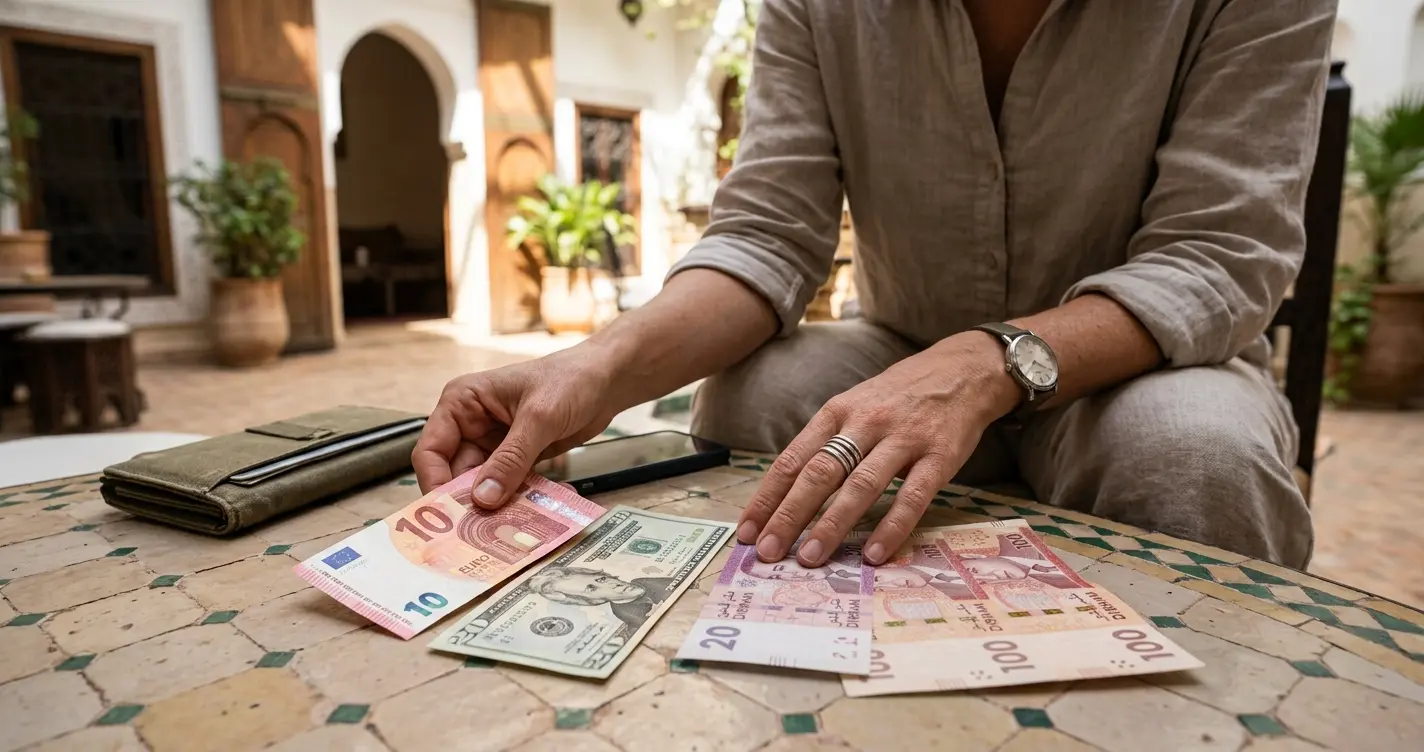
Can you pay in euros or dollars in Morocco? Sometimes, but not reliably, and not at a rate that works in your favour. The Moroccan dirham is the currency of everyday life, and relying on euros or dollars in place of it is one of the quickest ways to lose money on a trip. A souvenir seller may happily take your euros and quietly set an exchange rate to suit himself. A petit taxi driver will probably ask for dirhams and have no change for a banknote from abroad.
This guide explains where foreign currency may be accepted informally, why dirhams are usually the better choice, how to get them, and how to avoid the common mistakes. Acceptance varies by business, and informal acceptance does not make euros or dollars an official payment currency, so treat everything here as a guide to likely situations, not a promise.
Can You Pay in Euros or Dollars in Morocco?
In most everyday situations, you should plan to pay in Moroccan dirhams. Some tourist-focused businesses will accept euros, and a few may accept dollars, but they are not required to, and the exchange rate is whatever they decide.
Is the Moroccan Dirham the Main Currency?
Yes. Prices in shops, restaurants, taxis and markets are set in dirhams (MAD), and receipts and fares are issued in dirhams. The dirham is also a restricted currency, which means it is difficult to buy outside Morocco and hard to exchange once you leave. Most visitors get theirs after they arrive.
Do Shops and Restaurants Accept Euros or Dollars?
Some do, especially in tourist areas, but acceptance depends on the business. A shop in a popular medina may take euros for a larger purchase, while a local café or street stall will not. Where foreign currency is accepted, the seller sets the exchange rate, and it is often worse than a bank’s.
Can You Pay in Foreign Currency at Hotels and Riads?
Some hotels and riads quote prices in euros, particularly in booking confirmations, but on-site payment is normally made in dirhams or by card. Ask how and in which currency you will pay before you arrive, and check the final amount in writing.
Why You Should Not Rely on Euros or Dollars for Everyday Purchases
Foreign cash cannot cover taxis, street food, small shops, tips or rural stops. It also exposes you to rounded-up prices, change in dirhams at an unfavourable rate and confusion about what you are actually paying. Dirhams make every price clear.
Where Might Euros Be Accepted in Morocco?
Euros are the foreign currency you are most likely to find accepted, because Europe sends many of Morocco’s visitors. Acceptance remains informal and depends on who you are paying.
Tourist Hotels and Upscale Accommodation
Some tourist hotels and upscale accommodation accept euros, or quote them for bookings and extras. Even then, you may be asked to settle in dirhams or by card. Confirm the currency and the rate in advance.
Private Tours and Tourist-Focused Businesses
Private tour operators, drivers and some excursion providers deal with foreign visitors every day and may take euros for tours or deposits. Agree the price and the currency before you commit, and ask for a receipt.
Souks and Shops in Popular Tourist Areas
In busy tourist areas, a shopkeeper may accept euros for larger purchases. The rate is negotiable and usually favours the seller, so it is often cheaper to pay in dirhams.
Why Acceptance Depends on the Business
There is no general rule. Acceptance changes from stall to stall, even in the same street. A business that took euros yesterday may not take them today, and a smaller one may refuse them altogether.
Can You Use US Dollars in Morocco?
Less often than euros. Dollars are more familiar in some exchange offices than in shops, and informal acceptance is rarer.
How Dollar Acceptance Differs From Euro Acceptance
Euros are more commonly encountered because of Morocco’s links with Europe. Dollars are more widely recognised at banks and exchange offices than at market stalls or taxis. Do not expect the same informal acceptance.
Where You Might Encounter Dollar Prices
You may see dollar prices for some tours, activities and online bookings aimed at international visitors. Even then, payment is often by card or in dirhams, so check how the price is converted.
Why You Should Convert Dollars Before Relying on Them
Exchange dollars into dirhams at a bank or licensed exchange office before you start spending. That avoids rates set by individual sellers and leaves you with money every business accepts.
Why Paying in Moroccan Dirhams Is Usually Better
Dirhams make prices simpler and costs clearer.
Avoiding Unfavourable Exchange Rates
A seller who accepts euros or dollars sets the exchange rate, and it often includes a margin. Dirhams from an ATM or a bank give you a transparent rate, and your bank’s conversion is usually closer to the market rate.
Knowing the Actual Price of What You Buy
When you pay in dirhams, you see the real price and can compare it with other sellers. Paying in a foreign currency adds a conversion step that makes comparison harder, and that is where a margin can hide.
Making Small Purchases Without Payment Confusion
Taxis, snacks, water and tips are small, frequent payments. Handling them in dirhams is quicker and avoids awkward exchanges at the till.
Avoiding Problems With Change and Refunds
If you pay with a foreign banknote, change is almost always given in dirhams at the seller’s rate. A refund or a disagreement over the amount is harder to resolve when the rate is unclear.
Should You Exchange Euros or Dollars Into Moroccan Dirhams?
Yes, for most travellers, and it is simple to do. Our guide to ATMs in Morocco covers withdrawals in detail.
Exchanging Cash at Banks and Licensed Exchange Offices
Banks and licensed exchange offices (bureaux de change) are the safest places to exchange cash. Compare the rate and any commission, check the amount you will receive before you hand over your money and keep the receipt. Avoid exchanging money on the street.
Withdrawing Dirhams From ATMs
ATMs are often the most convenient source of dirhams, since they work at any hour in most cities and use your card network’s rate. Choose dirhams if a machine offers to charge you in your home currency. See our ATM guide for fees and tips.
Exchanging Money at the Airport
Airport exchange desks are convenient for a small first amount, such as a taxi and a meal. Rates and commissions at airports vary and can be less favourable than in town, so avoid exchanging your whole budget there.
Comparing Exchange Rates and Fees
Compare the final number of dirhams you would receive for the same amount, not just the advertised rate. Add any commission or ATM fee to the comparison. A small difference in rate matters less than a flat fee on a small amount.
Can You Pay in Euros or Dollars in Morocco for Taxis, Souks and Restaurants?
For these everyday payments, plan on dirhams.
Petit Taxis and Grand Taxis
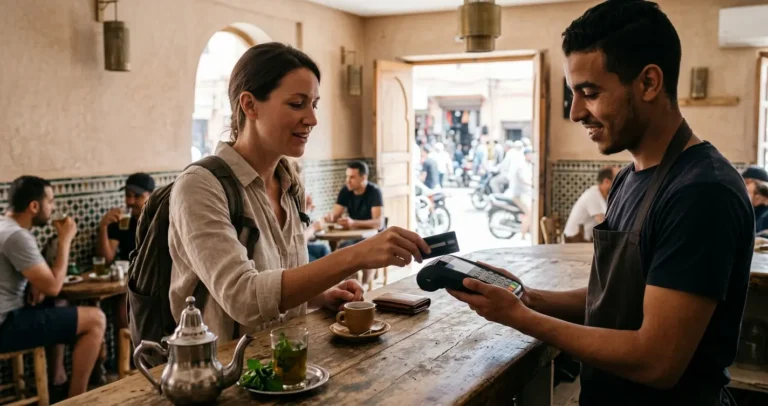
Petit taxis and grand taxis expect dirhams. Drivers are unlikely to accept foreign currency, and they often carry limited change. Keep small notes ready.
Traditional Souks and Small Shops
In souks and small shops, dirhams are the norm, and bargaining is done in them. Some shopkeepers will accept euros for larger purchases, but you will rarely get a better deal than by paying in dirhams.
Street Food Stalls and Local Restaurants
Street food stalls and local restaurants take dirhams. Foreign currency is unlikely to be accepted, and the amounts are too small to make sense.
Tips and Small Everyday Purchases
Tips are best given in dirhams. A foreign coin is less useful to the recipient, and small notes and coins are easy to carry.
Rural Towns and Remote Destinations
Villages, mountain areas and desert camps rely on dirhams. Foreign currency is even less likely to be accepted, and exchange options may not exist. Withdraw or exchange in a larger town before you go. Our cash budgeting guide helps you estimate how much to carry.
Can You Pay in Euros or Dollars in Morocco for Hotels, Tours and Larger Expenses?
Larger payments follow different rules. They are usually made by card or online, or in dirhams, and sometimes in foreign currency by agreement.
Paying for Riads and Hotels
Many hotels and riads accept cards, and some accept cash in dirhams. A few may take euros by arrangement. Check the payment method and currency in your booking confirmation, and ask for a receipt.
Booking Desert Tours and Excursions
Tour operators may quote prices in euros or dollars, but the payment method varies. Some take a card deposit, with the balance paid in dirhams, while others prefer cash. Agree the price, the currency and the payment schedule in writing.
Paying for Rental Cars and Transport
Car rental companies generally want a credit card for the deposit, and they set the rental price in dirhams or a stated currency. Trains and buses are paid in dirhams or by card. Check the details before you travel.
When to Use a Credit or Debit Card Instead
For hotels, larger meals, tours and car rentals, a card is often simpler. If the terminal offers a choice of currency, choose dirhams. Our guide to using cards in Morocco explains fees and acceptance.
Should You Bring Euros or US Dollars to Morocco?
Bring a small amount of foreign cash as a backup, if you like, and plan to get most of your dirhams after arrival.
Which Currency Is More Convenient to Exchange?
Euros are widely recognised at banks and exchange offices, and dollars are also commonly exchanged in tourist cities. Both are easier to change than less common currencies. Check the rates and commission before you exchange.
Bringing Cash vs. Withdrawing Dirhams After Arrival
Withdrawing dirhams from an ATM is usually simpler than carrying a large amount of foreign cash. A small amount of euros or dollars is useful as a backup if your card is blocked. Do not bring more than you are comfortable carrying.
What to Check Before Exchanging Foreign Banknotes
Check the rate, any commission and the condition of your notes. Damaged, old or heavily creased banknotes can be refused or exchanged at a worse rate, so bring clean ones. Count the dirhams you receive before you leave the counter, and keep the receipt.
Why Bank Cards Can Be a Useful Backup
A bank card and an ATM give you access to dirhams without carrying large amounts of cash. Bring more than one card if you can, and keep them in separate places.
Common Currency Mistakes to Avoid in Morocco
These mistakes are easy to make and easy to avoid.
Assuming Euros and Dollars Are Accepted Everywhere
Foreign currency is accepted only informally, and only by some businesses. Assume you need dirhams, and treat foreign currency as a bonus.
Accepting an Unclear Exchange Rate
If a seller offers to take euros or dollars, ask for the rate before you agree. If it is unclear or poor, pay in dirhams instead.
Paying in Foreign Currency Without Checking the Final Price
Check the final price in dirhams and compare it with the foreign-currency price. A rounded-up amount can hide a margin.
Exchanging Too Much Money at Once
Exchanging a large sum at once makes a poor rate or a loss more costly, and leaves you with dirhams you may be unable to change back. Exchange in stages, and keep your receipts.
Forgetting to Keep Smaller Dirham Banknotes
Large notes are hard to break at taxis, small shops and cafés. Break them at supermarkets, hotels and larger restaurants, and keep small notes and coins for everyday use.
Frequently Asked Questions About How to Pay in Euros or Dollars in Morocco
Can You Pay in Euros in Morocco?
Sometimes. Tourist-focused hotels, tours and shops may accept euros informally, but they are not required to, and the exchange rate is set by the seller. Most everyday payments, such as taxis, street food and small shops, need dirhams. Treat euros as a backup, not a plan.
Can You Pay in US Dollars in Morocco?
Less often than euros. Some tourist-focused businesses may take dollars, but acceptance is rarer and the rate is usually worse. Convert dollars into dirhams at a bank or licensed exchange office before you rely on them.
Should I Bring Euros or Dollars to Morocco?
You can bring a small amount of either as a backup, and both are easy to exchange at banks and exchange offices. For most travellers, withdrawing dirhams from an ATM after arrival is simpler than carrying a lot of foreign cash.
Can I Use Euros in Marrakech’s Souks?
Some stallholders in busy tourist areas may accept euros, especially for larger purchases, but the rate is set by the seller and usually favours them. Paying in dirhams is generally cheaper and clearer.
Do Moroccan Hotels Accept Euros?
Some tourist hotels and riads quote prices in euros or accept them by arrangement, but many expect payment in dirhams or by card. Ask about the payment method and currency before you arrive, and check the amount in writing.
Can You Exchange Dollars for Moroccan Dirhams?
Yes. Banks and licensed exchange offices commonly exchange dollars, particularly in cities and tourist areas. Compare the rate and any commission, and keep the receipt.
Is It Better to Exchange Money or Use an ATM in Morocco?
For most visitors, an ATM is the simplest way to get dirhams, though fees apply. Exchange offices suit foreign cash you already carry. Compare the final number of dirhams you would receive in each case.
Do You Need Moroccan Dirhams Before Arriving?
Not necessarily. The dirham is a restricted currency and is easier to get after you arrive, through ATMs, banks and exchange offices. If you want a small amount for your first taxi, an airport ATM or exchange desk can provide it.
Can You Take Moroccan Dirhams Out of the Country?
Only a small amount. Moroccan customs guidance states that the import and export of dirhams is limited to 2,000 MAD, though some secondary sources quote different figures, so check the current rules with Moroccan customs before you travel. Dirhams are hard to exchange outside Morocco, so reconvert leftover money at an authorised bank or exchange office before you leave, and keep your receipts. Foreign currency amounts of 100,000 MAD or more (or the equivalent) must be declared.
Final Advice: Should You Pay in Euros or Dollars in Morocco?
For most purchases, no. You may be able to pay in euros or dollars in Morocco at some tourist-focused businesses, but dirhams give you clearer prices, better rates and fewer problems. These nine tips bring the advice together:
- Plan on dirhams for taxis, food, souks, tips and anywhere outside the main tourist areas.
- Treat euros and dollars as a backup, not a payment plan, since acceptance is informal.
- Get dirhams after you arrive, since the currency is restricted and easier to obtain in Morocco.
- Use ATMs and licensed exchange offices, and avoid street money changers.
- Compare the final number of dirhams you would receive, including fees and commission.
- Check the rate and the final price before you agree to pay in foreign currency.
- Choose dirhams if a card terminal or ATM offers to charge you in your home currency.
- Keep small notes and coins, and exchange in stages instead of all at once.
- Spend or reconvert your dirhams before leaving, keep your receipts and check the current customs limit.
With these habits, currency becomes one of the easier parts of your trip. Check current exchange rules and your bank’s terms before you travel, and carry dirhams for everyday spending.