How to Travel Between Morocco’s Major Cities (2026): The Complete Transportation Guide
Figuring out how to travel between Morocco’s major cities is usually the first real planning decision a trip comes down to, and the honest answer is that no single option wins every leg. Trains handle the Tangier-Casablanca-Marrakech-Fes corridor brilliantly, buses reach everywhere the rails don’t, and a private driver or a rental car earns its keep the moment your route bends toward the Atlas or the Sahara.
This guide breaks down every transport option available, matches routes to the right mode of travel, and gives you real prices and journey times so you can build an itinerary that actually works. By the end, you’ll know exactly which option fits each leg of a typical Morocco trip, rather than defaulting to one mode of transport for the entire journey.
How to Travel Between Morocco’s Major Cities: The Quick Answer
What’s the Best Way to Travel Around Morocco?
For the Tangier-Casablanca-Rabat-Marrakech-Fes corridor, the train wins outright , it’s fast, comfortable, and the motorway traffic it bypasses makes it genuinely quicker than driving yourself. For everywhere else , Chefchaouen, Essaouira, Ouarzazate, the Sahara gateways , buses from CTM or Supratours fill the gap reliably. A private driver or rental car makes the most sense once your itinerary includes the Atlas Mountains or a Sahara excursion, where public transport either doesn’t reach or takes considerably longer than the drive itself.
Which Transportation Option Is Right for You?
The right choice depends less on personal preference and more on your specific route. A trip staying entirely within the rail corridor barely needs to consider anything else. A trip that adds Chefchaouen, Essaouira, or a Merzouga desert stay needs buses or a private transfer for those specific legs. And any itinerary built around flexibility , stopping at small kasbahs, adjusting the plan day to day , genuinely benefits from a rental car or driver, since Morocco’s most scenic stretches often sit well off any train line or fixed bus route.
Travel by Train
ONCF Train Network
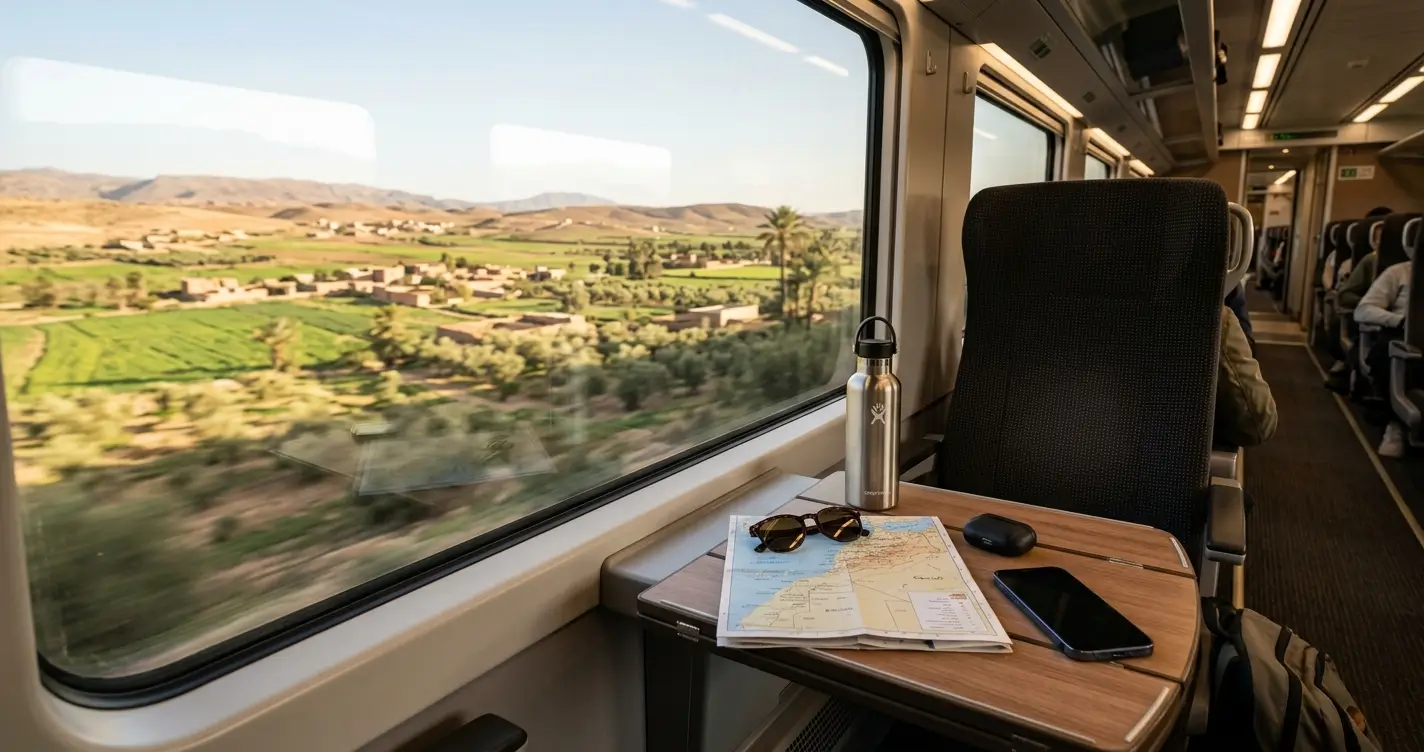
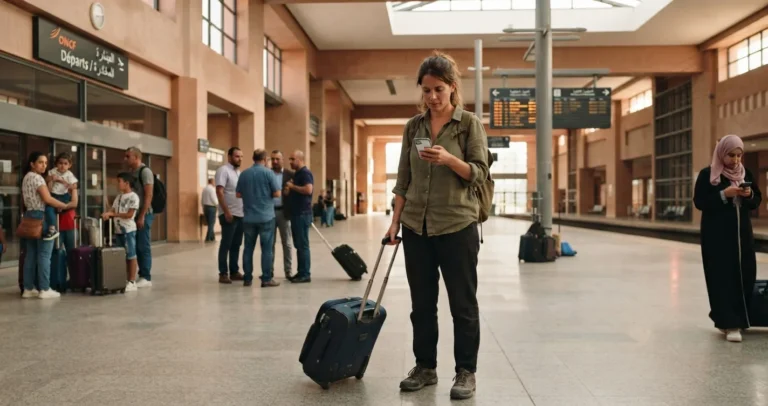
Morocco’s national railway, ONCF (Office National des Chemins de Fer), runs the most developed rail network in Africa, spanning roughly 2,100 kilometers and linking Tangier, Rabat, Casablanca, Meknes, Fes, Marrakech, and Oujda. Trains are air-conditioned, comfortable, and run frequently enough on the main corridor — often every one to two hours , that spontaneous travel between major cities rarely requires much advance planning. Stations in the larger cities also offer practical extras like luggage storage, which is useful for a late flight or an early checkout with hours still to fill before departure.
Al Boraq High-Speed Train
Al Boraq, launched in November 2018, is Africa’s first and still only high-speed rail line, connecting Tangier and Casablanca at speeds up to 320 km/h and cutting what used to be a five-hour journey down to about two hours and ten minutes. It also serves Rabat along the same corridor, roughly 1 hour 20 minutes from Tangier. ONCF has discussed extending the high-speed line further south toward Marrakech and Agadir and east toward Fes and Oujda, though these extensions remain in planning rather than operation as of 2026.
Routes Covered by Train
Beyond Al Boraq’s high-speed segment, conventional Al Atlas trains connect Casablanca to Marrakech in around 2 hours 40 minutes, and to Fes in roughly 3 hours 45 minutes. A Marrakech-to-Tangier journey runs around 5 hours 30 minutes to 6 hours with a change at Casablanca or Kénitra, while Fes to Marrakech directly is a longer haul near 7 hours, which is why many travelers split this route with an overnight stop in Casablanca or Rabat instead. What the train network doesn’t reach is just as important to know: there’s no rail service to the Sahara, the Atlas Mountains, Essaouira, or Chefchaouen, all of which require a bus, private transfer, or rental car.
Booking Train Tickets
Tickets can be booked online up to several months in advance through ONCF’s official site, oncf-voyages.ma, or in person at any station. Second-class fares generally start around 5 EUR for shorter hops, first class from around 10 EUR, and Al Boraq tickets from roughly 28 EUR, though prices climb closer to departure — a Casablanca-to-Marrakech first-class fare, for instance, can roughly double between a two-week advance booking and a same-day purchase. Booking a week or more ahead, especially around Eid, summer, and other peak periods, is worth the small effort for both better pricing and guaranteed seating.
Travel by Bus
CTM
CTM (Compagnie de Transports Marocains), operating since 1919, is Morocco’s largest and most established bus company, together with Supratours covering roughly 80% of the country’s express intercity routes. CTM buses are air-conditioned, generally reliable on schedule, and reach virtually every city and town of note, including many destinations the rail network never touches. Its overnight services, running reclining seats and AC on longer routes, are a genuinely practical way to cover a long distance while sleeping through most of it.
Supratours
Supratours operates as the transport subsidiary of the ONCF group, positioning itself as a slightly more premium alternative to CTM, with newer coaches, more legroom, and amenities like USB charging and Wi-Fi on select routes. It specializes in connecting rail stations to towns without train service , Essaouira, Agadir, Ouarzazate, and Merzouga among them , making it a natural complement to a train-based itinerary rather than a competitor to it. Because it’s part of the same group as ONCF, tickets for connecting Supratours legs can sometimes be booked alongside a train ticket in a single transaction.
Other Bus Companies
Beyond CTM and Supratours, a range of smaller regional operators serve the same routes at lower prices, though with less consistency on comfort, punctuality, and English-language support. For a first Morocco trip, sticking to CTM or Supratours is the more dependable choice, particularly for longer or overnight journeys.
When the Bus Is the Best Option
Buses are the clear choice for any city or town outside the rail corridor. Marrakech to Essaouira runs about 3 hours and 80-110 MAD ($8-11), Marrakech to Agadir about 3.5 hours and 120-150 MAD ($12-15), and Fes to Chefchaouen around 5 hours. Overnight services also run on longer hauls like Marrakech to Tangier, departing between 9pm and midnight and arriving the next morning, which can save a full day of travel time versus a daytime journey.
Travel by Rental Car
Who Should Rent a Car?
A rental car suits travelers who want genuine flexibility , stopping at small kasbahs, adjusting the itinerary day by day, or reaching villages in the Atlas foothills that no bus or train serves. It’s less essential for a trip confined to the main cities, where trains and taxis handle everything comfortably, and it’s worth knowing upfront that many rental agencies require drivers to be at least 23 and have held a license for two years. Renting through a local specialist rather than a large global aggregator often delivers better local road knowledge and more responsive support if something goes wrong mid-trip.
Driving Conditions in Morocco
Morocco drives on the right, and its toll autoroutes are genuinely excellent, comparable to European motorways. Conditions shift considerably once you leave them: city driving in Casablanca, Marrakech, and Fes can be chaotic and assertive, medina streets mix pedestrians, scooters, and the occasional cart in narrow lanes, and rural or mountain roads vary widely in quality.
Morocco enforces a zero-tolerance policy on drink-driving, and speed cameras are increasingly common on routes like Casablanca-Marrakech, with on-the-spot fines running roughly 300-600 MAD for infractions. Night driving outside cities is best avoided, given unlit vehicles, livestock, and potholes that are far harder to spot after dark. A valid license from your home country is generally accepted for a tourist stay, though an International Driving Permit is recommended and sometimes required by the rental company itself, particularly if your home license isn’t in French, Arabic, or Latin script.
Parking and Tolls
Autoroute tolls are distance-based and typically paid in cash at booths marked with a green arrow or cross , lanes marked “J” are reserved for a prepaid electronic tag and should be avoided unless your rental includes one. A Casablanca-to-Marrakech toll run costs roughly 70-90 MAD one way. Keeping smaller notes on hand makes both tolls and casual parking considerably easier, since attendants and booths don’t always have change for larger bills.
Travel by Private Transfer
Advantages of Private Transfers
A private driver removes every logistical question at once , no station, no timetable, no transfers, just a door-to-door journey at whatever pace and schedule suits you. For routes into the Atlas Mountains or toward the Sahara, where mountain passes and unfamiliar road conditions can make self-driving stressful, a private driver who already knows the route is often the more relaxing choice, even at a higher price than a bus or rental car. Many drivers also double as informal guides, pointing out roadside stops and viewpoints a self-driven trip might otherwise miss entirely.
When Private Transfers Are Worth It
Private transfers earn their cost most clearly on routes public transport doesn’t serve well, particularly Marrakech to Merzouga through the High Atlas, or any itinerary involving several stops in a single day. They’re also the practical choice for families and groups splitting the cost across several people, since the per-person price often lands close to a bus fare once divided, with far more comfort and flexibility included.
Travel by Domestic Flight
Royal Air Maroc Domestic Routes
Royal Air Maroc operates domestic routes connecting Casablanca with Marrakech, Fes, Agadir, and other regional airports, generally using Casablanca’s Mohammed V Airport as the main hub for connections. Flight times are naturally short , often under an hour in the air , though total door-to-door time needs to include airport transfers and check-in on both ends.
When Flying Makes Sense
Domestic flights make the most sense for genuinely long hauls where a flight saves the better part of a day compared to a train or bus, or for connecting two cities that aren’t on the same rail line at all. For most classic itineraries , Marrakech, Fes, Chefchaouen, the desert , the time saved rarely justifies the cost and airport hassle compared to the train or a well-planned road journey.
Popular Routes Between Morocco’s Major Cities
Casablanca to Marrakech
The train is the clear winner here: around 2 hours 40 minutes, comfortable, and free of the traffic that can slow a drive along the same corridor. First-class fares run roughly 190-280 MAD depending on how far ahead you book.
Marrakech to Fes
At around 7 hours direct by train, this is one of the longer rail journeys in the country, and many travelers split it with a night in Casablanca or Rabat rather than riding it in one sitting. A domestic flight is worth considering here specifically, given the distance involved.
Fes to Chefchaouen
No rail line reaches Chefchaouen, so this route runs by bus, roughly 5 hours with CTM or Supratours, or by private transfer for a more direct and flexible journey through the Rif Mountains scenery along the way.
Marrakech to Essaouira
A straightforward 3-hour bus ride through argan tree groves and coastal landscapes, priced around 80-110 MAD depending on the operator, and one of the most popular short routes for travelers adding a coastal stop to a Marrakech-based trip.
Marrakech to Merzouga
This route has no rail service and typically means an 8-9 hour bus journey via Errachidia with CTM, a shorter Supratours run to Ouarzazate followed by a grand taxi, or , far more commonly , a multi-day organized desert tour that breaks the drive into stops at Ait Benhaddou and the Dades Valley along the way. Given the distance and mountain-pass driving involved, most travelers choose a private driver or organized tour over self-driving this specific leg, both for the scenery stops along the route and the comfort of not tackling the Tizi n’Tichka pass without local road experience.
Tangier to Chefchaouen
A popular route for travelers arriving via the Spain ferry, typically covered by CTM or Supratours bus in around 2 to 2.5 hours, or by private transfer for a more direct trip up into the Rif Mountains.
Which Transport Option Is Best?
Best for Budget Travelers
Buses and second-class trains offer the lowest cost per kilometer, and combining CTM or Supratours for off-rail destinations with ONCF for the main corridor covers almost any itinerary affordably.
Best for Families
A private transfer or rental car tends to work best for families, since it avoids station waits and transfers with children or heavy luggage, and the per-person cost often compares reasonably once split across a group.
Best for Couples
Couples on a standard city-and-coast itinerary do perfectly well with trains and buses, saving a private transfer specifically for a desert excursion or a particularly remote stop.
Best for Luxury Travelers
Private drivers and domestic flights suit luxury travelers best, prioritizing comfort and time saved over the lower cost of public transport.
Best for Digital Nomads
Trains along the main corridor offer the most reliable Wi-Fi and workspace-like comfort for anyone needing to stay productive between cities, making Casablanca, Rabat, and Marrakech an easy base to work from with day trips by rail.
Travel Tips
Book Early During Peak Season
Trains and buses on popular routes sell out during Eid, school holidays, and the July-August peak, so booking a week or more ahead, and three to four weeks ahead for Al Boraq during the busiest summer weekends, is worth the effort.
Carry Cash for Small Expenses
Tolls, parking, and many bus tickets are easiest to pay in cash, and smaller notes matter more than usual, since change isn’t always readily available at booths or on board.
Download Offline Maps
Signal can be patchy on Atlas Mountain roads and remote desert routes regardless of your mobile provider, so offline maps are worth downloading before setting out on any longer road journey.
Allow Extra Travel Time
Morocco’s distances are larger than they look on a map, and mountain or desert routes in particular often take longer than a straight-line distance would suggest , building in buffer time avoids a rushed, stressful travel day.
How to Travel Between Morocco’s Major Cities: Frequently Asked Questions
Is Public Transportation Good in Morocco?
Yes, genuinely so. ONCF’s train network is comfortable, air-conditioned, and reasonably priced, and it covers the busiest tourist corridor ,Tangier, Rabat, Casablanca, Fes, and Marrakech , efficiently and reliably. CTM and Supratours extend that coverage to nearly every other town and city in the country, including popular stops like Chefchaouen, Essaouira, and Ouarzazate that have no rail access at all. The main limitation is that public transport doesn’t reach deep into the Atlas Mountains or directly into the Sahara, where a private driver, organized tour, or rental car becomes necessary rather than optional.
Is It Better to Travel by Train or Bus?
For any route the train serves , Tangier, Rabat, Casablanca, Fes, Marrakech, it’s the better choice on comfort, speed, and reliability, since it bypasses road traffic entirely. For everywhere else, the bus is simply the only realistic public option, and CTM and Supratours both run comfortable, well-maintained coaches that make this a genuinely pleasant way to travel rather than a compromise. The practical rule most experienced travelers use is straightforward: take the train wherever the tracks go, and take the bus everywhere they don’t.
Should You Rent a Car?
It depends on your itinerary and comfort with driving conditions that can shift quickly from excellent toll motorways to chaotic city traffic or unpredictable rural roads. A rental car is worth it for genuine flexibility, reaching small towns, stopping wherever you like, and setting your own pace, particularly around the Atlas Mountains and coastal routes. It’s less necessary for a city-focused trip where trains and taxis handle everything, and many travelers heading toward the Sahara specifically prefer a private driver over self-driving, given the mountain-pass conditions and unfamiliar road hazards involved.
What Is the Fastest Way to Travel Around Morocco?
For the Tangier-Casablanca corridor specifically, Al Boraq’s high-speed service is unmatched, covering the distance in just over two hours at up to 320 km/h. For longer hauls not served by rail, like Marrakech to Fes or Marrakech to Agadir, a domestic flight on Royal Air Maroc is the fastest door-to-door option, though it requires factoring in airport transfer and check-in time on both ends. For most standard tourist routes within a single region, the difference in total time between train, bus, and private transfer is often smaller than travelers expect once boarding and station time are included.
Is Traveling Between Moroccan Cities Safe?
Yes, public transportation in Morocco is considered safe and reliable, with ONCF trains and the major bus operators, CTM and Supratours, recommended consistently by travelers and travel forums alike. Standard precautions, keeping valuables close on buses and trains, being aware of your surroundings at busy stations, are sensible anywhere, but there’s no particular safety concern specific to intercity travel in Morocco.
Driving yourself carries more genuine risk than public transport, given variable road quality, aggressive city traffic, and hazards like unlit vehicles on rural roads at night, which is why many travelers choose a private driver for the more demanding mountain and desert routes rather than self-driving them.
Final Thoughts: How to Travel Between Morocco’s Major Cities
The best way to travel between Morocco’s major cities isn’t a single answer so much as a route-by-route decision: let the train handle Tangier, Rabat, Casablanca, Fes, and Marrakech, let CTM or Supratours cover everywhere else, and bring in a private driver or rental car once the Atlas or the Sahara enters the itinerary.
Book the popular routes a week or more ahead, keep cash on hand for tolls and small fares, and build in a little extra time for the legs that wind through the mountains, get those pieces right, and getting around ends up being one of the smoother parts of a Morocco trip rather than a source of stress. Most seasoned Morocco travelers end up mixing two or three of these options across a single itinerary rather than committing to just one, and that flexibility is exactly what makes the country as easy to navigate as it is.
3 Comments
Comments are closed.