Morocco Airport Arrival Guide (2026): Everything You Need for a Smooth Arrival
Landing in Morocco for the first time comes with a small flurry of decisions packed into the first hour, immigration, baggage, customs, a SIM card, cash, and finally the ride into the city, and having a mental map of that sequence before you touch down makes the whole process considerably less stressful. None of it is complicated on its own, but doing it in the wrong order, or without the right documents in hand, is exactly how a tired traveler ends up overpaying for a taxi or standing confused at a currency exchange counter.
This Morocco airport arrival guide walks through that first hour step by step, airport by airport, so you know exactly what to expect from the moment your plane touches down to the moment you’re settled into a taxi or transfer heading toward your riad.
Morocco Airport Arrival Guide: The Quick Answer
What Happens After You Land in Morocco?
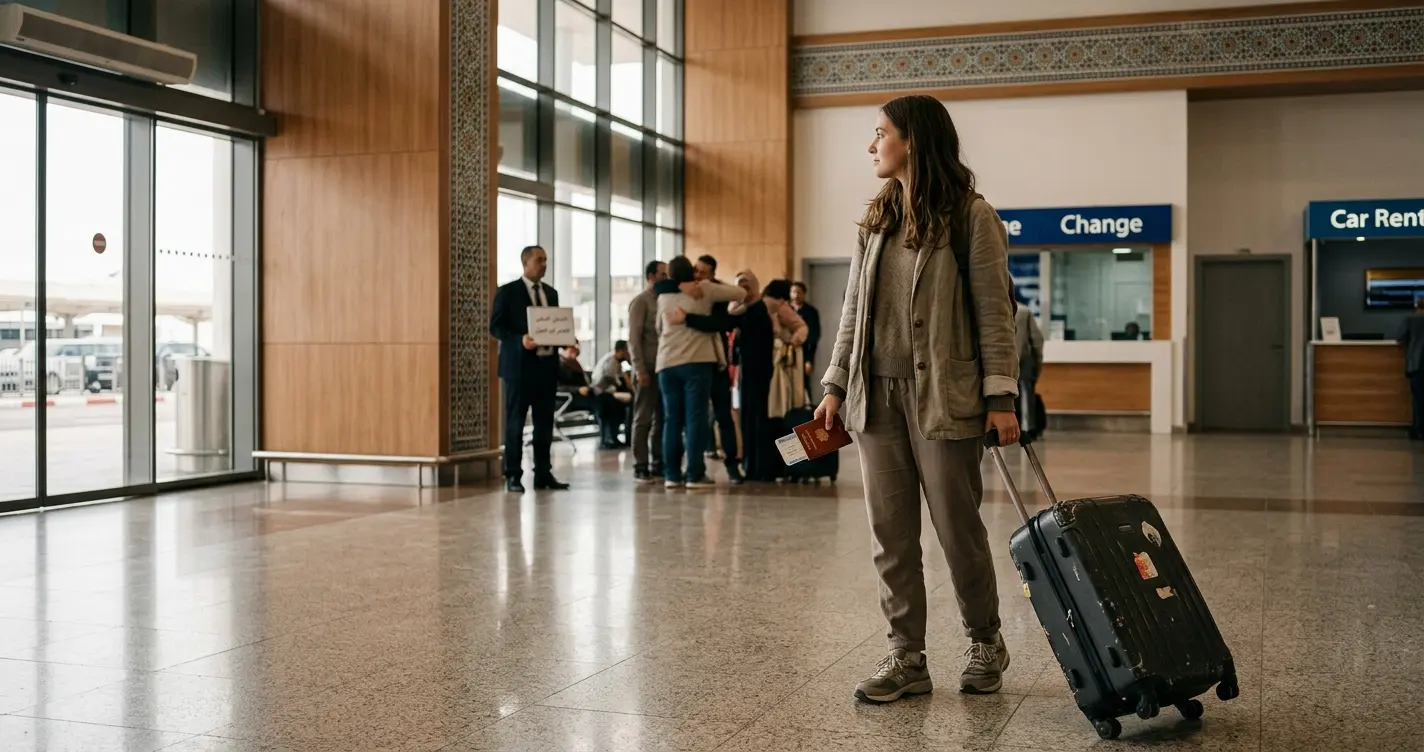
After disembarking, you’ll walk to immigration and passport control, complete a short arrival card if one isn’t already filled in, collect your luggage, pass through customs, and exit into the arrivals hall where SIM card kiosks, currency exchange counters, and transport options are all clustered together. For most travelers at a well-staffed airport like Casablanca or Marrakech, this entire sequence takes somewhere between twenty minutes and an hour, depending on how busy the immigration queue happens to be.
Morocco’s Ministry of Foreign Affairs has also confirmed that travelers no longer need to complete a separate passenger health form, which removes one layer of paperwork compared to earlier years.
What Documents Should You Have Ready?
Have your passport out and easily accessible, along with any visa or eVisa approval printout if your nationality requires one, your accommodation details, and, if you completed one in advance, any arrival card confirmation. Keeping these together in a single folder or pocket rather than spread across your carry-on saves genuine time at the immigration desk, particularly during busier arrival windows when every extra minute at the counter adds to the queue behind you.
Immigration and Passport Control
Visa Requirements
Most Western travelers, including citizens of the US, UK, Canada, most EU countries, and Australia, can enter Morocco visa-free for stays of up to 90 days, needing nothing beyond a valid passport. Other nationalities may need an eVisa arranged in advance or a traditional visa from a Moroccan consulate, so it’s worth confirming your specific status well before you fly rather than assuming visa-free entry applies universally.
Passport Checks
At the immigration desk, an officer will review your passport, confirm your visa status if applicable, and stamp your entry. Officers generally speak French and often some English, and the process for a visa-exempt traveler is usually brief and routine. Morocco’s airports have seen growing passenger numbers in recent years, so peak-season queues, particularly in the evening when several European flights land close together, can run longer than the check itself. Checking your passport has been stamped clearly before walking away from the desk is worth the extra few seconds, since a missing or illegible stamp can create complications when it’s time to leave the country.
Arrival Cards (If Required)
Morocco requires an arrival card or police form to be completed on entry, typically distributed on the plane before landing or available at a stand near immigration if you didn’t receive one in the air. It asks for standard details, passport information, flight number, address in Morocco, and takes only a couple of minutes to fill in, though having a pen ready and your accommodation address written down beforehand speeds things up considerably.
Collecting Your Luggage
Finding Your Baggage Carousel
Carousel numbers are displayed on arrivals screens throughout the terminal, generally matching your flight number, and Morocco’s main airports are well signposted in French, Arabic, and often English, making the walk from immigration to baggage claim straightforward even on a first visit.
What to Do If Your Luggage Is Lost
If your bag doesn’t appear, report it immediately at your airline’s baggage service desk, typically located within or just past the baggage claim area, before you leave the secure zone. You’ll file a report with a reference number, which you’ll need to track your bag and arrange delivery to your accommodation once it’s located, keep a copy of this reference, along with your accommodation’s address and contact details, easily accessible for exactly this scenario.
Going Through Customs
Green and Red Channels
Most Moroccan airports use a green and red channel system: green for travelers with nothing to declare, red for anyone carrying goods above duty-free allowances or restricted items. The vast majority of tourists walk straight through the green channel without being stopped, and customs officers generally focus their attention on commercial-quantity goods rather than the ordinary contents of a tourist’s suitcase.
Duty-Free Allowances
Standard duty-free allowances run to around 200 cigarettes or 25 cigars, roughly 1 liter of alcohol per adult, and about 150ml of perfume. Currency amounts equivalent to 15,000 MAD (roughly $1,500) or more should be declared on arrival, a detail that rarely affects the average tourist carrying normal spending money.
Restricted Items
Morocco prohibits importing weapons and ammunition, narcotics, and pornographic material as serious offenses, while alcohol beyond the personal duty-free allowance and pork products face restrictions tied to the country’s status as a majority-Muslim nation. Drones face particularly strict enforcement, flying one without prior government authorization isn’t permitted, and unregistered drones are routinely confiscated at customs, so most travelers are better off leaving one at home entirely.
Currency Exchange and ATMs
Should You Exchange Money at the Airport?
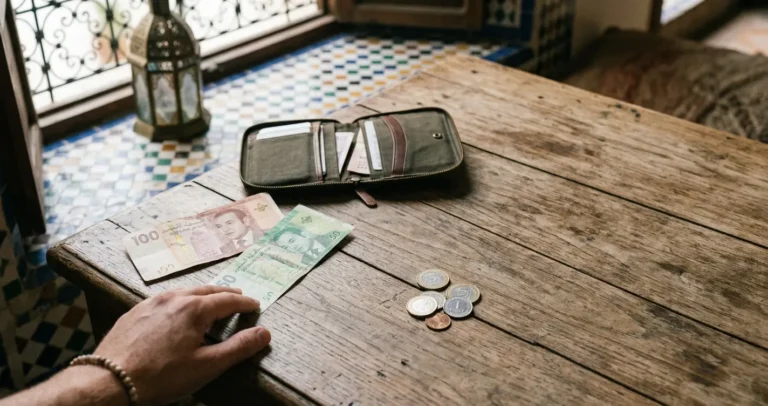
Airport exchange counters are convenient for your first taxi fare and a bit of initial spending money, but their rates are consistently among the weakest in the country. A practical approach is exchanging a modest amount at the airport to cover transport and incidentals, then finding a bank or exchange bureau in the city for anything larger, since Morocco’s dirham can’t be bought or sold outside the country and every visitor exchanges money after arrival regardless.
Using Airport ATMs
ATMs are available at every major Moroccan airport and generally accept international cards without issue, offering a more favorable rate than the exchange counters nearby. Standard local ATM fees plus your home bank’s foreign transaction fee both apply, so withdrawing a reasonably sized amount rather than several small sums keeps the cumulative fees down.
Paying by Card
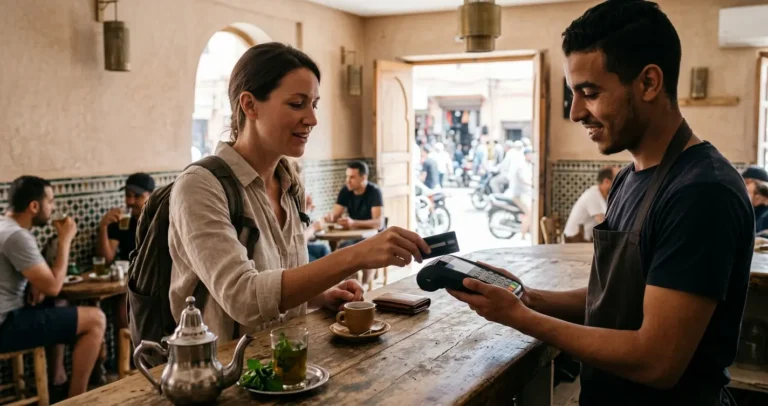
Cards are accepted at airport shops, cafés, and larger restaurants, but cash becomes essential the moment you step outside, taxis, souk vendors, and small cafés in the city run predominantly on cash, so leaving the airport with some dirhams in hand rather than relying entirely on a card is the safer default.
Buying a SIM Card at the Airport
Maroc Telecom
Maroc Telecom’s kiosk is a reliable pick if your route heads toward the Atlas Mountains or the Sahara later in the trip, since it consistently offers the strongest coverage outside the main cities.
Orange Morocco
Orange performs well across cities and coastal routes and is often competitively priced for a trip that stays within the main tourist corridor.
Inwi
Inwi rounds out the airport’s three kiosk options, frequently cited for strong overall value and coverage, and is a common default for travelers who don’t have a strong reason to prefer one of the other two.
Should You Buy One Immediately?
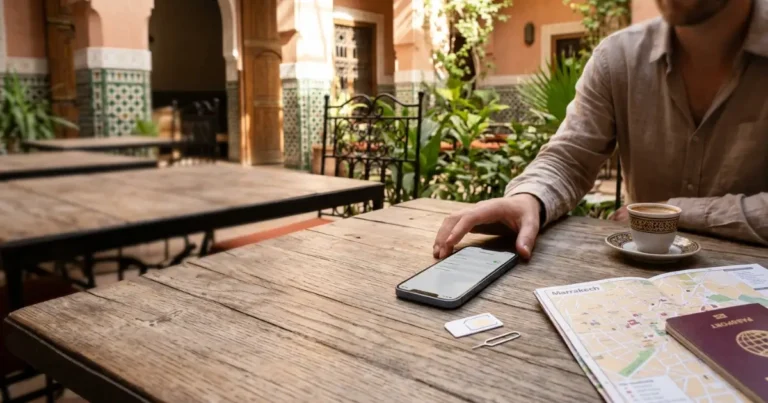
For most visitors, yes. A working SIM from the moment you land means functioning maps, ride-hailing or taxi coordination, and messaging apps without hunting for airport Wi-Fi, and prices at the kiosk run only slightly higher than in the city, a small premium for the convenience of walking out already connected. The whole process, passport in hand, typically takes under fifteen minutes.
Transportation from the Airport
Airport Taxis
Official airport taxis are available at every major airport, and while petit taxis are legally metered within city limits, airport pickups are sometimes negotiated at a fixed price instead, agreeing on the fare before getting in, or firmly requesting the meter, avoids the overcharging that’s a genuine and commonly reported issue at busier airports like Marrakech. A rough sense of what a fair fare looks like for your specific destination, checked before you land, gives you a useful benchmark for any negotiation.
Trains
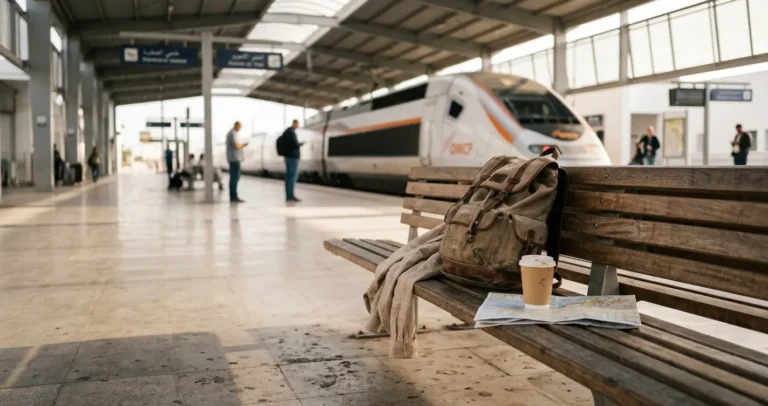
Casablanca’s Mohammed V Airport has a direct train link into the city center and onward to Rabat, making the train a fast, fixed-price option for that specific route. Other major airports, including Marrakech, Fes, and Agadir, don’t currently have direct airport rail connections, so a taxi or transfer is the practical choice there instead. This is one of the more useful details to know before you fly, since assuming every airport has rail access is a common and avoidable planning mistake.
Buses
Some airports offer public or shuttle bus services into the city center at a fraction of a taxi’s cost, though schedules can be infrequent and less convenient with heavy luggage compared to a taxi or private transfer.
Private Transfers
A pre-booked private transfer, arranged before you fly, removes the entire negotiation question, a fixed price agreed in advance, a driver waiting with your name at arrivals, and no haggling after a long flight. This is consistently the least stressful option for a first-time arrival, particularly late at night.
Rental Cars
Rental car counters are available at every major airport for travelers planning to drive from the moment they land, though picking up a car immediately after an international flight means navigating unfamiliar roads and city traffic while jet-lagged, which some travelers prefer to avoid on arrival day specifically.
Airport Safety Tips
Avoid Unofficial Taxi Drivers
Touts offering rides inside or just outside the terminal, ahead of the official taxi rank, are best declined, sticking to marked official taxis, a pre-arranged transfer, or a licensed ride-hailing option avoids both overcharging and the uncertainty of an unregulated vehicle.
Keep Important Documents Accessible
Store your passport, accommodation confirmation, and any transfer or hotel pickup details in an easily reachable pocket or bag compartment rather than buried in checked luggage, since you’ll need them repeatedly within the first hour.
Watch Your Luggage
Airport arrivals halls are busy, and keeping bags within sight and reach, particularly while sorting out a SIM card or exchanging money, is a sensible habit anywhere, Morocco included.
Download Offline Maps Before Arrival
Download the maps for your arrival city, and ideally your full route, before you fly, so navigation works immediately even if your SIM card purchase or Wi-Fi connection takes a few extra minutes to sort out.
Arrival Tips for First-Time Visitors
Have Small Cash Available
Arriving with a small amount of your home currency to exchange, or having already withdrawn dirhams from an airport ATM, ensures you can pay for a taxi or transfer immediately rather than searching for an exchange counter with luggage in tow.
Save Your Hotel Address Offline
Save your riad or hotel’s address, and ideally a local phone number, somewhere accessible without needing data, a screenshot or a printed confirmation works well, since medina addresses in particular can be difficult for a driver to locate without clear directions.
Expect Security Checks
Standard security screening applies on arrival at Moroccan airports, consistent with international norms, and cooperating promptly with any request keeps the process quick.
Stay Connected Immediately
Setting up a SIM card or confirming your eSIM is active before leaving the arrivals hall means you’re not navigating your first taxi negotiation or hotel check-in without a working map or translation app.
Major International Airports in Morocco
Casablanca Mohammed V Airport (CMN)
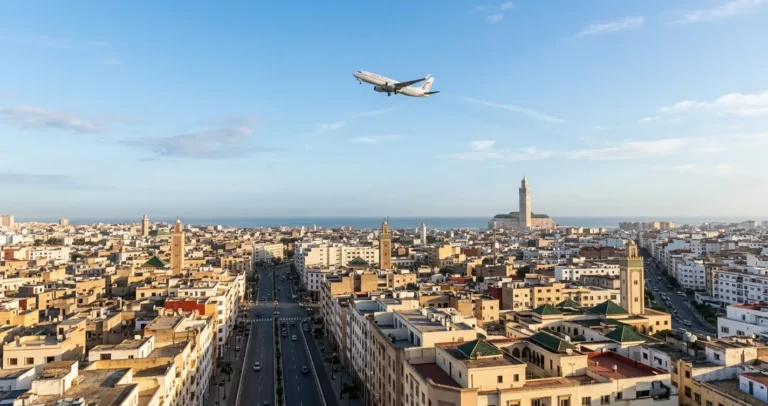
Morocco’s largest and busiest international gateway, with kiosks for all three mobile operators, multiple currency exchange counters, and a direct train link into Casablanca and onward to Rabat. As the country’s main hub for long-haul connections, it also tends to see the heaviest evening arrival traffic, so allowing extra time for immigration during peak hours is worth building into your plans.
Marrakech Menara Airport (RAK)
A major tourist gateway with SIM kiosks and currency exchange just past the arrivals doors, though no direct rail link, making a taxi, transfer, or rental car the standard way into the city center. Menara is a compact airport by international standards, so the walk from your gate to arrivals and baggage claim is generally short.
Fes–Saïss Airport (FEZ)
A smaller regional airport serving northern Morocco’s imperial city, with the same core services, SIM kiosks, exchange counters, and taxi access, scaled to a quieter facility. Its smaller size generally means shorter immigration queues than the country’s busier hubs.
Tangier Ibn Battouta Airport (TNG)
Serving northern Morocco and travelers connecting via the Spain ferry routes, with a compact but functional arrivals setup including all three operators’ kiosks. Its location makes it a natural gateway for a northern-focused itinerary through Chefchaouen and the Rif.
Agadir Al Massira Airport (AGA)
The main gateway for Morocco’s southern coast, following the same general arrivals pattern as the country’s other regional airports, and a common entry point for travelers heading straight to the beach towns of Agadir and Taghazout rather than the imperial cities further north.
Morocco Airport Arrival Guide: Frequently Asked Questions
How Long Does Immigration Take?
For visa-exempt travelers, immigration itself is usually quick, often just a few minutes at the desk once you reach it. The variable is queue length rather than processing time, since Morocco’s airports have seen substantial growth in passenger numbers in recent years, and peak arrival periods, particularly evenings when several European flights land in a short window, can mean a wait of thirty minutes to an hour before you reach an officer. Arriving with your passport and any required documents already out, rather than digging through a bag at the desk, helps keep your own portion of the process as brief as possible.
Can I Buy a SIM Card at the Airport?
Yes, every major Moroccan international airport has staffed kiosks for Maroc Telecom, Orange, and inwi in or near the arrivals hall. You’ll need your passport for the mandatory registration, which is standard for any SIM purchase in Morocco, and the whole process, from approaching the counter to walking away connected, typically takes under fifteen minutes. Prices run slightly higher than in the city, generally by a small margin, which most travelers consider a fair trade for landing already online.
Are Airport Taxis Safe?
Official airport taxis are generally safe, but overcharging tourists is a well-documented issue at busier airports, particularly Marrakech, where drivers sometimes quote considerably more than a fair metered fare. The safest approach is agreeing on a price before getting in, insisting on the meter where it applies, or arranging a private transfer in advance with a fixed, pre-agreed cost. Sticking to the official taxi rank rather than accepting an offer from someone approaching you inside the terminal removes most of the risk entirely.
Can I Withdraw Moroccan Dirhams at the Airport?
Yes, ATMs are available at every major Moroccan airport and are generally a better option than the exchange counters nearby, since Morocco’s dirham can’t be bought or sold outside the country, meaning every visitor exchanges money after arrival one way or another. Standard ATM fees and your home bank’s foreign transaction charge both apply, so withdrawing a reasonably sized amount rather than several small withdrawals is the more cost-effective approach. Bringing a card with low foreign-transaction fees specifically for this purpose saves a meaningful amount over the course of a trip.
Is Uber Available at Moroccan Airports?
This is genuinely mixed, and it’s worth checking the app for your specific city rather than assuming either way. Uber suspended its Moroccan operations in 2018, and for most of the years since, it hasn’t been reliably available anywhere in the country. Some more recent reports describe a limited, city-specific return in places like Casablanca and Marrakech, though this hasn’t been consistently confirmed across sources, so treat any claim of a full relaunch with some caution until you’ve verified it yourself close to your travel dates.
Careem, by contrast, has operated continuously in Morocco and is well-documented as available in Casablanca, Rabat, Marrakech, and Tangier, making it the more dependable ride-hailing option to check first. For an airport arrival specifically, most experienced travelers still recommend a pre-booked private transfer or an official taxi over any ride-hailing app, simply because flight delays and heavy luggage are easier to manage with a driver who’s expecting you by name.
Final Thoughts: Morocco Airport Arrival Guide
The first hour after landing in Morocco runs smoothly for almost everyone who arrives with a passport ready, a rough sense of the sequence ahead, and a little cash for the initial taxi or transfer. Immigration and customs are routine, a SIM card takes minutes to sort out, and the transport options taxi, transfer, train where available, all work well once you know which one fits your specific airport and arrival time.
Get those first steps right, and the rest of the trip starts from a calm, unhurried place rather than a stressful scramble in an unfamiliar arrivals hall. This Morocco airport arrival guide covers the sequence once, but it’s worth revisiting the specific details for your own airport and arrival time before you fly, since a little preparation here pays off far more than anywhere else in the trip.