Driving in Morocco (2026): Essential Rules & Tips for a Safe Road Trip
Driving in Morocco follows a familiar European framework, right-hand traffic, French-style road signs, priority-to-the-right at unmarked junctions, but the way those rules play out on the ground has its own local character. A slowdown near a village often means a speed trap waiting just past the sign, roundabouts don’t always follow the rule you’d expect, and a donkey cart sharing the road with trucks and taxis is simply part of the scenery rather than an anomaly.
This guide walks through the rules, the signage, the checkpoints, and the everyday habits that make driving in Morocco genuinely manageable once you know what to expect, rather than something to be nervous about before you even pick up the keys. It focuses specifically on the rules of the road and how they’re actually enforced day to day, for the separate questions of choosing a rental agency, insurance, and vehicle types, a dedicated car rental guide covers that ground in more depth.
Driving in Morocco: The Quick Answer
Is Driving in Morocco Safe?
Yes, with the right expectations. Morocco’s toll motorways are excellent and safe by any standard, and the vast majority of tourists who drive here do so without incident. The genuine risks cluster in specific situations, assertive city traffic, mountain roads with tight hairpin turns, and reduced visibility after dark in rural areas, rather than being spread evenly across every kilometer you’ll drive.
Is Driving in Morocco Difficult?
It varies enormously by road type. Motorways are straightforward and well-signed, comparable to Southern Europe. City driving is more assertive than many visitors expect, with closer following distances and frequent horn use as routine communication. Mountain roads demand real concentration, and rural stretches mix pedestrians, cyclists, and animals into the traffic flow in ways that require constant attention rather than casual cruising.
Driving Rules in Morocco
Which Side of the Road Do You Drive On?
Morocco drives on the right, with the steering wheel on the left side of the vehicle, the same convention used across continental Europe and North America. Visitors arriving from left-hand traffic countries, the UK, Ireland, Japan, Australia, should allow themselves a short adjustment period, particularly at roundabouts and when judging overtaking gaps.
Seat Belt Laws
Seat belts are mandatory for every occupant, front and back, and this is actively enforced rather than a rule that exists only on paper.
Mobile Phone Laws
Using a handheld mobile phone while driving is illegal in Morocco, with hands-free use permitted. Police do enforce this, particularly in and around city checkpoints.
Drink-Driving Laws
Morocco enforces an extremely strict standard on alcohol and driving, commonly described as zero tolerance in practice even though a very low legal blood alcohol threshold technically exists. The safest approach, and the one nearly every guide to driving in Morocco recommends, is treating it as an absolute zero: don’t drink at all if you’re driving afterward.
Required Documents
Keep your passport, driving license, International Driving Permit if you’re carrying one, vehicle registration, and insurance papers (attestation d’assurance) accessible in the car at all times. Police can and do ask for these at routine checkpoints, and having them ready avoids turning a thirty-second stop into a longer one.
Speed Limits in Morocco
Urban Areas
Speed limits in towns and villages generally run 40-60 km/h, with 40 km/h being a common default through historic centers and residential streets. Staying at or below 40 km/h through smaller settlements, even where a slightly higher limit is posted, is a sensible habit given how often speed enforcement clusters exactly at village entrances.
Rural Roads
Open rural roads and national routes generally carry a limit of 80-100 km/h, though this drops to 60-80 km/h wherever the road passes through even a small settlement, a detail that catches out drivers who assume a rural highway limit applies continuously along its full length.
Motorways
Morocco’s toll motorways (autoroutes) carry the highest limit in the country, generally up to 120 km/h, and their quality genuinely supports it, these are modern, well-maintained roads comparable to European standards.
Speed Cameras and Fines
Speed enforcement in Morocco is genuinely strict, with fixed cameras increasingly common on busy corridors like Casablanca–Rabat–Marrakech, alongside frequent mobile radar checks by the Gendarmerie Royale on highways and the Police Nationale within cities. Fines are typically issued on the spot in cash, commonly running 300-600 MAD depending on the severity of the violation, and officers have been known to fine drivers for exceeding a limit by as little as 5 km/h.
Using radar detection equipment is illegal, so relying on posted signs and driving conservatively through any area that looks like it might be monitored is the more reliable approach. A useful habit borrowed from local drivers: if traffic ahead suddenly slows for no obvious reason, it’s often a signal that a radar checkpoint is just ahead.
Understanding Moroccan Road Signs
Warning Signs
Warning signs in Morocco follow the same triangular, red-bordered format used across Europe, generally in compliance with the Vienna Convention on Road Signs and Signals, which Morocco formally joined in 1982. Expect the familiar warnings for curves, animal crossings, and pedestrian zones, with symbols that are visually intuitive even without reading the accompanying Arabic or French text. Yellow warning signs indicating temporary roadworks are common too, though it’s worth noting these are sometimes treated more casually by local drivers than permanent signage, so a cautious approach through any marked construction zone is still worthwhile.
Regulatory Signs
Regulatory signs, stop, yield, no overtaking, speed limits, closely mirror French road sign conventions, including the octagonal red stop sign and circular prohibition signs. Speed limit numbers are shown in standard Western numerals rather than Arabic numerals, which removes one potential source of confusion for visiting drivers.
Direction Signs
Directional signage is typically bilingual in Arabic and French, with Tamazight (Berber) increasingly present on motorway signage as well, sometimes appearing alongside the other two languages on the same sign. City and town names are generally rendered in Latin script, making them straightforward to match against a paper map or GPS destination.
Road Markings
White lines mark single-carriageway roads and yellow lines mark dual carriageways, following the same general logic used across much of Europe. A solid white center line means no overtaking, and Moroccan police do enforce this, crossing one to pass is a common and actively ticketed violation, not merely a suggestion.
Police Checkpoints
Why They Are So Common
Checkpoints appear constantly on Moroccan roads, particularly at the entrances to towns and villages, and they’re a routine, longstanding feature of road administration and safety enforcement rather than a sign of any unusual concern. It’s entirely normal to pass through several in a single day’s drive, and locals generally treat them as an unremarkable part of getting from one place to another rather than a source of anxiety.
What Documents You’ll Need
Have your passport, license, IDP if applicable, vehicle registration, and insurance documents within easy reach. Officers will sometimes ask for all of them, sometimes for none, and having them organized rather than scattered through the car keeps the interaction brief either way.
How to Handle a Checkpoint
Slow down well before the checkpoint, follow any temporary signage telling you to reduce speed, and stop fully if waved down. Answer questions courteously, tourists are very often simply waved through without further questions, and if you’re issued a genuine fine, pay it rather than attempting to negotiate or offer a bribe, since attempting to bribe an officer in Morocco is treated as a serious offense with real legal consequences, not a shortcut.
Road Conditions Across Morocco
Modern Highways
Morocco’s toll autoroutes connecting the major cities are excellent, well-signed, and well-maintained, genuinely comparable to a European motorway network.
Mountain Roads
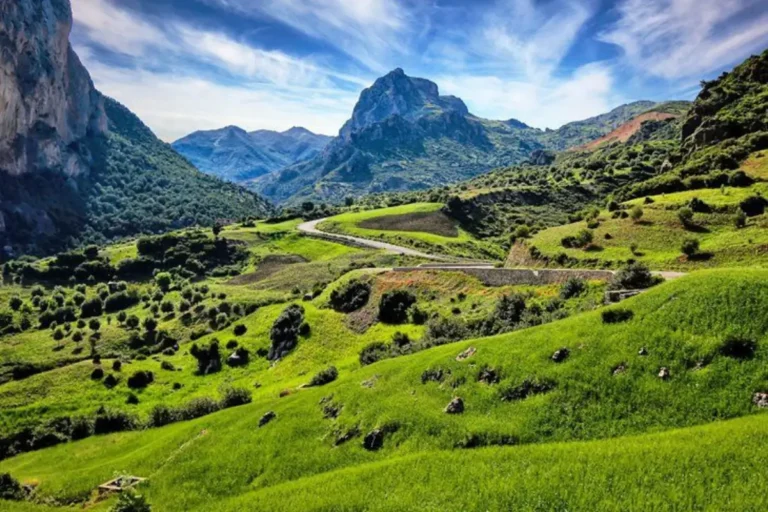
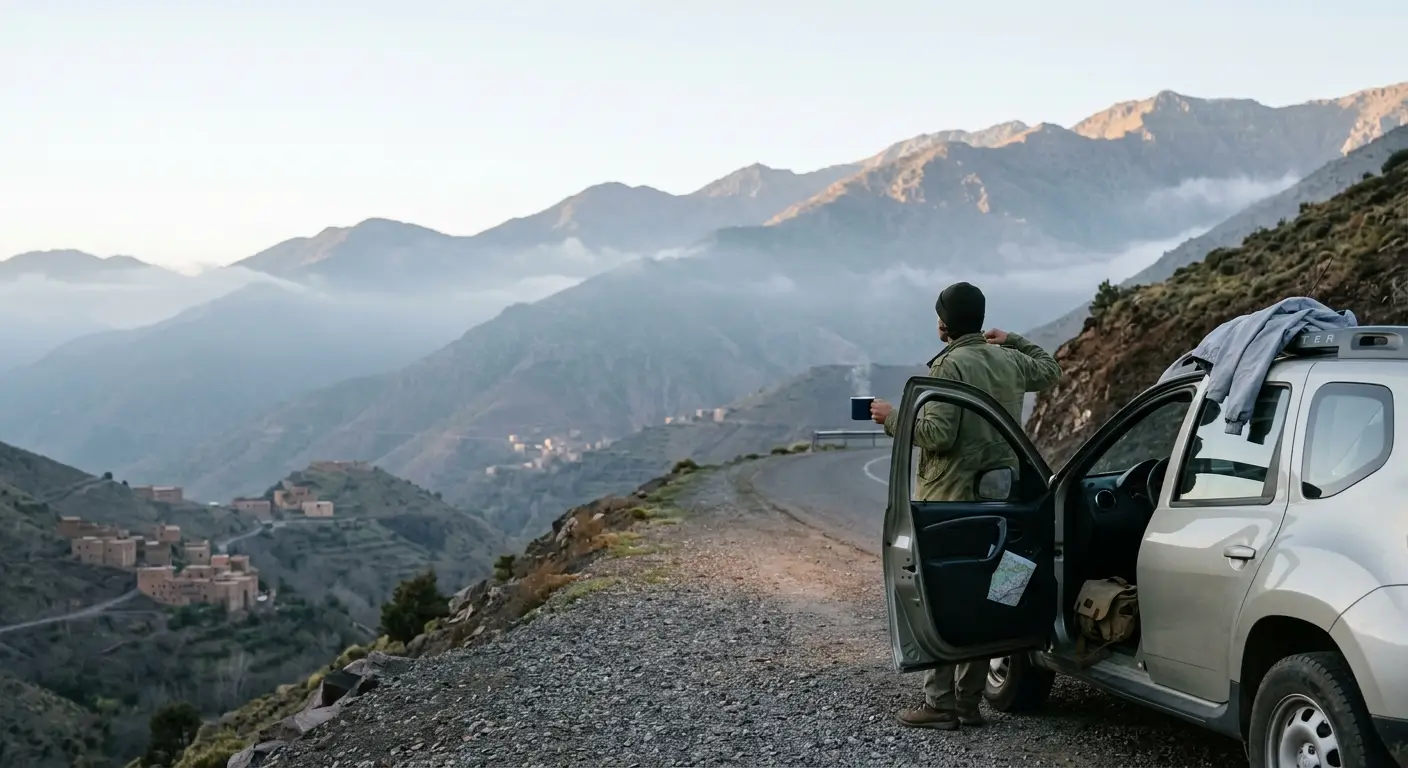
Mountain passes like the Tizi n’Tichka are paved and generally well-maintained but narrow, with tight hairpin turns and limited or no guardrails in places. These roads demand full attention, a lower gear on descents, and patience with slower trucks and buses, which have practical priority on the tightest sections.
Desert Roads
Roads leading toward desert gateway towns are generally paved and reliable, though sand can occasionally drift across the road surface in open stretches, sometimes difficult to spot from a distance, and the final approach into the dunes themselves typically requires a 4×4 transfer rather than a standard rental car.
Driving in the Medina
Medina streets are not built for cars, narrow, crowded, and often effectively one-way in ways that aren’t obvious from outside. Parking at the medina’s edge and walking in is almost always the better choice than attempting to navigate a vehicle through Fes’s or Marrakech’s old city.
Toll Roads
How Toll Roads Work
Morocco’s autoroute network operates on a standard ticket system: take a ticket on entry, pay based on distance traveled when you exit.
Payment Methods
Cash is the most reliable payment method at toll booths, taken at lanes marked with a green arrow or cross. Lanes marked “J” are reserved for the Jawaz electronic tag system and should be avoided unless your specific vehicle has one fitted.
Major Toll Routes
The Casablanca-Marrakech and Casablanca-Rabat-Tangier corridors are the country’s busiest toll routes, connecting the cities most tourists move between, with a typical Casablanca-to-Marrakech toll running roughly 70-90 MAD one way.
Fuel Stations
Petrol vs Diesel
Fuel stations in Morocco are staffed rather than self-service, so an attendant will fill the tank for you, confirm your vehicle’s fuel type before you drive off from wherever you picked it up, since guessing based on the car’s size is unreliable. Diesel is commonly labeled “gasoil” rather than diesel, which is worth knowing so you can communicate clearly with the attendant.
Fuel Prices
As of 2026, gasoline runs roughly 14-16 MAD per liter and diesel slightly less, around 13-14 MAD per liter, broadly in line with global averages and subject to weekly adjustment based on international crude prices.
Refueling in Rural Areas
Stations are common in cities and along motorways, thinning out on routes toward the Atlas, the desert, or smaller rural roads. Starting a long rural driving day with at least half a tank, and topping up before a known long stretch rather than after, avoids running low somewhere remote.
Driving Tips for Tourists
Drive Defensively
Moroccan traffic doesn’t always follow the rules with the same consistency travelers might expect from home, and treating every intersection, roundabout, and overtaking maneuver with a defensive mindset, assuming the other driver might not yield, pays off consistently.
Avoid Driving at Night
Night driving outside cities carries genuine, well-documented risk: unlit vehicles, pedestrians and cyclists without reflective gear, poor road lighting, and livestock that can appear on the road with no warning. Planning routes to arrive before sunset is standard advice from nearly every experienced Morocco driver.
Watch for Pedestrians and Animals
In rural areas, roads double as a shared space for pedestrians, cyclists, and animals moving between towns, and they don’t always observe traffic rules the way a driver might expect. Slowing down through any settlement and staying alert on open rural stretches, particularly near dusk when low sun can obscure visibility, is essential.
Be Careful in Roundabouts
Roundabout priority in Morocco isn’t fully standardized, most follow the now-common European convention where traffic already in the circle has priority over vehicles entering, but a number of older roundabouts still operate on the reverse rule, giving priority to entering traffic. When the correct rule isn’t obvious from signage, slowing down and yielding is the safer default regardless of which convention applies, and it’s worth watching how local traffic is actually behaving at a given roundabout for a few seconds before committing, since that’s often a faster read than trying to spot a small sign.
Use Offline Navigation
Signal can be unreliable in the Atlas Mountains and remote desert stretches regardless of your mobile provider, so downloading offline maps before setting out on any longer rural or mountain drive is worth the few minutes it takes at a hotel with reliable Wi-Fi.
Common Mistakes Tourists Make When Driving in Morocco
Speeding Near Villages
The single most common way tourists pick up a fine is misjudging the speed limit through a small settlement, where a rural highway’s higher limit drops sharply for a short stretch, often with a checkpoint waiting almost immediately after the reduced-speed sign.
Ignoring Local Driving Style
Assuming Moroccan drivers will behave exactly as drivers do at home, yielding at the “right” moment, maintaining a consistent following distance, leads to more near-misses than any actual road hazard. Adjusting your expectations to the local driving culture, rather than expecting it to match your own, removes most of the frustration.
Not Carrying Cash
Tolls, many rural fuel stations, and roadside parking attendants all expect cash, and running short of smaller notes mid-journey is an easily avoidable inconvenience.
Parking Illegally
Parking in a spot that blocks a doorway, a driveway, or a narrow medina-adjacent street can result in a fine or, in more serious cases, having the vehicle towed, using a formal lot or an attended street space, even for a small tip, avoids the risk entirely.
Driving in Morocco During Different Seasons
Summer
Summer heat can push well past 38°C (100°F) inland, which affects both driver fatigue and vehicle performance on longer drives, keeping the air conditioning in good working order and carrying extra water is a sensible precaution for any summer road trip. Tire pressure is also worth checking more often in summer heat, since hot asphalt and long highway stretches put more strain on tires than cooler-weather driving.
Winter
Winter brings the possibility of snow on higher Atlas passes, including the Tizi n’Tichka, occasionally closing or slowing traffic on routes that are otherwise reliable year-round. Checking conditions before a winter mountain crossing avoids an unwelcome surprise partway up, and it’s worth building extra time into any winter itinerary that depends on a specific pass being clear.
Spring
Spring offers some of the most comfortable driving conditions of the year, with mild temperatures and generally dry roads, though occasional rain in the north, particularly around Chefchaouen and the Rif, is worth planning around in March specifically.
Autumn
Autumn largely mirrors spring’s comfortable driving conditions, with the added benefit of daylight hours still long enough for a full day’s drive without rushing to beat sunset.
Driving in Morocco: Frequently Asked Questions
Can Tourists Drive in Morocco?
Yes, tourists can legally drive in Morocco with a valid driving license from their home country, along with a passport and the vehicle’s registration and insurance documents if renting. Most car rental agencies additionally require drivers to be at least 23 years old with at least two years of driving experience. The road rules themselves follow a broadly European structure that most visitors from Europe, North America, and similar regions will find familiar in principle, even if the on-the-ground driving style and enforcement patterns take a short adjustment period to get comfortable with.
Do You Need an International Driving Permit?
An International Driving Permit isn’t strictly required by Moroccan law for most nationalities on a short tourist visit, but it’s recommended and often requested by rental companies, particularly if your home license isn’t printed in French, English, or Arabic, or uses a script that’s harder for local officials to read quickly. An IDP costs roughly $20-30, remains valid for a year, and mainly serves to simplify checkpoint interactions and rental pickup rather than being a strict legal necessity for every visitor. It’s worth arranging one through your home country’s automobile association before you travel if there’s any doubt about your license’s compatibility.
Is It Safe to Drive at Night?
Night driving within well-lit city centers is generally manageable, but driving at night in rural or mountain areas carries meaningfully higher risk and is not recommended, especially for first-time visitors unfamiliar with the roads. Poor lighting, unmarked hazards, pedestrians and cyclists without reflective gear, and livestock that can appear on the road without warning all combine to make after-dark rural driving considerably more dangerous than the same route in daylight.
Planning each day’s drive to arrive at your destination before sunset is the standard, widely repeated advice for exactly this reason, and it’s a habit worth building into any Morocco road trip itinerary from the start.
Are Moroccan Roads Good?
It depends entirely on the road category. Toll motorways connecting the major cities are excellent, modern, and well-maintained, genuinely comparable to European standards. National roads and rural routes are generally serviceable but more variable in quality, with surface conditions that can deteriorate the further you get from a major city.
Mountain roads, while paved on the main passes, are narrow with tight turns and limited guardrails, demanding a different level of attention than motorway driving. Overall, the road network supports a confident, well-prepared driver perfectly well, but it rewards matching your driving style and expectations to the specific type of road you’re on rather than assuming uniform conditions throughout the country.
Should You Rent a Car or Use Public Transport?
This depends on your itinerary more than any general rule. Public transport, particularly ONCF’s train network, is faster, cheaper, and less stressful for the Tangier-Casablanca-Rabat-Fes-Marrakech corridor specifically, since it avoids both traffic and the need to navigate unfamiliar roads.
A rental car earns its cost once your route includes the Atlas Mountains, rural valleys, or coastal towns without direct train or bus service, where the flexibility to stop and explore at your own pace outweighs the added complexity of driving yourself. Many travelers end up combining both, taking the train between major cities and renting a car only for a specific regional leg like a desert or mountain excursion.
Final Thoughts: Driving in Morocco
Driving in Morocco rewards preparation more than nerve, know the speed limits shift sharply near villages, expect checkpoints as routine rather than remarkable, and treat roundabouts and rural roads with a bit more caution than you might at home. Do that, stick to daylight hours outside the cities, and the country’s genuinely excellent motorways and spectacular mountain and desert routes become one of the most rewarding ways to experience Morocco rather than a source of stress behind the wheel.