Is Chefchaouen Worth Visiting? (2026): The Honest Truth About Morocco’s Blue City
Chefchaouen shows up on nearly every Morocco itinerary and Instagram feed for the same reason: those blue-washed walls are genuinely photogenic. But a detour to the Rif Mountains costs real time, and depending on where the rest of your trip is based, that cost can range from a quick side trip to a multi-day commitment.
This guide gives an honest answer on whether Chefchaouen is worth visiting, who it actually suits, and how to weigh the detour against the rest of a Morocco itinerary including the travel time from each of the country’s main cities, since that single factor does more to determine the right answer than anything else.
Is Chefchaouen Worth Visiting?
Yes, for most travelers but the honest answer depends heavily on where you’re starting from and what kind of trip you want. Chefchaouen offers something genuinely different from Morocco’s larger cities: a small, walkable mountain town with a slower pace and a completely distinct color palette. It’s not, however, packed with major monuments or activities, so it rewards travelers looking for atmosphere and scenery more than a checklist of sights.
What Makes Chefchaouen Different From Other Moroccan Cities?
The Blue Medina and Mountain Setting
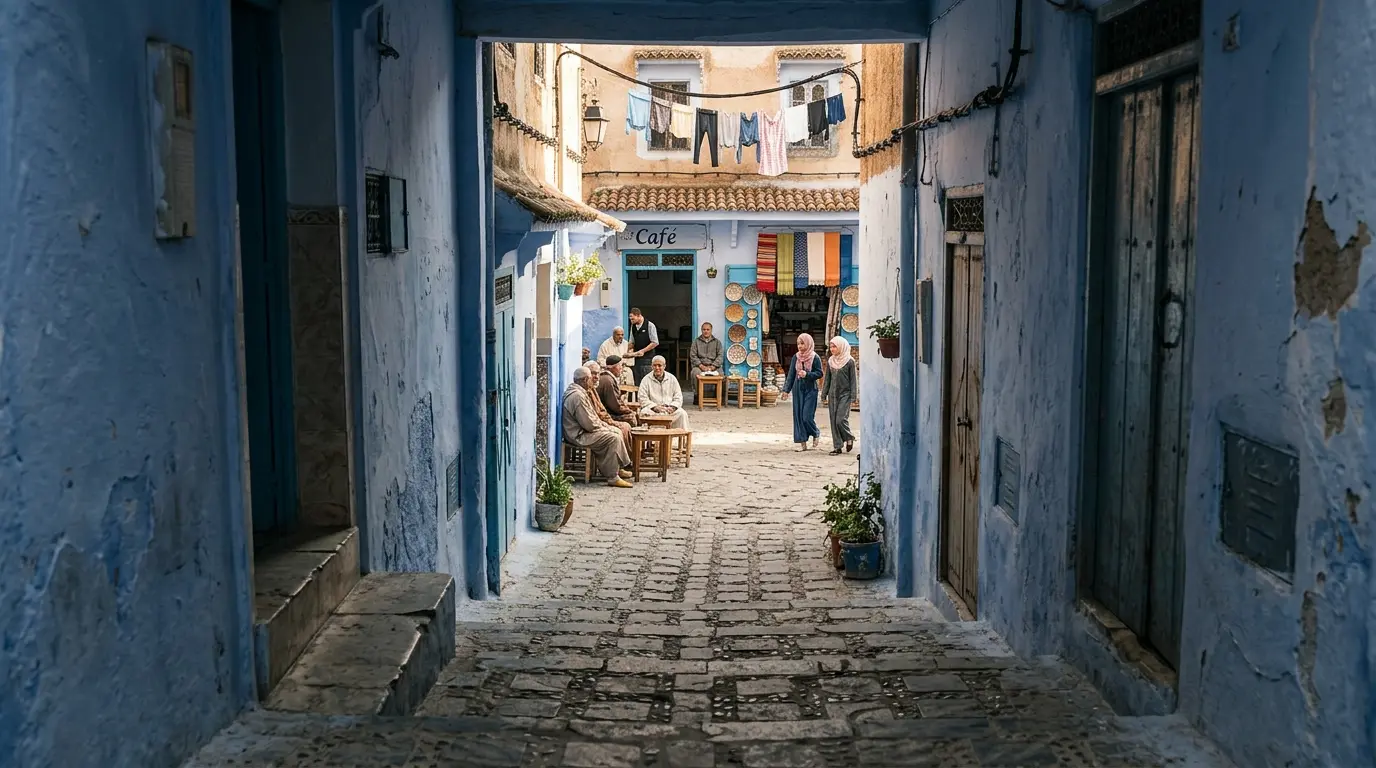
Chefchaouen’s blue-washed buildings, set against the green slopes of the Rif Mountains, create a visual identity unlike anywhere else in Morocco. Marrakech and Fes both offer dense, historic medinas, but neither has this particular combination of color and mountain backdrop, and the effect genuinely does shift throughout the day as the light changes.
The Slower Pace of Life
With no major souks to navigate and a fraction of the population of Morocco’s big cities, Chefchaouen moves at a noticeably gentler rhythm. Cafés linger longer, streets empty out earlier in the evening, and there’s less of the persistent commercial pressure found in Marrakech’s medina, which many travelers find is itself a genuine relief after several days in a larger city.
The Rif Mountain Landscape
Beyond the town itself, the surrounding Rif Mountains and Talassemtane National Park offer genuine hiking and natural scenery within less than an hour’s drive, a contrast to the flatter, more urban settings of Morocco’s imperial cities. This proximity to real mountain wilderness is something neither Marrakech nor Fes can offer within such a short distance.
Northern Moroccan Culture and Character
Chefchaouen’s history as a former Spanish protectorate town gives it a distinct architectural and culinary character, blending Andalusian influence with Rif Mountain Berber culture in a way that feels genuinely different from central or southern Morocco. Spanish loanwords still surface in local speech, a subtle reminder of this shared history.
What Chefchaouen Is Really Like Beyond the Photos
Is the Blue Medina as Impressive in Person?
Largely yes, though it’s worth calibrating expectations: not every street is uniformly blue, and the most photogenic corners are concentrated in specific pockets of the medina rather than spread evenly throughout. The best photos online are often taken in a handful of well-known spots that can feel more curated in person than they appear on a feed, and travelers expecting every single alley to look like a postcard sometimes come away slightly underwhelmed by the more ordinary streets in between.
How Tourist-Focused Has Chefchaouen Become?
Certain streets, particularly those closest to Plaza Uta el-Hammam, have become noticeably geared toward photography and souvenir shopping. That said, Chefchaouen remains considerably less commercially intense than Marrakech’s medina, and genuine daily life is still easy to find just a few streets away from the busiest routes, particularly once you climb into the quieter upper medina.
What the City Feels Like Outside the Main Streets
Away from the postcard corners, Chefchaouen is a working mountain town residents hanging laundry, small grocery shops, children playing in quieter alleys. This everyday texture is arguably as rewarding to experience as the famous blue streets themselves.
The Biggest Reasons to Visit Chefchaouen
For a Different Side of Morocco
Chefchaouen offers a genuine change of pace and scenery from Morocco’s larger, more intense cities, making it a valuable contrast point on a longer itinerary. Travelers who’ve spent days navigating Marrakech’s crowded souks often describe Chefchaouen as a genuine reset.
For Slow Travel and Wandering
Its small scale and lack of major “must-see” sites make it one of the best places in Morocco to simply wander without a fixed plan, something that’s harder to pull off comfortably in Fes or Marrakech’s larger medinas.
For Mountain Scenery and Nature
Akchour and Talassemtane National Park offer genuine hiking and natural beauty within easy reach, a rarity this accessible elsewhere in Morocco’s northern region, and the cooler mountain air offers a welcome break from the heat of the country’s interior.
For a Short Escape From Morocco’s Larger Cities
After several days in the intensity of Marrakech or Fes, Chefchaouen’s calmer streets and cooler mountain air offer a genuine change of pace before continuing on with a trip, functioning almost as a palate cleanser partway through a longer Morocco itinerary.
The Biggest Reasons to Skip Chefchaouen
The Long Journey From Morocco’s Main Tourist Routes
Chefchaouen sits well off Morocco’s main north-south travel corridor. From Marrakech in particular, the drive runs 7 to 9 hours each way, making it a genuine multi-day commitment rather than a simple detour, and this single fact eliminates it from consideration for many travelers with a tighter schedule.
Limited Major Attractions
Beyond the medina itself, the Kasbah, and Akchour, Chefchaouen doesn’t offer the density of historic monuments found in Fes or Marrakech, so travelers specifically chasing major sites may find a day or two is genuinely enough, with little left to discover after that.
Crowds in the Middle of the Day
Between roughly 10am and 4pm, day-trippers arriving from Fes and Tangier can make the most photogenic streets feel considerably busier than the quieter mornings and evenings, occasionally undercutting the very sense of calm that draws people to Chefchaouen in the first place.
Steep Streets and Uneven Medina Lanes
Chefchaouen’s hillside layout means more walking uphill than Morocco’s flatter medinas, which can be a genuine consideration for travelers with mobility concerns or limited patience for stairs, particularly with luggage in tow on arrival.
Is Chefchaouen Worth the Detour?
From Tangier
Yes, easily at around 2 to 2.5 hours each way, Chefchaouen is a very manageable day trip or, better still, an overnight stop from Tangier, making it one of the most straightforward add-ons to a northern Morocco itinerary. This is consistently the easiest and most recommended route into the Blue City.
From Fes
Generally yes, though a same-day round trip is a long, tiring day at roughly 3.5 to 4 hours each way. Staying at least one night is strongly preferable to a rushed day trip from Fes, since nine or more hours of round-trip driving for a few hours in town rarely feels worth it in hindsight.
From Rabat
Worth considering but demanding, at around 4 hours each way. An overnight stay is a more sensible option than attempting the round trip in a single day, particularly given how little time a same-day trip would actually leave for exploring.
From Marrakech
This is the trip most worth thinking twice about. At 7 to 9 hours each way by road, Chefchaouen only makes sense from Marrakech as part of a longer northern loop of several days, not as a discrete side trip, and travelers on a tight Marrakech-based itinerary are often better served by another destination entirely.
Is Chefchaouen Worth Visiting for One Day?
Yes, if that’s genuinely all the time you have a single day is enough to see the medina’s main landmarks, the Kasbah, and Plaza Uta el-Hammam. It won’t leave time for Akchour or the town’s more unhurried pace, which many travelers consider the real appeal, so it’s worth treating a one-day visit as a taste of Chefchaouen rather than the full experience.
Is It Better to Stay Overnight in Chefchaouen?
Yes, if your itinerary allows it. An overnight stay lets you experience the medina in the early morning and evening light, when it’s calmest and most atmospheric, and leaves realistic time for a half-day trip to Akchour the following morning. Travelers who only pass through on a day trip consistently report feeling like they missed the town’s real character.
Who Should Visit Chefchaouen?
First-Time Visitors to Morocco
Chefchaouen offers an approachable, easy-to-navigate introduction to Moroccan medina life, less overwhelming than Marrakech or Fes for anyone easing into their first visit. Its manageable size means getting lost, if it happens at all, resolves itself far more quickly than in a larger medina.
Couples
The town’s romantic scenery, quieter pace, and sunset viewpoints at the Spanish Mosque make it a strong fit for couples looking for a slower, more intimate stop, particularly as part of a longer itinerary that’s included a few busier cities.
Solo Travelers
Chefchaouen’s small scale and generally calm atmosphere make it a comfortable, low-stress destination for solo travelers still building confidence navigating Morocco independently, and it’s often recommended as an easier starting point than Marrakech or Fes.
Nature Lovers
Akchour’s waterfalls and the wider Rif Mountains give nature-focused travelers a genuine hiking destination within easy reach of the town, something rare this close to a major Moroccan tourist stop.
Travelers Who Prefer Slow Travel
Anyone who prefers wandering and lingering over checking off a list of sites will find Chefchaouen’s unhurried pace particularly rewarding, since the town simply doesn’t offer enough discrete attractions to rush through in the first place.
Who Might Not Enjoy Chefchaouen?
Travelers With a Tight Itinerary
Given the travel time involved from most of Morocco’s other major cities, Chefchaouen can feel like poor value for travelers with only a week or less who are trying to cover the whole country. The math simply doesn’t favor a rushed visit when the drive alone can eat up the better part of a day.
Travelers Looking for Nightlife
Chefchaouen’s evenings are calm and low-key by design; travelers hoping for a livelier scene will find much more of that in Marrakech, where bars, live music, and later-night dining are all considerably more common.
Travelers Who Prefer Major Attractions and Museums
With no palaces, grand madrasas, or major museums to speak of, Chefchaouen doesn’t reward travelers whose main interest is ticking off historic monuments, and that’s worth being honest about before committing significant travel time to reach it.
How Many Days Do You Actually Need in Chefchaouen?
Two nights is the realistic sweet spot: one full day for the medina and Kasbah, and a second for a half-day trip to Akchour. A single night can work if time is genuinely tight, while three days suits travelers wanting a slower, more relaxed pace or additional time in the surrounding mountains, particularly those interested in exploring beyond the two main marked trails.
Where Chefchaouen Fits Into a Morocco Itinerary
Chefchaouen works best as part of a northern loop connecting Tangier, Fes, and possibly Rabat, rather than as an isolated add-on to a Marrakech-centered trip. Travelers planning a longer, two-week-plus itinerary covering both northern and southern Morocco have the easiest time fitting it in without the detour feeling disproportionate to the rest of the trip, since the drive naturally slots between other northern stops rather than requiring a dedicated round trip.
Is Chefchaouen Worth Visiting in 2026? The Honest Answer
Yes, for the right traveler and the right itinerary. Chefchaouen delivers a genuinely different, memorable experience but it demands real travel time from most of Morocco’s other major destinations, and it doesn’t offer the density of major sites that Fes or Marrakech do. The honest calculation is straightforward: if your route naturally passes near Tangier or Fes, the detour is easily worth it; if you’re based in Marrakech with limited time, the math becomes considerably harder to justify.
Is Chefchaouen Worth Visiting? FAQs
Is Chefchaouen worth visiting for the first time?
Yes its manageable scale and calm atmosphere make it an approachable, memorable stop, particularly for travelers also visiting Morocco’s north as part of the same trip.
Is Chefchaouen worth visiting for one day?
Yes, if time is limited, though a single day only allows for the medina and Kasbah rather than a trip to Akchour or a slower, unhurried pace that many consider the real draw.
Is Chefchaouen worth staying overnight?
Yes an overnight stay lets you experience the medina in its calmest early morning and evening light and leaves time for a half-day Akchour trip the next morning.
Is Chefchaouen too touristy?
Certain central streets have become quite tourist-focused, but the wider medina still retains a genuine, everyday character just a short walk from the busiest corners, particularly in the quieter upper medina.
Is Chefchaouen worth the trip from Fes?
Yes, though an overnight stay is strongly preferable to a rushed same-day round trip given the roughly 3.5 to 4 hour drive each way.
Is Chefchaouen worth the trip from Tangier?
Yes, easily at around 2 to 2.5 hours each way, it’s one of the most manageable and worthwhile detours in northern Morocco, whether as a day trip or an overnight stop.
How many days do you need in Chefchaouen?
Two nights covers the medina and a trip to Akchour comfortably, with a third day useful for a slower, more relaxed pace or extra time in the mountains.
Is Chefchaouen better for nature or sightseeing?
It leans more toward nature and atmosphere than historic sightseeing, with Akchour and the surrounding Rif Mountains standing out more than any single monument in town.
Is Chefchaouen worth adding to a Morocco itinerary?
Yes, particularly for itineraries that already include Tangier, Fes, or a wider northern loop, where the detour fits naturally rather than requiring a long standalone trip from further south.