Morocco Weather in Spring (2026): The Ultimate Guide to What to Expect
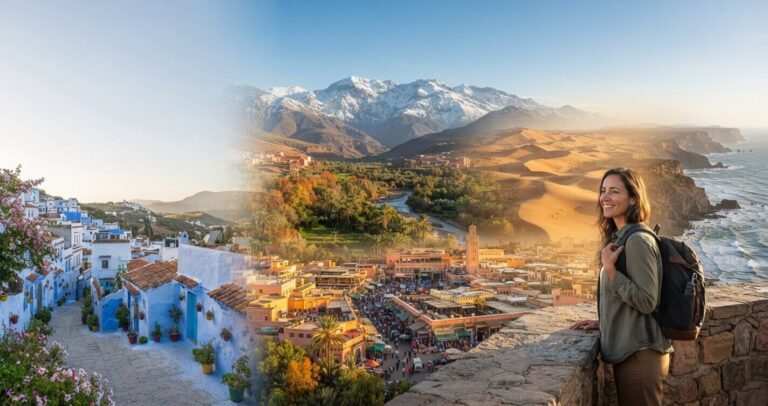
Spring is the season Morocco’s tourism industry quietly builds itself around, and for good reason: it’s the stretch of the year when nearly every region — coast, cities, mountains, and desert — sits somewhere close to its most comfortable. But “spring in Morocco” isn’t one single climate. March, April, and May each bring a noticeably different version of the season, and Marrakech’s spring looks nothing like Chefchaouen’s or the Sahara’s.
This guide breaks spring down month by month and region by region, so you know exactly what to expect and how to pack for it, wherever your itinerary takes you. Whether you’re planning a city-focused week in the imperial cities, a desert-and-mountains loop, or a full circuit that touches all of it, the details below should help you pick the right weeks and pack for what you’ll actually encounter.
Morocco Weather in Spring: Is It a Good Time to Visit?
Why Spring Is One of Morocco’s Best Travel Seasons
Spring (March through May) is widely considered Morocco’s finest travel window, and the reasoning holds up against the numbers: daytime temperatures across most of the country settle into a genuinely comfortable 20-28°C (68-82°F) range, rainfall drops off sharply as the season progresses, and the countryside turns green with wildflowers and blossoming almond and rose trees in the south. It’s a season that suits nearly every kind of itinerary at once — city walking, desert excursions, and mountain hikes are all workable without extreme heat or cold forcing a compromise.
This versatility is what sets spring apart from summer or winter, which each tend to favor one type of trip over another. A summer visitor largely commits to a coastal-heavy itinerary to avoid inland heat, while a winter traveler trades warmth for quiet. Spring is one of the only windows where a single itinerary can realistically combine cities, desert, and mountains without any one leg feeling like a compromise.
What Makes Spring Different From Other Seasons
Spring’s defining feature is balance rather than any single extreme: it lacks summer’s punishing inland heat, winter’s cold snaps and rain, and it largely avoids the year’s coldest desert nights while still keeping daytime temperatures pleasant almost everywhere. The trade-off is that spring is also Morocco’s most popular season for exactly these reasons, so accommodation and tours book up earlier and cost more than in the quieter months on either side of it.
It’s also worth understanding that spring isn’t uniformly mild from its first day to its last — March still carries real winter carryover in the north and the mountains, while May starts edging toward summer conditions in the south and the desert. Thinking of spring as three distinct sub-seasons, rather than one flat three-month window, makes for considerably better planning.
Morocco Weather in Spring by Month
Morocco Weather in March
March marks the real start of spring, though it’s still a transitional month — Marrakech typically sees daytime highs around 22-23°C (72-73°F) with nights dropping to roughly 9°C (48°F), while Fes runs a touch cooler by day and about the same at night. March is also one of the wetter months of the year for parts of the country: Chefchaouen and the north see meaningfully more rain than the south, with the Rif region receiving its highest rainfall of the year in March, so a light rain jacket is worth packing if your route heads north.
The Atlas and Rif Mountains can still hold snow at this point, and the desert, while dry and sunny by day, still swings sharply toward cold nights. On the plus side, March offers some of the year’s clearest desert skies for stargazing, and daylight hours are already stretching out, giving roughly eight hours of sunshine a day across most of the country.
Morocco Weather in April
April is one of the easiest months to travel in the entire country. Marrakech and Fes typically sit between 24-26°C (75-79°F) during the day, with evenings cooling to around 11-14°C (52-57°F), while the coast stays milder still, generally 20-22°C (68-72°F) with steady ocean breezes. Rain becomes noticeably rarer than in March, tending to arrive as short showers rather than day-long washouts, and the desert warms further, with Merzouga’s daytime highs pushing into the low 30s°C (upper 80s°F) while nights still drop to around 7°C (45°F).
The Atlas Mountains keep snow at higher elevations, but lower trails begin opening up for hiking. April also tends to be the busiest of the three spring months for tourism, partly thanks to European Easter and spring school holidays overlapping with what is genuinely excellent weather almost everywhere in the country.
Morocco Weather in May
May is Morocco’s warmest spring month and arguably its most reliably dry: Marrakech typically reaches 28°C (82°F) by day with nights around 14°C (57°F), Fes runs close behind at 27°C (81°F), and rainfall drops to some of the lowest levels of the year — Marrakech averages only around 25mm for the entire month. The Sahara heats up considerably by May, with Merzouga daytime highs climbing to roughly 34°C (93°F) and nights warming to around 20°C (68°F), which makes overnight desert camps noticeably more comfortable than in March or April, if considerably hotter during the day.
May also marks the point where the south starts edging toward summer conditions, which is worth factoring into any late-May itinerary that spends significant time in Marrakech, Ouarzazate, or the desert during midday hours.
Morocco Weather in Spring by Region
Marrakech and Central Morocco
Marrakech moves through spring from a mild, slightly cool 22-23°C (72-73°F) in March to a warm 28°C (82°F) by May, with rainfall dropping steadily across the three months. This progression makes early spring better suited to those who run warm or plan long walking days, while late spring starts to edge toward the kind of heat that rewards an earlier start to sightseeing. Ouarzazate and the broader central-south region follow a similar arc, generally running a few degrees warmer and drier than Marrakech throughout the season.
Fes and Northern Morocco
Fes tracks closely behind Marrakech in temperature, generally a degree or two cooler by day, but the north sees noticeably more rainfall through the season, particularly in March. Travelers splitting time between Marrakech and Fes in the same spring trip should expect the northern leg to be a touch cooler and wetter, especially early in the season, with the gap narrowing considerably by May as the whole country dries out.
Chefchaouen and the Rif Mountains
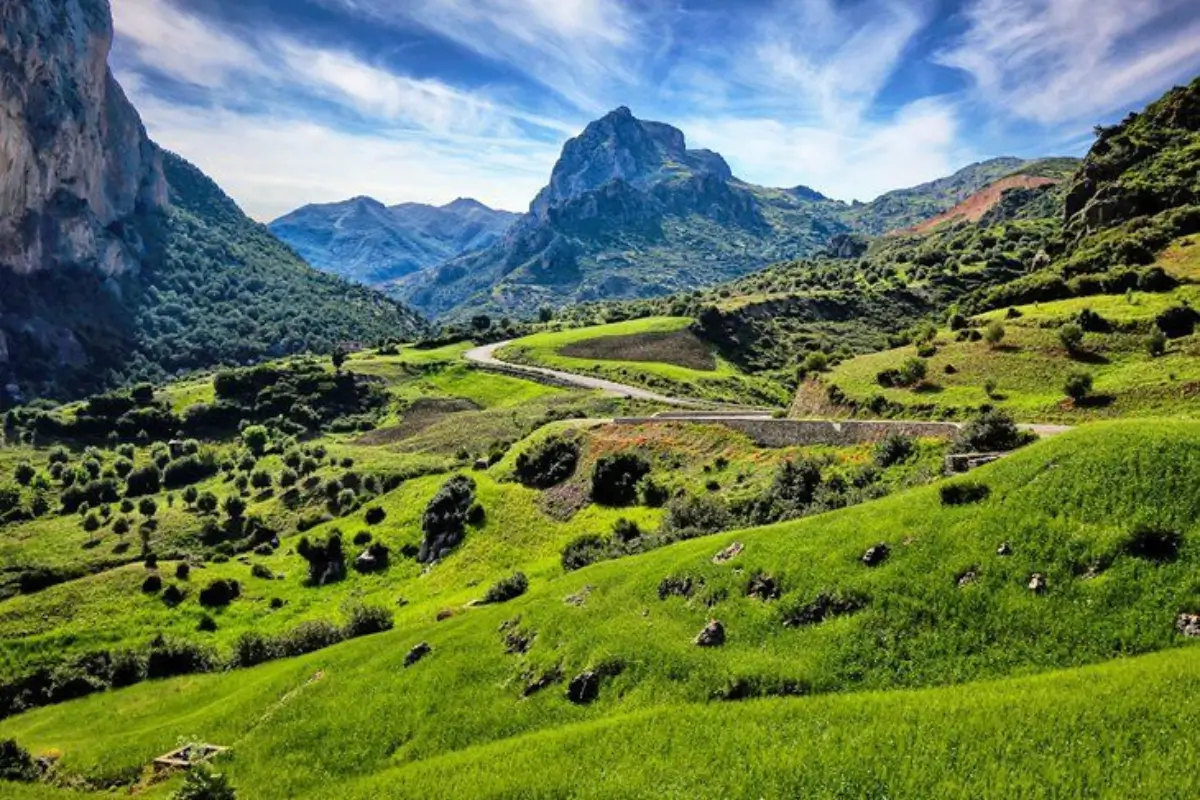
Chefchaouen runs cooler and more humid than the rest of the country year-round, and spring is no exception — it also holds the distinction of receiving the highest rainfall of any major Morocco destination in March, so packing for rain here matters more than almost anywhere else on a spring itinerary. By April and May, the Rif dries out considerably and becomes one of the more pleasant, green corners of the country to explore on foot, with wildflowers and fresh green hillsides that make a strong case for a late-spring visit specifically.
The Sahara Desert
The Sahara’s spring pattern is straightforward: it warms steadily from cool, comfortable days in March to genuinely hot ones by May, while nights follow the opposite trajectory, easing from a real chill in March toward a mild, comfortable warmth by May. Spring is also notably windier in the desert than autumn or winter, with dust and haze more likely on a dune excursion, so April in particular is worth planning around if crystal-clear skies matter to your trip. Travelers prioritizing comfortable nights over cooler days tend to prefer May for a desert camp, while those who prioritize cooler days lean toward March.
The Atlas Mountains
Snow lingers at higher elevations well into spring, particularly in March, while lower foothill trails begin opening progressively through April and May as the snowline retreats. Mornings stay crisp even as valley floors warm up, making layering essential for anyone planning a day hike or a multi-day trek during this season. Waterfalls and rivers throughout the Atlas also tend to run fuller in spring thanks to snowmelt, which makes destinations like the Ourika Valley or Setti Fatma particularly scenic during this window.
Atlantic Coastal Cities
Essaouira, Agadir, and the broader Atlantic coast stay the most consistent region in the country through spring, holding a mild, breezy 20-23°C (68-73°F) across all three months with comparatively little rain. This consistency makes the coast a reliable fallback for travelers whose spring dates don’t line up neatly with the best inland weather windows, and it’s also when the region’s trade winds begin building toward their summer strength, drawing early-season windsurfers and kitesurfers to Essaouira and Taghazout.
What to Pack for Morocco Weather in Spring
Clothing Essentials
Spring calls for breathable layers that flex through a wide daily temperature range — a lightweight base layer for warm afternoons, a cardigan or light jacket for cooler mornings and evenings, and at least one warmer layer if your route includes the Atlas or an early-spring desert night. Cotton and linen handle the daytime warmth far better than synthetics, and a scarf or shawl earns its place as both a modesty layer and protection against the north’s occasional spring showers.
Packing two or three lighter layers that combine for warmth, rather than one heavy jacket meant to do all the work alone, generally packs down smaller and adapts better to spring’s wide temperature range across a multi-region itinerary.
Footwear
Comfortable, well broken-in walking shoes matter for spring more than almost any other season, since it’s peak season for full days of medina exploring, and cobblestones don’t get any softer just because the weather is pleasant. Anyone planning a Rif or Atlas hike should bring real hiking boots rather than casual sneakers, particularly for March and early April routes that may still cross patches of snow or mud.
Breaking in new shoes before the trip, rather than on day one of a spring itinerary packed with walking, avoids one of the more common and entirely avoidable travel frustrations.
Travel Accessories
A compact umbrella or light rain shell is worth packing for a northern spring itinerary, particularly in March, alongside sunglasses and sunscreen for the desert and coastal legs where UV exposure stays strong regardless of the mild air temperature. A reusable water bottle and a scarf that doubles as sun and dust protection round out the list for nearly any spring route through the country.
A daypack for carrying these accessories through a full day of sightseeing is worth including too, particularly for travelers planning to combine a city day with an afternoon excursion into the surrounding countryside, common on a spring Marrakech or Fes itinerary.
Best Places to Visit During Morocco Weather in Spring
Marrakech
Spring is close to Marrakech’s ideal season: warm enough for rooftop dinners and pool afternoons, cool enough for full days of walking the souks and palaces without the summer’s punishing midday heat. Late March through April tends to offer the best balance of comfortable temperatures and manageable crowds before the late-spring peak, when accommodation prices and visitor numbers both climb toward their spring high point.
Chefchaouen
Visiting Chefchaouen in April or May, once the heaviest of the spring rain has passed, delivers the blue medina at its most photogenic — clear skies, green hillsides, and comfortable walking temperatures throughout the day. Photographers in particular tend to favor this window, since the combination of clear light and lingering greenery from the spring rains rarely lasts much beyond early summer.
Merzouga
March and early April strike the best balance for Merzouga and the Erg Chebbi dunes: warm, comfortable days and nights that, while still cool, are far more manageable than winter’s near-freezing lows, without yet reaching May’s considerable daytime heat. Travelers planning an overnight camel trek and desert camp specifically should weigh this window carefully against May’s warmer but windier conditions.
Dades Valley
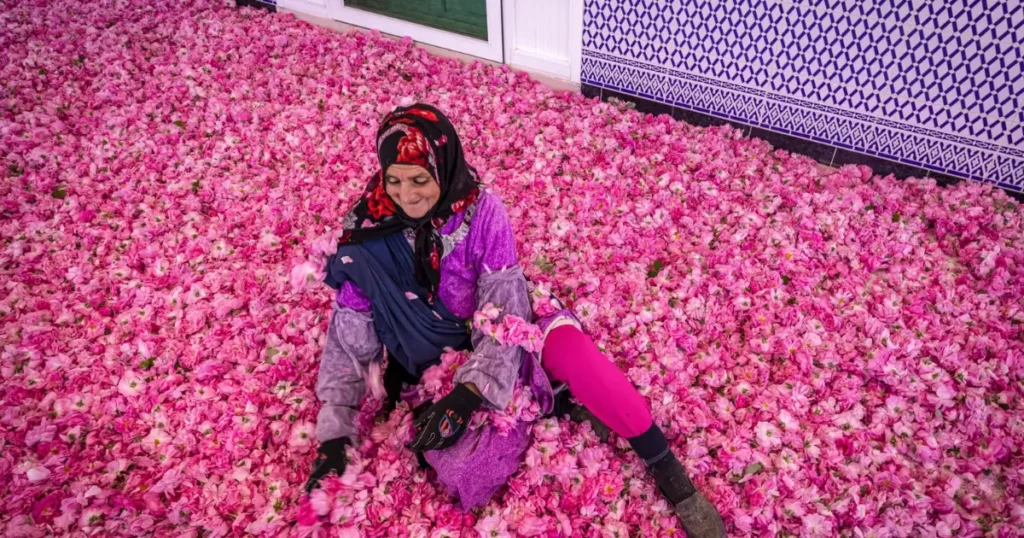
The Dades Valley, home to the Rose Festival and some of southern Morocco’s most dramatic gorge scenery, hits its best moment in late April and early May, when the Damask rose harvest is underway and the surrounding High Atlas foothills stay green from the spring rains. Mornings at the valley’s roughly 1,400-meter elevation stay cool even as the harvest festival gets underway, so a light jacket is worth carrying even on an otherwise warm May day.
Essaouira
Essaouira’s spring weather barely shifts from month to month, which makes it a dependable choice for travelers whose dates don’t align with the ideal inland window elsewhere. Its steady Atlantic breeze also means spring here runs noticeably cooler than Marrakech, just a few hours inland, which makes it a popular add-on for travelers looking to escape a hot late-spring stretch in the interior, or simply wanting a change of pace from the desert heat further south.
Spring Festivals Worth Planning Around
Rose Festival
The Rose Festival (Moussem des Roses) in Kelaat M’Gouna celebrates the annual Damask rose harvest with several days of parades, Amazigh music, craft markets, and the crowning of a Rose Queen. Exact dates shift with the harvest itself but typically land in the first half of May — 2026’s festival is expected around May 6-9 — and accommodation in the town fills up well ahead, so most visitors base themselves in nearby Skoura or Ouarzazate and make the short drive in for the festival days.
The festival has run continuously since 1962, and beyond the celebration itself, the drive through the Dades Valley in bloom is a strong reason to visit even outside the exact festival dates — the valley’s roughly 4,000 kilometers of rose hedgerows are at their most fragrant during this same spring window.
Fes Festival of World Sacred Music
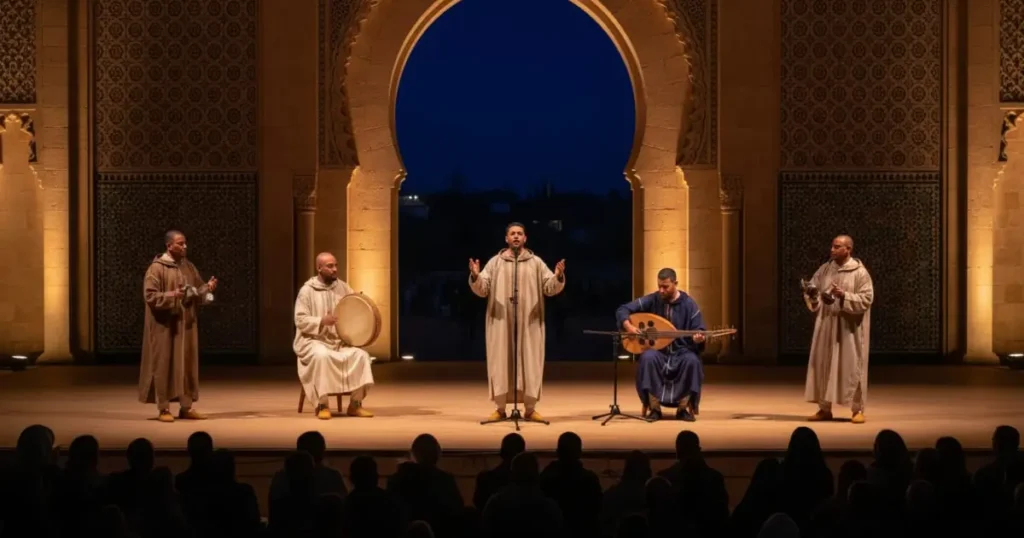
While the Fes Festival of World Sacred Music itself typically lands in June, just past the spring window, its build-up and surrounding cultural programming often begin in late spring, and Fes in May offers a genuinely pleasant preview of the city with fewer crowds than festival week itself. Travelers whose spring trip runs into early June sometimes catch the festival’s opening days as a natural extension of a spring itinerary, and Fes’s spring weather — warm days, cool evenings, and minimal rain by this point in the season — makes the city especially pleasant to explore in the run-up to the festival.
Morocco Weather in Spring: Travel Tips
Book Accommodation Early
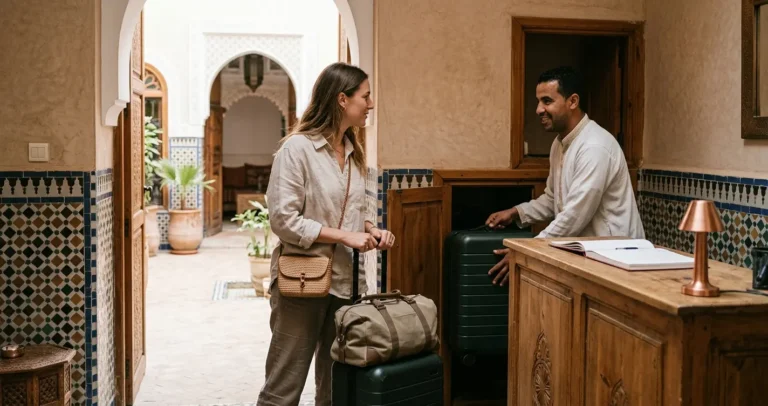
Spring, particularly April and May, is Morocco’s peak booking season, and riads, desert camps, and guided tours in popular destinations can sell out weeks or even months ahead. Booking three to four months in advance for a spring trip, especially one that includes the Rose Festival or a desert excursion over a weekend, meaningfully improves your odds of getting the property or tour you actually want, and often at a better rate than a last-minute booking would secure.
Prepare for Temperature Changes
Spring’s daily temperature swing is wider than it looks on paper — a 22°C afternoon in Marrakech can still mean a genuinely cool evening, and the gap becomes dramatic the moment your itinerary touches the desert or the mountains. Packing in layers rather than for a single expected temperature avoids the most common spring packing mistake, and checking each specific leg of a multi-region itinerary against its own regional weather, rather than assuming one temperature for the whole trip, pays off considerably.
Plan Outdoor Activities
Spring’s comfortable temperatures make it an excellent season for outdoor-heavy plans — Atlas hikes, desert camel treks, and long walking days in the medinas — but it’s still worth scheduling the most physically demanding activities for morning or late afternoon, particularly by May, when midday sun in Marrakech and the desert starts to carry real heat even if the air temperature reads as moderate. Building a rest or indoor stretch into the middle of the day, especially on a May itinerary, keeps the rest of the day considerably more enjoyable.
Morocco Weather in Spring: Frequently Asked Questions
Is Spring the Best Time to Visit Morocco?
For most itineraries, yes — spring offers the widest range of comfortable conditions across cities, desert, and mountains simultaneously, which is part of why it draws Morocco’s largest crowds alongside autumn. The trade-off is higher prices and more competition for accommodation, so travelers prioritizing value or quiet over ideal weather sometimes prefer the shoulder edges of the season, like early March or late May, when conditions are still good but demand hasn’t fully peaked.
Does It Rain in Spring?
Yes, particularly in March and particularly in the north — Chefchaouen and the Rif see the year’s heaviest rainfall in March, while Marrakech and the south stay considerably drier throughout the season. Rain drops off substantially by April and especially May, when many parts of the country see only a handful of rainy days for the entire month, and even March’s rain tends to arrive as scattered showers rather than sustained multi-day downpours.
Is the Sahara Too Hot in Spring?
Not for most of spring — March and April desert daytime temperatures are genuinely comfortable, and even May’s warmer days (often into the low-to-mid 30s°C) are manageable with proper sun protection and a well-timed itinerary that avoids the most intense midday hours. What catches some travelers off guard isn’t the daytime heat but the nighttime cold in March, when overnight desert camps still call for genuinely warm layers, sometimes more than visitors expect from a “spring” trip.
Can You Hike the Atlas Mountains in Spring?
Yes, though timing matters — March and early April routes may still cross snow or mud at higher elevations, making proper boots and layered clothing essential, while by late April and May, lower and mid-elevation trails open up fully and offer some of the year’s best hiking conditions. Higher summit routes, including toward Mount Toubkal, are generally more reliably snow-free from late spring onward, though conditions vary year to year and it’s worth checking current trail status with a local guide before committing to a higher-elevation route in early spring specifically.
Final Thoughts: Morocco Weather in Spring
Spring rewards a little planning more than a purely spontaneous approach, mainly because the season itself shifts so much between March and May, and because Morocco’s regions respond so differently to the same calendar month. Pick your month with your specific route in mind — early spring if the desert and mountains are the priority, late spring if the cities and the Rose Valley are — pack in layers regardless, and book ahead for anything popular.
Get those three things right, and spring delivers close to the best version of Morocco the calendar has to offer: warm enough for the coast, cool enough for the cities, and just unpredictable enough at the margins — a lingering patch of Atlas snow, a fragrant valley in full bloom — to make the trip feel genuinely alive rather than simply comfortable.