How Much Does 2 Weeks in Morocco Cost? Realistic Budgets Revealed
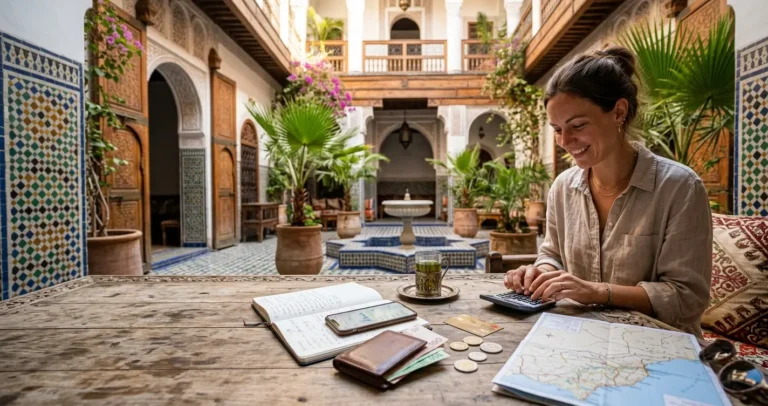
How much does 2 weeks in Morocco cost? Roughly 4,500 to 8,000 dirhams per person for a budget trip, 10,000 to 18,000 for mid-range and 30,000 to 50,000 or more for luxury. In US dollars, that is about $485 to $860, $1,075 to $1,935 and $3,225 to $5,375 or more, using roughly 9.3 dirhams to the dollar. All figures are per person and exclude international flights.
Four things move the total more than anything else: where you sleep, how you travel between cities, which destinations you choose and whether you add a Sahara tour. A fortnight also magnifies small habits. A restaurant habit that adds 200 dirhams a day adds 2,800 over the trip, and every extra hotel change costs both a transfer and half a day.
This guide breaks the Morocco travel cost for 14 days into six expense categories, then builds three itemized sample budgets so you can see exactly how the numbers add up. For the daily spending behind these totals, see our Morocco Daily Budget guide, and for shorter trips, Morocco Travel Cost for 7 Days and Morocco Travel Cost for 10 Days.
How Much Does 2 Weeks in Morocco Cost?
These are planning estimates, not fixed prices. Published estimates vary with accommodation standards, route and whether major excursions are included, so check current prices before you book. The ranges below assume 13 nights of accommodation, which is typical for a 14-day trip with flights on the first and last days.
| Travel style | Estimated cost per person (MAD) | Approximate USD |
|---|---|---|
| Budget | 4,500–8,000 MAD | $485–860 |
| Mid-range | 10,000–18,000 MAD | $1,075–1,935 |
| Luxury | 30,000–50,000+ MAD | $3,225–5,375+ |
The lower end of each band assumes you skip the desert, and the upper end includes a three-day Sahara tour. The Sahara tour is a single line, and the nights and meals it covers are not counted again. International flights, shopping and insurance are separate, and we list them near the end. Exchange rates move, so check the current rate before you travel.
What Counts as a Budget Trip?
A budget trip means dorm beds or simple guesthouses, meals at local cafés and street stalls, buses and public transport and a few carefully chosen paid sights. Over two weeks it is perfectly workable, and it can include a shared Sahara tour. It leaves little room for private transfers, guided days or rooftop dinners.
What Can You Expect From a Mid-Range Budget?
A mid-range budget buys a comfortable riad with breakfast, a mix of local and sit-down restaurants, buses or trains between cities and a handful of experiences, such as a guided medina tour, a cooking class and a hammam. This is where most visitors find the best balance of comfort and value.
What Makes a Morocco Trip Luxury?
Luxury begins when accommodation leaves the standard range. Premium riads and resorts, private drivers, fine dining, private guides and a luxury desert camp all push the total upward, and accommodation alone can account for well over a third of the budget.
How Much Does 2 Weeks in Morocco Cost? The 6 Main Expenses
The cost of a two-week Morocco vacation is easiest to understand one category at a time. These six lines make up nearly every total in this article.
1. Accommodation for 13 Nights
Accommodation is usually the largest line. Rates depend on room-sharing, seasonal demand and location, and prices rise around public holidays and in the most popular months.
- Hostels and basic guesthouses: about 100 to 200 dirhams for a dorm bed, or 250 to 450 for a private room, which is 125 to 225 per person when shared.
- Mid-range riads and hotels: roughly 700 to 1,300 dirhams per room, or 350 to 650 per person when shared.
- Luxury riads and resorts: from about 1,800 dirhams per room, rising well past 4,000 for suites and premium properties.
A central location costs more per night but saves taxi fares and time, so compare locations as well as prices.
2. Food and Drinks for 14 Days
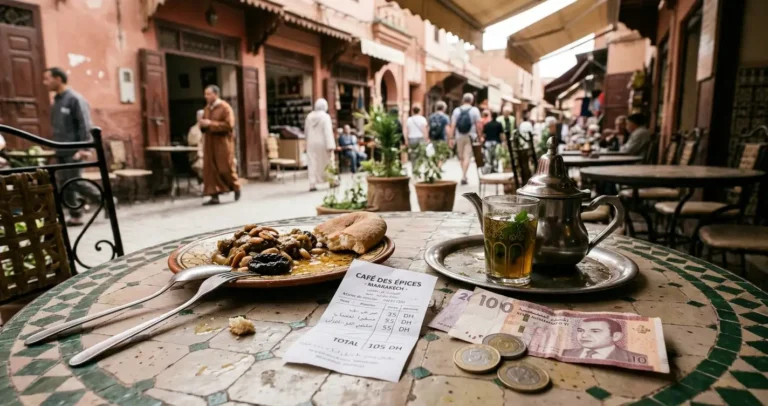
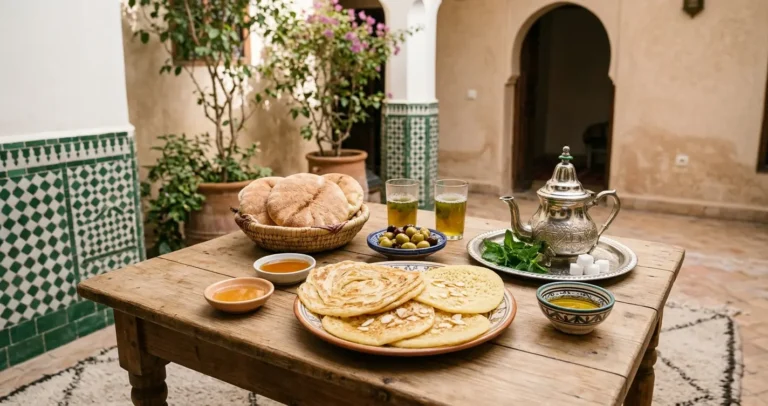
Food is where Morocco gives its best value, and over two weeks it is also where eating habits show. A traveler who favors local cafés and stalls might spend 100 to 200 dirhams a day, while one who prefers sit-down restaurants may spend 300 to 500 and a fine-dining traveler 800 or more. Do not assume everyone eats the same way, and adjust the lines to your own habits.
Add coffee, bottled water, snacks and tips, which are small each day but accumulate across fourteen days. Rooftop and tourist-oriented restaurants cost noticeably more than local ones for similar food.
3. Transportation Between Cities
Intercity travel depends on how many places you visit. Trains and buses are the best value, petit taxis and trams handle local trips, and rental cars, fuel, tolls and private drivers cost much more.
Short bus legs are modest. The samples below assume roughly 100 to 120 dirhams each way between Marrakech and Essaouira, so check current fares. Longer routes cost more, and private transfers are priced per vehicle. Every extra city adds at least one transfer, so a route with fewer stops is cheaper and less tiring. For the wider picture, see Getting Around Morocco.
4. Attractions and Activities
Historic sites and museums usually cost between 20 and 150 dirhams each. Guided city tours run about 230 to 370 dirhams for a half day, cooking classes commonly 350 to 700, and hammams range from very cheap local baths to spa treatments at several hundred dirhams. Free activities, such as wandering medinas, walking the coast and watching sunset from a rooftop, fill many hours at no cost.
5. Sahara Desert Tour
A Sahara tour is a single large purchase, so budget it as its own line. Shared three-day group tours from Marrakech to Merzouga are listed from roughly $100 to $400 per person, depending on the operator and camp standard. Private tours with a dedicated vehicle cost several times more, and some listings exceed $1,000 for the vehicle.
A standard camp usually offers a private tent with shared bathrooms, while a luxury camp adds private bathrooms and finer dining. Typical packages include transport, two nights (one on the way and one in the camp), dinners, breakfasts and a camel ride. Lunches, drinks, tips and local guide fees are usually extra.
Avoid double-counting. If the tour covers two nights and several meals, do not add them again under accommodation and food. The samples below subtract them. See our Merzouga destination guide for more on the desert.
6. SIM Card, Tips and Unexpected Expenses
Add an allowance for mobile data, small purchases, tips and emergencies. A tourist SIM often costs around 100 dirhams for a modest package, though prices vary. Tips for guides, drivers and restaurant staff accumulate over two weeks, and a contingency protects you from surprises. The samples use between 600 and 2,900 dirhams for this line, depending on the travel style.
Three Realistic Budgets for 14 Days in Morocco
All three samples use the same route so you can compare them directly: three nights in Marrakech, three in Essaouira, two more in Marrakech, a three-day Sahara tour (two nights included) and three final nights in Marrakech. That is 13 nights, 11 of them paid as hotel nights and two covered by the tour.
Each sample is per person, assumes a shared double room and includes the Sahara tour. It also includes a bus or private transfer between Marrakech and Essaouira each way, and it excludes flights, insurance, visas and shopping. The food lines count 11 town days at a full daily rate, three lunches on tour days and one dinner on the evening you return from the desert.
Budget Traveler — Two Weeks for Less
This traveler uses dorm beds or half of a simple guesthouse room, eats local food, takes buses and joins a shared tour with a standard camp.
| Item | Calculation | MAD |
|---|---|---|
| Accommodation | 11 nights × 150 | 1,650 |
| Sahara tour (shared, standard camp) | 1 tour | 1,300 |
| Food | 11 town days × 160 + 3 tour lunches × 60 + 1 dinner × 80 | 2,020 |
| Intercity transport (bus, both ways) | 2 × 100 | 200 |
| Local transport | 14 days × 30 | 420 |
| Attractions | 8 sights × 70 | 560 |
| SIM, tips and buffer | 100 + 200 + 300 | 600 |
| Total | 6,750 (about $726) |
The average is about 482 dirhams a day. Without the Sahara tour, a similar plan would cost roughly 5,970 dirhams, because you would pay for two extra hotel nights and meals, so the tour adds less than its price.
Mid-Range Traveler — Comfort Without Overspending
This traveler shares a 1,000 dirham riad room with breakfast, mixes local and nicer restaurants, takes buses between cities and joins a shared tour with an upgraded camp.
| Item | Calculation | MAD |
|---|---|---|
| Accommodation | 11 nights × 500 | 5,500 |
| Sahara tour (shared, upgraded camp) | 1 tour | 2,200 |
| Food | 11 town days × 400 + 3 tour lunches × 100 + 1 dinner × 200 | 4,900 |
| Intercity transport (bus, both ways) | 2 × 120 | 240 |
| Local transport | 14 days × 70 | 980 |
| Activities | 8 entrances × 100 + guided medina tour 300 + cooking class 500 + hammam 300 | 1,900 |
| SIM, tips and buffer | 100 + 500 + 600 | 1,200 |
| Total | 16,920 (about $1,819) |
The average is about 1,209 dirhams a day. A solo traveler paying the full 1,000 dirham room would add 5,500 dirhams, for about 22,420.
Luxury Traveler — Premium Stays and Private Experiences
This traveler shares a 3,200 dirham room at a high-end riad, dines well, uses private transfers and guides, and takes a private Sahara tour with a luxury camp. The private vehicle is shared by two, so each person pays half.
| Item | Calculation | MAD |
|---|---|---|
| Accommodation | 11 nights × 1,600 | 17,600 |
| Sahara tour (private vehicle, luxury camp) | 1 tour, half the vehicle cost | 6,500 |
| Food | 11 town days × 800 + 3 tour lunches × 250 + 1 dinner × 500 | 10,050 |
| Private transfers (Marrakech–Essaouira, both ways) | 2 × 500 | 1,000 |
| Local transport and private driver | 14 days × 200 | 2,800 |
| Activities | Private guide 800 + spa and hammam 800 + private cooking class 700 + 8 entrances × 100 | 3,100 |
| SIM, tips and buffer | 100 + 1,200 + 1,600 | 2,900 |
| Total | 43,950 (about $4,726) |
The average is about 3,139 dirhams a day. For a couple, double each total: 13,500 dirhams for the budget sample, 33,840 for mid-range and 87,900 for luxury, excluding flights and shopping.
How Your Morocco Route Affects the Total Cost
Your route can change the total as much as your hotel category. Long distances, frequent hotel changes and private transfers all add cost, while a compact route saves money and energy. Our 10-Day Morocco Itinerary and 7-Day Morocco Itinerary show how to link destinations efficiently, and Best Time to Visit Morocco covers the seasons.
Marrakech and the Atlantic Coast
This is the cheapest structure for intercity travel. Marrakech, Essaouira and Agadir are linked by short road routes, so transfers are modest and most of the money goes to accommodation, food and activities. For route details, see Essaouira to Agadir and Agadir to Marrakech.
Marrakech, Aït Ben Haddou and the Sahara
Transfers dominate this route, and the desert tour is the largest single line. Costs rise with the camp standard and with whether the vehicle is shared or private. The long road back needs time, and our guides to Ouarzazate to Merzouga and Merzouga to Marrakech cover the legs.
Tangier, Chefchaouen, Fes and the Imperial Cities
The northern loop relies on trains and buses, which keeps individual fares moderate, but the hotel changes add up. As examples, listings have shown the Tangier to Fes trip at roughly 150 to 330 dirhams and the Rabat to Chefchaouen bus at around 100 to 200, though fares change. See Tangier to Fes, Rabat to Chefchaouen and Merzouga to Fes for the details.
A Grand Route Across Morocco
Covering the north, the Atlas and the Sahara in 14 days means long distances and many hotel changes. Each move costs a transfer and half a day, private transport raises the total, and backtracking is the most common source of avoidable expense. For help ordering your stops, How to Plan a Morocco Route: 9 Smart Ways to Save Time covers itinerary planning.
How to Save Money on a Two-Week Morocco Trip
Choose Accommodation for Value and Location
A cheaper room far from the sights can cost more in taxis and time. Include breakfast where possible, share rooms when you can and check the route to the property, since medina lanes are hard with luggage. Our Morocco Budget Guide offers more context.
Compare Train, Bus and Private Transport Costs
Trains and established bus operators offer predictable prices and comfort, while private transfers cost more but save time and suit groups. Compare the full cost of each leg, including station transfers.
Eat Locally and Plan Special Meals Selectively
Eat most meals at local restaurants and stalls, then choose two or three memorable dinners. Over fourteen days, this keeps the food line low without losing the experience.
Compare Desert Tours by Their Inclusions
A cheap tour may exclude meals, a decent camp or guide fees, and a dearer one may include them. Compare what each package covers, not just the headline price.
Avoid Unnecessary Backtracking
Order your destinations so you move in one direction where possible. Every return to a previous city costs a transfer you did not need.
Travel Outside Peak Demand Periods When Practical
Public holidays and school holidays tend to raise prices and reduce availability, while quieter periods may offer more choice. No period is cheapest everywhere, and weather matters, since inland heat in summer and cold desert nights in winter affect comfort.
Costs That Are Not Included in Your Budget
The estimates above leave out several costs, which you should add to the ground budget for a more complete trip estimate:
- International flights
- Travel insurance
- Visa or document expenses, where applicable, so check the current requirements for your nationality
- Shopping and souvenirs
- Optional upgrades and unexpected expenses
Add your own figures for each to reach your full total. The most useful single step is to choose your accommodation level and decide whether you want a Sahara tour, since those two choices set most of the Morocco two-week trip cost, then build the rest around them.
Frequently Asked Questions
Is 5,000 MAD enough for two weeks in Morocco?
Only with a very lean plan. The budget sample above costs 6,750 dirhams with a Sahara tour, so 5,000 would mean skipping the tour, staying in dorm beds, eating mostly street food and limiting paid sights. That works out to roughly 357 dirhams a day, which leaves little margin for surprises. If you want a comfortable budget trip, plan for at least 6,000 to 7,000, and add flights, insurance and shopping separately.
Is 10,000 MAD enough for 14 days in Morocco?
It is enough for a budget trip with a desert tour, which costs about 6,750 dirhams in the sample, and it leaves room for some upgrades. It is not enough for the mid-range sample, which costs about 16,920. A mix is possible, such as a few nights in a nicer riad on a budget base, but a full mid-range fortnight with a tour needs more. Solo travelers paying a full room should plan for more.
How much does a two-week Morocco trip cost for a couple?
Multiply the per-person figures by two, since the samples already assume a shared room and a shared vehicle. That gives roughly 13,500 dirhams for the budget sample, 33,840 for mid-range and 87,900 for luxury, including a three-day Sahara tour and excluding flights, insurance and shopping. Accommodation remains the largest cost, and a couple saves a little by sharing private transport.
Does the budget include a Sahara Desert tour?
The samples do, and the upper end of each range assumes one. If you skip the tour, the total falls, but not by the tour’s full price, because you would pay for two extra hotel nights and meals. The tour covers transport, two nights, dinners and breakfasts, so avoid counting those again. Lunches, drinks, tips and guide fees are usually extra.
How much spending money should I bring for two weeks?
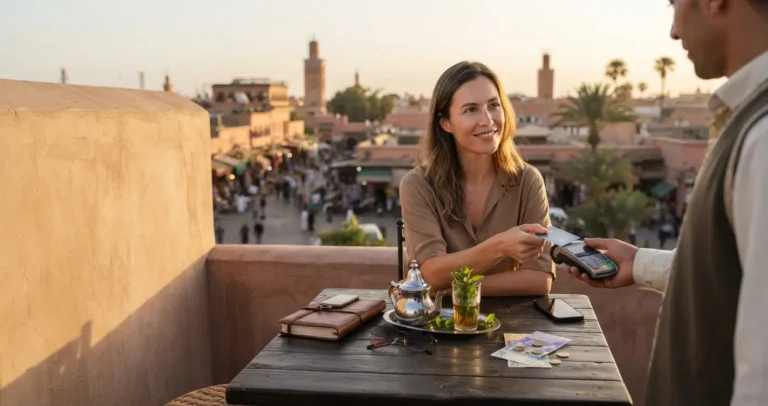
Hotels, tours and some larger restaurants can be paid in advance or by card, so spending money mostly covers day-to-day costs. In the samples, food, local transport, attractions and miscellaneous items come to roughly 3,600 dirhams for a budget traveler and 8,980 for mid-range. Small cafés, taxis, markets and tips usually need cash, and ATMs are common in cities. Check current rules on exchanging or taking dirhams out of the country.
Is Morocco affordable for luxury travelers?
Yes, relative to many destinations, though luxury here is not cheap. The luxury sample costs about 43,950 dirhams per person, roughly $4,700 excluding flights, and that buys premium riads, private guides, fine dining and a private desert trip. Prices climb steeply for the top properties and for private vehicles, so decide where luxury matters most. Our Morocco Daily Budget guide shows how the daily costs build up.
Is it cheaper to travel independently or book an organized tour?
Independent travel is usually cheaper per day, because you avoid operator margins and can choose budget accommodation and public transport. An organized tour costs more but saves planning time and handles logistics, which can be worth it on complex routes. The Sahara is the common exception, since a shared group tour often works out cheaper than arranging the transport yourself. Compare what each option includes, not just the headline price. If you travel independently, check the route guides linked above before you book.