Berber Culture in Morocco : Fascinating Traditions You Need to Discover
Berber culture in Morocco is not a single tradition preserved in the mountains. It is a living set of languages, crafts, rituals and habits of hospitality that runs from the Rif to the Sahara. Long before Morocco took its modern shape, Amazigh communities were farming terraces, herding flocks across the Atlas and trading through the desert. Those communities still shape how the country speaks, eats, dresses and celebrates. This guide follows that thread, region by region and craft by craft, and ends with practical advice on meeting people respectfully.
Who Are the Amazigh People of Morocco?
The Meaning of “Amazigh” and “Berber”
“Amazigh” (plural Imazighen) is the name people use for themselves. It is often translated as “free people”, though linguists debate the exact origin. “Berber” comes from outside, ultimately from the same root as “barbarian”, and many Amazigh people prefer not to use it. The word still appears in everyday travel language, so this guide uses both.
The Amazigh Peoples of North Africa
Amazigh communities live across North Africa, from Morocco and Algeria to Tunisia, Libya, Egypt’s Siwa Oasis and the Sahel. They share related languages and cultural echoes, but no single identity. Kabyle, Tuareg, Chenoua and Moroccan Amazigh groups each have their own dialects and customs.
Amazigh Communities Across Morocco
In Morocco, three broad groups are usually described: Rifian speakers in the north, Middle Atlas and central High Atlas communities, and Soussi communities in the south-west. Estimates of the Amazigh-speaking population vary widely, depending on how people are counted and how they identify. Many Moroccans move between Amazigh and Arabic identities, and the two are not always separate.
The History of Amazigh Culture in Morocco
Amazigh Heritage Before Arab-Islamic Influence
Amazigh peoples have lived in the region for thousands of years, well before Phoenician traders, Romans or Arab armies arrived. Ancient writers described kingdoms and tribes in what is now Morocco, and rock engravings and early inscriptions in the Atlas and the south point to a long-established culture. The details of early history remain debated among historians.
Arab and Amazigh Cultural Exchange
Islam spread across Morocco from the seventh century, and Arabic became the language of scholarship and administration. Amazigh dynasties later ruled the country, including the Almoravids and Almohads, and Amazigh scholars, saints and soldiers shaped Moroccan Islam. Exchange ran in both directions, which is why many Moroccan words, foods and customs are hard to label as purely one or the other.
Amazigh Identity in Modern Morocco
The colonial era complicated the picture, since French protectorate policy treated Amazigh and Arab populations differently, which left lasting suspicion. After independence, Amazigh culture was often sidelined in official life. Cultural associations pushed for recognition over the following decades, and that movement is the background to the reforms covered later in this guide.
Amazigh Languages in Morocco
Tamazight, Tarifit and Tashelhit
Three main varieties are spoken. Tarifit belongs to the Rif in the north, Tamazight to the Middle Atlas and central High Atlas, and Tashelhit to the Souss, the western High Atlas and the Anti-Atlas. They are related but not always mutually easy to understand. “Standard Moroccan Amazigh” is the standardized form taught in schools and used in official settings.
Tifinagh and the Amazigh Alphabet
Tifinagh is the script of the Amazigh language family, with ancient roots. The version used in Morocco today is a modernized form adopted by the Royal Institute of Amazigh Culture (IRCAM) in the early 2000s. You will see it on street signs, public buildings and shopfronts, often beside Arabic and French.
Where Amazigh Languages Are Spoken
Amazigh languages are most alive in mountain villages, southern oases and family homes. In big cities, many speakers use them mainly among relatives, and younger urban Moroccans may understand more than they speak. Travelers who learn a few greetings often notice how quickly a conversation warms up.
Amazigh Villages and Mountain Life
Life in the High Atlas
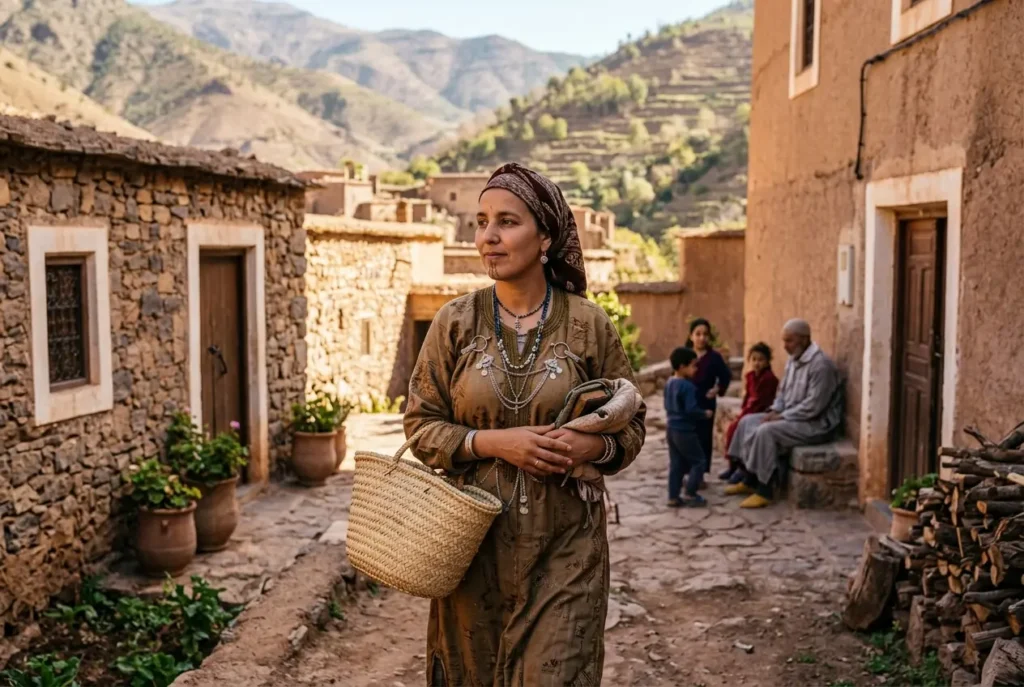
High Atlas villages are built into steep valleys, with stone or earthen houses stepping up the slope and small terraced fields below. Barley, walnuts, apples and livestock support many households, and some families still move animals between seasonal pastures. Winter is long and cold, so daily life follows the weather.
Amazigh Villages in the Anti-Atlas
The Anti-Atlas is drier and rockier, with palm groves, argan trees and villages the color of the surrounding stone. Around Tafraoute, almond blossom colors the valleys in late winter. Farming here depends on carefully managed water, and older villages often keep collective granaries and watchtowers.
Community and Village Traditions
Many villages rely on shared decision-making, with elders and local assemblies handling matters like irrigation, pasture and disputes. Collective granaries, called agadirs in some regions, are one visible sign of this shared approach. Traditional structures are changing, but they still matter in many communities.
Hospitality in Amazigh Culture
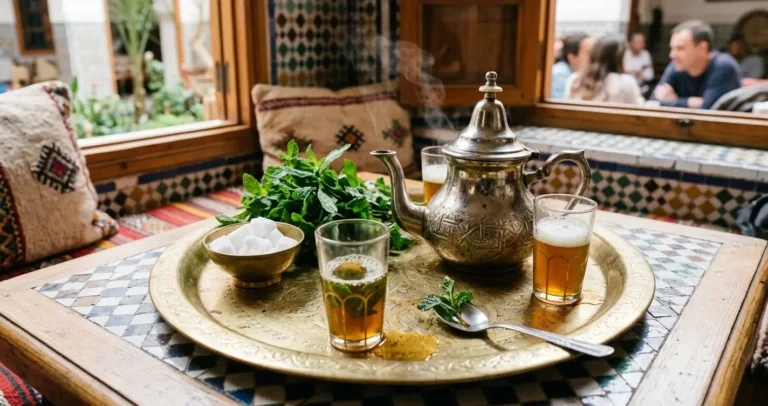
A visitor who reaches a village is traditionally offered tea, bread and a place to sit. Refusing outright can feel awkward, so accept a glass and take your time. Hospitality here is a social duty, not a tourism product.
Amazigh Family and Community Traditions
The Importance of Family
Extended family is the center of village life. Several generations may share a compound or live within walking distance, and relatives help with harvests, weddings and mourning. Family reputation carries weight, and decisions are rarely made alone.
Community Cooperation
Shared work has long been a survival strategy in mountain regions. Neighbors help each other build houses, gather crops and maintain irrigation channels, often with the expectation that the favor will be returned. This reciprocity is a quiet backbone of rural life.
Hospitality and Welcoming Guests
Welcoming guests is treated as a mark of a household’s character. Even modest homes may offer a full meal on short notice. If you are invited, small gifts such as sugar, tea or fruit are usually appreciated.
Passing Traditions Between Generations
Songs, proverbs, recipes and weaving patterns have mostly been taught by example, at home and in the fields. Grandmothers and mothers play a central part in passing on textile skills and oral poetry. As younger people move to cities, that chain of transmission is under pressure, and it is one reason cooperatives and schools now try to record and teach traditional skills.
Amazigh Clothing and Traditional Dress
Traditional Clothing for Men
Men’s dress traditionally includes the djellaba, a hooded woolen robe suited to mountain winters, and the burnous, a heavier cloak. In the south, turbans are common, and in some Saharan settings indigo-blue cloth is closely associated with desert dress. Many men now wear Western clothes day to day, saving traditional garments for festivals or colder months.
Traditional Clothing for Women
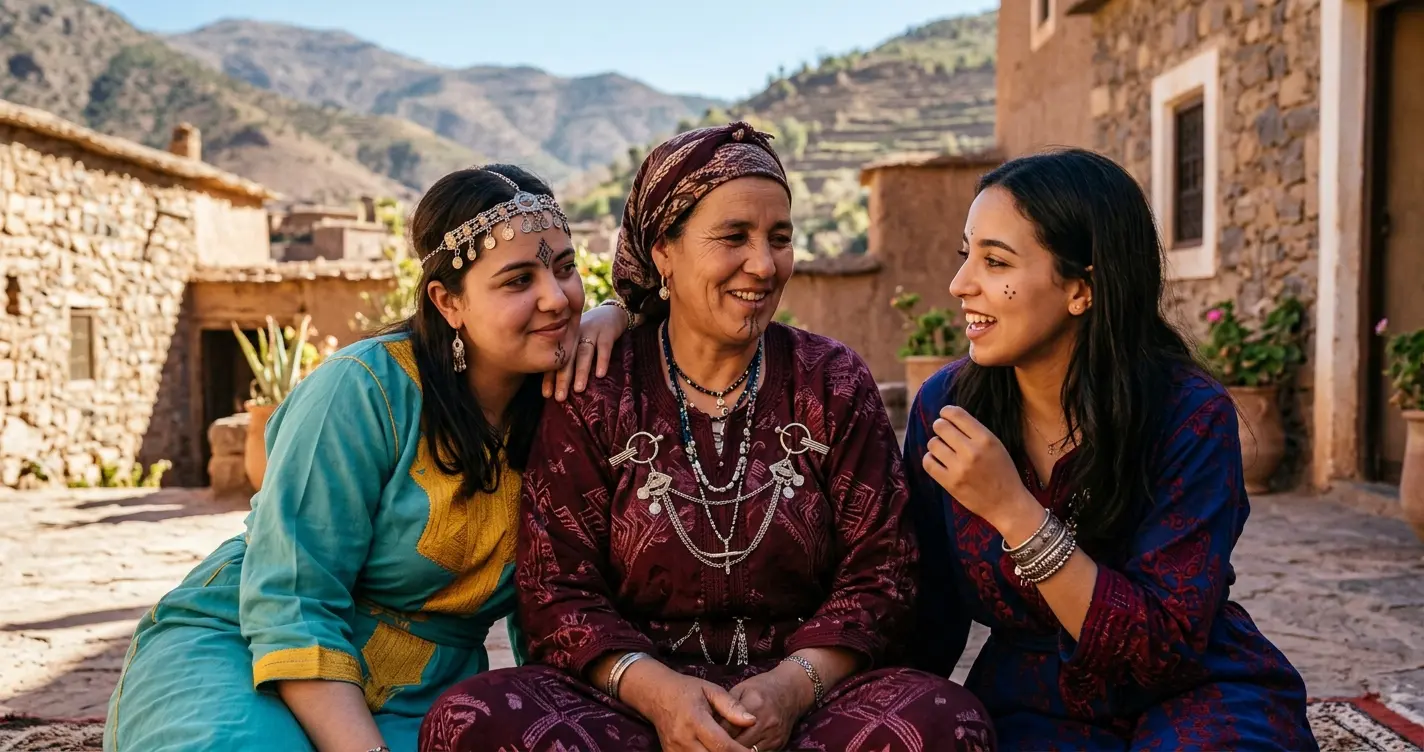
Women’s dress varies widely, but often includes long wraps, layered dresses, headscarves and shawls in bright colors or striped wool. In the Rif, striped wrap skirts and wide straw hats are part of local costume. Everyday clothing has become more standardized, but many women still wear regional pieces for weddings and celebrations.
Jewelry and Cultural Identity
Jewelry was traditionally worn to show a woman’s family, region and stage of life. It also served as portable wealth. The following section looks at jewelry in more detail.
Regional Differences in Amazigh Dress
Colors, patterns, cuts and fabrics differ from valley to valley. A cloak in the Anti-Atlas may look very different from one in the Middle Atlas. If you want to understand a region’s dress, ask local artisans rather than relying on generalizations, since even neighboring villages can disagree about tradition.
Amazigh Jewelry and Symbolism
Silver Jewelry
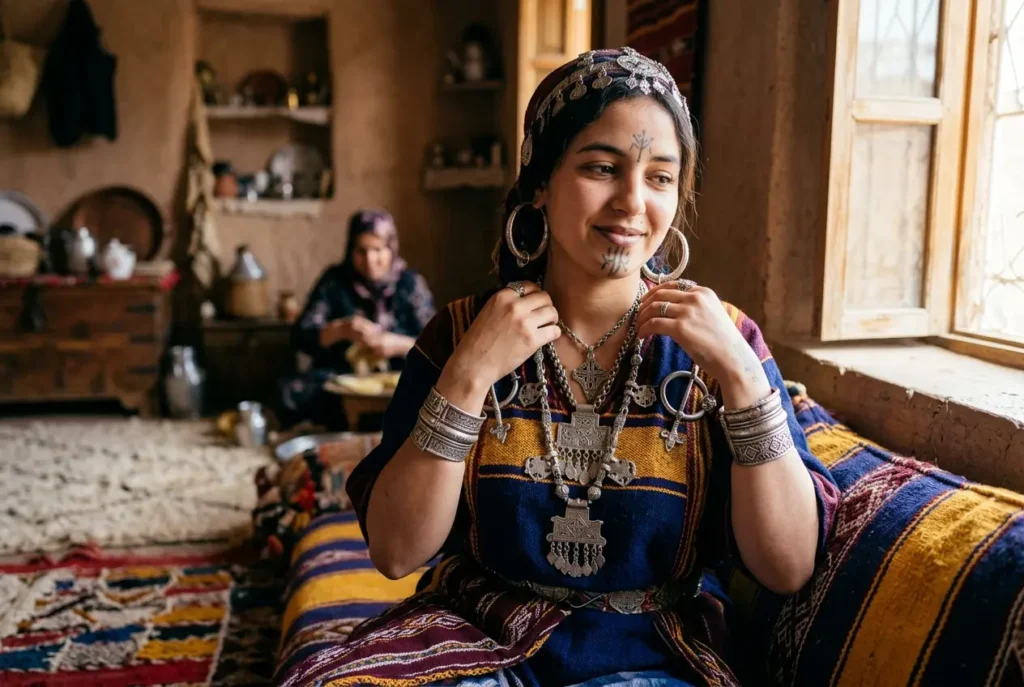
Silver has long been favored, and towns such as Tiznit in the south are known for silverwork. Pieces often include necklaces, bracelets and headpieces set with coral, amber or enamel. Older pieces are prized, though many modern items are made for visitors.
Berber Fibulas and Brooches
Fibulas are large triangular brooches used to fasten women’s cloaks or wraps. They can be heavy and decorative, and they often carry engraved patterns. Traditionally they were as practical as they were ornamental.
Geometric Designs and Symbolism
Triangles, diamonds, dots, crosses and zigzags recur across jewelry, textiles and tattoos. People often link these shapes to protection, fertility or the natural world. Meanings differ by region and family, and it is best to treat any single “translation” as one interpretation rather than fact.
Jewelry as Heritage Rather Than Decoration
For many families, jewelry is inherited and tied to memory, marriage and status. It was once a woman’s financial security as well. This helps explain why old pieces are treated with care, and why buying an authentic antique should be done thoughtfully.
Amazigh Music and Dance
Ahidous
Ahidous is a collective dance and song tradition found in the Middle Atlas and parts of the High Atlas. Participants form rows or circles, often shoulder to shoulder, singing call-and-response poetry to the beat of frame drums. It is as much a social event as a performance.
Ahwash
Ahwash is associated with Tashelhit-speaking regions of the High Atlas, the Anti-Atlas and the south. It combines group singing, drumming and choreographed movement, and it is usually performed in the evening at celebrations. The style and rhythm vary noticeably between villages.
Gnawa and Amazigh Cultural Connections
Gnawa music has roots in sub-Saharan communities and is distinct from Amazigh traditions. The two often meet in the south and in cities such as Essaouira, where musicians borrow rhythms and share stages. Treating them as separate but connected traditions is more accurate than merging them.
Music at Weddings and Celebrations
In many communities, weddings and seasonal festivals bring the whole village together. Musicians play instruments such as the bendir frame drum, and poets may compete or improvise verses. If you are invited to watch, ask whether photographing or filming is welcome.
Amazigh Weddings and Celebrations
Traditional Wedding Customs
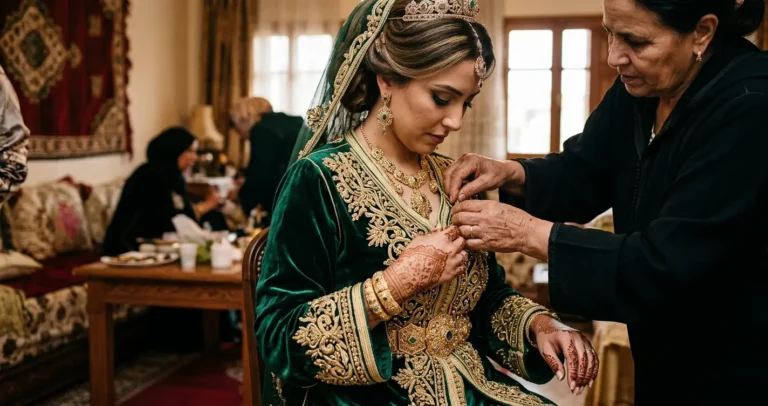
Traditional weddings can last several days and involve families, neighbors and the wider village. Steps often include negotiations between families, henna, ceremonial processions and shared feasts. The bride’s dress and jewelry are typically central.
Music, Dance and Community Gatherings
Music and dance run through the celebration, with community singing and drumming late into the night. Men and women may take part in different ways depending on local custom. Guests are generally treated with warmth.
Regional Differences in Wedding Traditions
Practices vary between the Rif, the Atlas, the Souss and the oases, in food, dress, rituals and length of celebration. There is no single Amazigh wedding, only a family of related customs. Be careful with any source claiming otherwise.
How Traditions Are Changing Today
Modern weddings may be shorter, held in event halls and mix older customs with contemporary trends. Costs, migration and changing expectations all play a part. Many families still keep key rituals, while dropping others.
Amazigh Food and Traditional Cuisine
Traditional Amazigh Bread
Bread is central to village meals, often made from barley or wheat and baked at home, in communal ovens or on clay griddles. It is used to scoop, wrap and share food. Ask before tearing bread from a shared table, since etiquette varies.
Couscous and Regional Cooking
Couscous is a staple across Morocco, especially on Fridays, and is served with vegetables and meat in many mountain households. In the south, ingredients such as argan oil, almonds and barley appear more often. Amlou, a spread of argan oil, almonds and honey, is a well-known southern specialty.
Tagine in Amazigh Communities
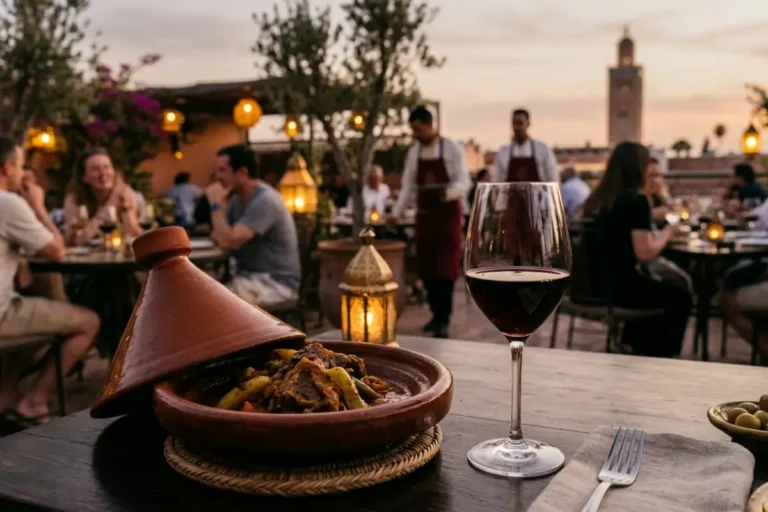
The tagine takes its name from the conical clay pot in which it is cooked slowly over low heat. In rural areas, it is a practical way to cook with little fuel. Recipes change with the season and the household.
Food, Hospitality and Shared Meals
Meals are traditionally served from a communal dish, and eating together is a form of welcome. Wash your hands, use the right hand for eating, and follow your host’s lead. For more on Moroccan cooking, see our guide to street food.
Amazigh Crafts and Traditional Arts
Berber Carpets
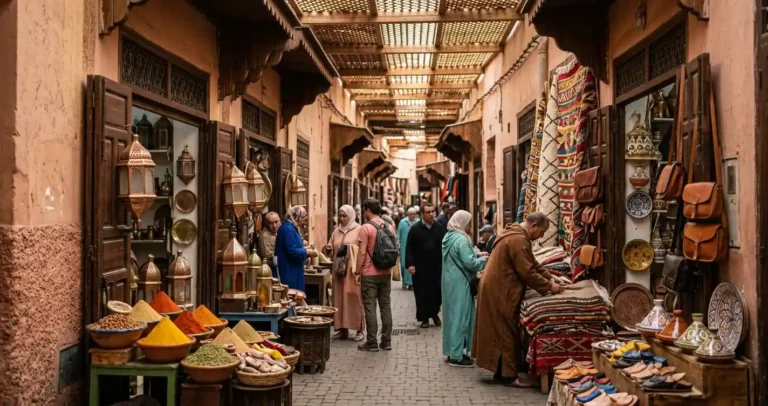
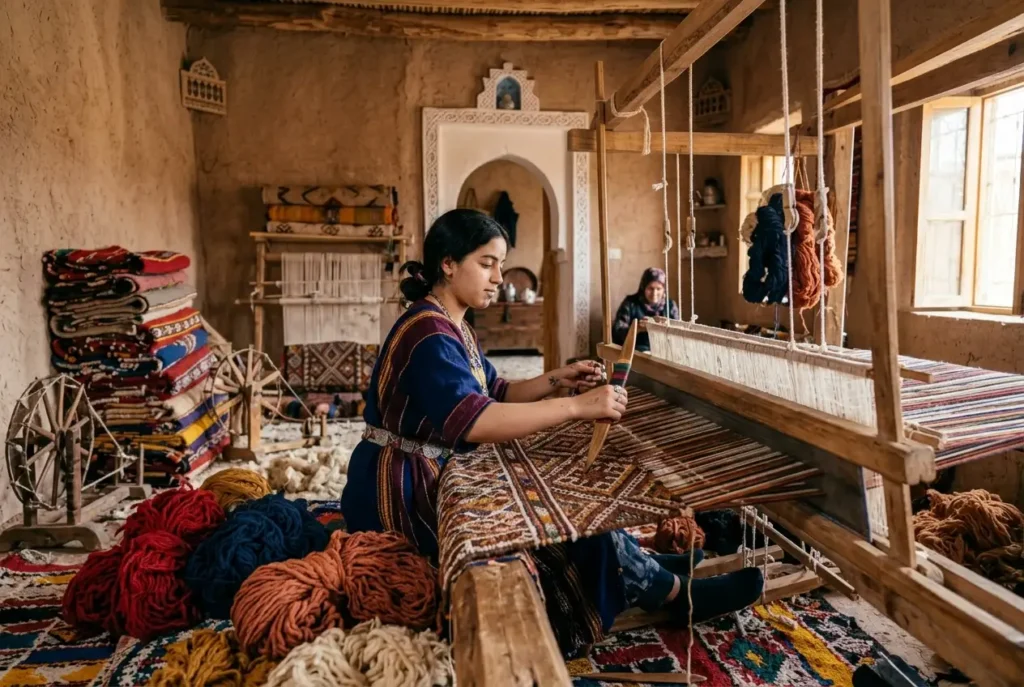
Handwoven carpets are among the best-known Amazigh crafts. Beni Ourain rugs from the Middle Atlas are typically cream wool with dark geometric lines, while Azilal and Taznakht rugs use brighter colors and varied patterns. Each weaver brings personal choices to the design.
Pottery
Pottery ranges from everyday cooking vessels to decorated ceramics. In the south, the village of Tamegroute is known for its green-glazed pottery. Buying directly from potters helps support the craft.
Basketry
Baskets made from palm leaves, reeds and other local materials serve for carrying, storing and winnowing. They are usually made by women in rural communities. Basketry is less visible to visitors than carpets, but it remains part of daily life.
Weaving and Textile Traditions
Wool is spun, dyed and woven into blankets, cloaks and household textiles. The handira, a woven wedding blanket from the Middle Atlas, is decorated with sequins and fringes. Textile skills are a major way of passing on identity, and they are increasingly supported by cooperatives.
Amazigh Symbols and Tattoos
Traditional Amazigh Tattoo Practices
Traditionally, some Amazigh women wore tattoos on the face, hands or arms. They were applied in ceremonies tied to age, beauty, protection or tribal identity. You may still see them on older women in some regions.
Common Geometric Motifs
Typical patterns include dots, lines, diamonds, triangles and crosses. Similar shapes appear on rugs and jewelry. This visual language links craft traditions together.
What the Symbols Can Represent
Explanations include protection, fertility, belonging or the natural world, but these are interpretations. Meanings differ by region and family, and researchers do not agree on a universal code. When in doubt, ask local people what a pattern means to them.
Why Traditional Tattooing Has Declined
Facial tattooing has largely faded over the past century, shaped by religious views, changing beauty standards and urban migration. Few younger women have them. Today, the tradition survives mainly in older generations and in photographs.
Amazigh Festivals and Cultural Events
Imilchil Marriage Festival
Imilchil, in the High Atlas, hosts a well-known gathering each autumn. It is usually described as a marriage festival, linked to a local legend of two lovers. In practice it is also a regional fair with trade, music and social meetings, so expectations should be realistic.
Amazigh New Year — Yennayer
Yennayer marks the start of the Amazigh calendar in mid-January. In 2026 the count reached 2976. Morocco announced it as an official paid national holiday in 2023, and families usually gather for a shared meal, with dishes varying by region.
Local Music and Cultural Festivals
Regional festivals bring together music, crafts and local food. Agadir’s Timitar festival, for example, is known for Amazigh and international artists. Smaller village moussems (annual gatherings) also occur, often tied to a local saint or season.
When Travelers Can Experience Amazigh Culture
Dates change from year to year, so check with local sources before planning a trip around a festival. Spring and autumn are comfortable for hiking and village stays. Our guide to the best time to visit Morocco covers seasons in more detail.
Amazigh Culture in the Sahara
Amazigh Communities in Southeastern Morocco
The oases of the Draa, Dadès and Tafilalet valleys include many Amazigh communities, with fortified villages and palm groves. Mud-brick architecture and irrigation systems reflect centuries of adaptation. Ait Benhaddou is a well-known example.
Nomadic and Semi-Nomadic Traditions
Nomadic and semi-nomadic groups historically moved with their animals between pastures. Their number has fallen sharply, as drought, settlement policies and new economic options have changed rural life. Some families keep a partly mobile lifestyle, often alongside other work.
Desert Music and Storytelling
Evenings around a fire often bring drums, songs and stories. Oral tradition preserves proverbs, poems and histories. Many desert camps now stage performances for visitors, so ask what is community-run and what is arranged for tourism.
How Desert Life Shapes Culture
Water, heat and distance shape daily habits, from clothing to architecture to hospitality. Loose robes and head coverings protect against sun and sand. The desert also rewards patience and cooperation.
Where to Experience Amazigh Culture in Morocco
High Atlas Mountains
Villages around Imlil and the Ourika and Ait Bouguemez valleys offer guesthouses, walking routes and village life. Choose locally owned lodging, and keep trips unhurried.
Anti-Atlas
Tafraoute, Tiznit and nearby valleys combine argan groves, silver craft and painted-rock landscapes. Villages here are less visited than those near Marrakech.
Souss and Southern Morocco
Agadir, Taroudant and the surrounding plains are strongly Tashelhit-speaking. Look for argan cooperatives, markets and saffron in the Taliouine area.
Eastern and Southeastern Morocco
The Rif, the Middle Atlas towns and the oases in the south-east each offer their own dialects and crafts. Travel here is less packaged, so allow extra time.
Museums, Cooperatives and Cultural Experiences
The Berber Museum in Marrakech and the Amazigh heritage museum in Agadir give useful context, and cooperatives let you meet artisans directly. Confirm opening hours before you go. For route ideas, see our 10-day Morocco itinerary and our guide to getting around Morocco.
How Travelers Can Experience Amazigh Culture Respectfully
Stay in a Family-Run Guesthouse
Locally owned guesthouses keep income in the community and give a real sense of daily life. Ask about the family’s role in the business and how the money is shared.
Visit Local Cooperatives
Cooperatives, especially women’s cooperatives, sell directly and often explain their techniques. You can ask about materials, time spent and fair pricing.
Learn Before Photographing People
Always ask before photographing people, and accept a refusal graciously. Some people object for personal or religious reasons. Offering to share the photo can help.
Support Local Artisans
Buy from artisans rather than resellers when you can, and be willing to pay fairly for handmade work. Haggle politely, since heavy bargaining on low-cost crafts can hurt makers.
Avoid Treating Culture as a Tourist Performance
Traditions are lived, not staged. Dress modestly in villages, follow local advice and avoid asking people to pose in costume. A quiet, curious approach usually earns a more genuine welcome.
Amazigh Culture in Modern Morocco
Official Recognition of Amazigh Identity
Morocco’s 2011 constitution recognized Amazigh as an official language alongside Arabic. That was a landmark step, and later legislation set out how it should be implemented. Progress is often described as uneven, and debates about resources and pace continue.
Amazigh Language in Public Life
Amazigh now appears on public signs and in some media, courts and schools. Education programs have expanded, though coverage differs by region and by school. Many advocates say more teachers and materials are needed.
Preserving Traditional Crafts
Cooperatives, museums and heritage projects aim to sustain weaving, pottery and jewelry. Demand from visitors can help, but mass-market copies can undercut skilled makers. Choosing authentic pieces is one practical way to support the craft.
Young Moroccans and Cultural Heritage
Many young Moroccans are rediscovering Amazigh music, language and design, through social media, festivals and fashion. Some reinterpret traditions in modern ways. This blend of old and new is one of the most interesting parts of Berber culture in Morocco today.
Frequently Asked Questions About Berber Culture in Morocco
What is Berber culture in Morocco?
Berber culture in Morocco, more accurately called Amazigh culture, is the shared heritage of Morocco’s indigenous communities. It includes languages such as Tarifit, Tamazight and Tashelhit, along with music, crafts, food, dress, village life and seasonal celebrations. It is not uniform, and traditions vary between the Rif, the Atlas, the Souss and the Sahara. Many Moroccans combine Amazigh and Arab influences in daily life, so the boundary is not always sharp. Most visitors meet this culture through hospitality, craft cooperatives, festivals and mountain villages.
Are Berbers indigenous to Morocco?
Yes, Amazigh peoples are widely regarded as the indigenous inhabitants of Morocco and North Africa. Their presence in the region goes back thousands of years, before the arrival of Phoenician, Roman and Arab influences. Historians still debate details of their early history and origins. What is clear is that Amazigh languages and traditions have long been part of Moroccan society. Today, indigenous status is widely accepted, and Amazigh identity has official recognition in Morocco’s constitution.
What do Moroccans call Berber people?
Many Moroccans and most Amazigh activists use “Amazigh” (plural Imazighen). “Berber” is still common in English and in French-influenced usage, but it comes from an outside term linked to “barbarian”, and some people dislike it. Others use it without offense. In conversation, following the term your hosts use is the safest approach. You may also hear region-specific names such as Chleuh (or Shilha) for Tashelhit speakers in the south.
What language do Berbers speak in Morocco?
Amazigh people speak Tarifit in the Rif, Tamazight in the Middle Atlas and central High Atlas, and Tashelhit in the Souss and southern mountains. These are related but distinct varieties. Many speakers also use Moroccan Arabic, and some know French or Spanish. Standard Moroccan Amazigh is the standardized form used in schools and public settings, and it is written in Tifinagh. Learning a greeting or two in the local variety is usually appreciated.
What are famous Amazigh traditions?
Well-known traditions include the ahidous and ahwash group dances, handwoven carpets, silver jewelry, communal meals and the Yennayer New Year. Weddings, seasonal moussems and village hospitality are also central. Traditional tattooing was once common but has largely declined. Some practices are regional rather than universal, so a tradition that is famous in one valley may be unknown a few hours away. Local guides and cooperatives are good sources.
Where can I experience Amazigh culture in Morocco?
The High Atlas villages, the Anti-Atlas around Tafraoute and Tiznit, the Souss region and the southern oases are strong places to start. Cooperatives, family guesthouses and museums provide context. Festivals can be memorable but change dates and formats, so check locally. Traveling slowly, staying in locally owned accommodation and buying directly from artisans usually leads to more meaningful encounters than short stops.
What is the Amazigh New Year?
Yennayer marks the start of the Amazigh calendar, celebrated around 13 or 14 January. The year count reached 2976 in January 2026. Morocco announced it as an official public holiday in 2023. Families typically gather for a shared meal, though dishes and customs differ by region. If you are in Morocco in January, ask locally about celebrations, which are often family-centered rather than public.
What are common Amazigh symbols?
Common motifs include triangles, diamonds, dots, zigzags and crosses. They appear on jewelry, carpets, pottery and, historically, tattoos. Another well-known symbol is the Amazigh flag, with blue, green and yellow bands and a red Tifinagh letter, yaz. Many symbols are linked to protection, fertility or nature, but interpretations vary, and no single code explains every design. Local makers are the best source.
What is traditional Amazigh clothing?
Traditional clothing varies by region and includes the djellaba and burnous for men, and layered dresses, wraps, shawls and headscarves for women. Jewelry is an important part of women’s dress. In the Rif, striped wraps and straw hats are typical, while other regions have their own colors and fabrics. Most people wear modern clothing daily, and traditional pieces often appear at weddings, festivals and cultural events.
Are Amazigh traditions still practiced today?
Yes, though they are changing. Language, music, crafts, food and family customs remain part of everyday life for many communities, while some practices such as facial tattooing have faded. Migration to cities, education and media influence how traditions are passed on. At the same time, cooperatives, festivals, official recognition and young people’s interest are helping many traditions adapt rather than disappear.
Final Thoughts: Discovering Morocco Through Amazigh Culture
Berber culture in Morocco is easy to admire from a distance and harder to understand quickly. It lives in a shared plate of bread, a rug that took months to weave, a song passed from one voice to the next and a village that opens its door to strangers. The best way to approach it is slowly, with curiosity and a willingness to listen more than you photograph. Choose a family-run guesthouse, buy directly from a cooperative, and ask a local host to explain one tradition in their own words.