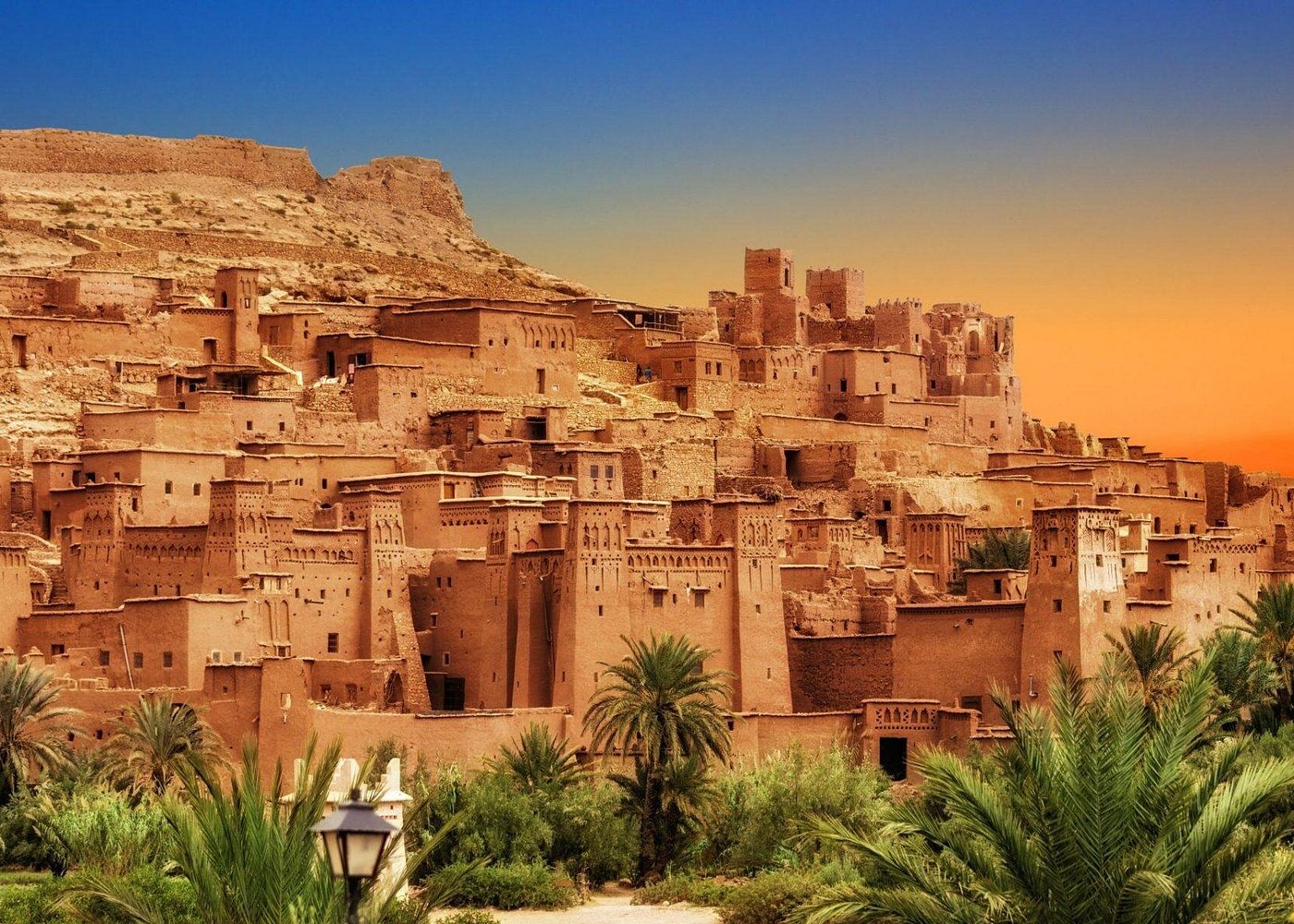
Aït Ben Haddou
Rising from the banks of the Ounila Valley like a mirage sculpted in clay, Aït Ben Haddou is a UNESCO World Heritage ksar — an ancient fortified village of mud-brick kasbahs that has endured for centuries. One of Morocco's most photographed sites, it remains a living testament to southern Berber architecture and the caravan routes that once connected sub-Saharan Africa to Marrakech.
Why Visit Aït Ben Haddou?
A fortified village frozen in amber light — Aït Ben Haddou is where Morocco's ancient Berber heritage, Hollywood glamour, and desert grandeur converge in one unforgettable setting.
UNESCO World Heritage
Inscribed in 1987, the ksar is one of the best-preserved examples of traditional earthen clay architecture in the entire Maghreb. Explore its official UNESCO designation.
Iconic Ksar Architecture
Towering kasbahs with crenellated towers and geometric Berber ornamentation, built entirely from rammed earth and mudbrick.
Film Location History
Backdrop to Gladiator, Game of Thrones, Lawrence of Arabia, and The Mummy — one of the most filmed locations on the planet.
Ounila Valley Setting
Nestled along a ancient river valley between the High Atlas and Anti-Atlas, surrounded by dramatic desert scenery.
Berber Culture
The ksar remains a window into southern Berber life — artisans, oral traditions, and centuries-old building techniques still alive today.
Photography Paradise
Golden hour transforms the ksar into a glowing fortress. Every angle, every shadow, every texture was made for a camera.
Aït Ben Haddou at a Glance
The essentials before you head into the valley.
Top Things to Do in Aït Ben Haddou
Ten experiences that capture what makes this ancient ksar one of Morocco's most extraordinary places.
Explore the Ksar
Wander through narrow alleys, past crumbling kasbahs and restored dwellings, climbing gradually through the layered terraces of the ancient village. Every turn reveals another courtyard, another story.
Climb to the Granary
The ksar's fortified granary sits at the very summit — a dramatic climb rewarded with sweeping 360-degree views of the Ounila Valley, the Atlas foothills, and the desert beyond.
River Crossing
Cross the Ounila River on stepping stones or wade through shallow pools to reach the ksar from the opposite bank — a simple act that connects you to centuries of caravan traders who did the same.
Ounila Valley Walk
Follow the ancient river valley away from the ksar, past crumbling marabouts, palm groves, and the ruins of seasonal dwellings that once sheltered trading caravans.
Atlas Film Studios
Just 30 minutes away in Ouarzazate, these sprawling studios have hosted some of cinema's biggest productions. Walk through recreated sets from Gladiator, King Tut, and more.
Ksar Museum
A restored kasbah near the entrance to the ksar houses exhibits on traditional Berber life, earthen architecture, and the history of the southern caravan routes.
Local Berber Shops
Small artisan shops line the ksar's lower paths, selling handwoven carpets, Berber jewellery, argan oil, and traditional pottery — each piece carrying centuries of craft tradition.
Sunrise Photography
Dawn light spills into the valley and sets the ksar's eastern walls ablaze in gold and copper tones. The first hour after sunrise is the most coveted window for photographers.
Sunset from the Rooftops
Climb to the ksar's upper terraces for a sunset that turns the surrounding desert into a canvas of orange, pink, and violet. The ksar itself glows in silhouette against the fading sky.
Traditional Craft Workshops
Local artisans in the ksar and nearby village demonstrate plasterwork, leather tanning, and weaving — skills passed down through generations of Berber craftsmen.
The Ancient Ksar
For over a thousand years, Aït Ben Haddou has stood watch over the Ounila Valley — a fortified village of earthen clay and hand-cut stone that once sheltered an entire Berber community behind its towering walls. Today it is one of the most important heritage sites in all of North Africa.
- UNESCO World Heritage — inscribed in 1987 as a masterpiece of traditional Berber architecture and a irreplaceable record of southern Moroccan life
- Mud-brick kasbahs — towering towers built entirely from rammed earth, each adorned with geometric plasterwork unique to the region
- Ounila Valley — the ancient river valley that once served as the main caravan route between Marrakech and the trans-Saharan gold trade
- Berber heritage — the ksar was home to several Berber families whose traditions, craft techniques, and oral histories stretch back centuries
- Living history — though many residents have moved to the modern village across the river, the ksar is still inhabited and continues to evolve
- Earthen architecture — the ksar demonstrates the extraordinary durability of traditional pisé construction, with some walls surviving over four centuries
Film Locations & Atlas Studios
Hollywood discovered Aït Ben Haddou decades ago, and the ksar's timeless desert grandeur has made it one of the most filmed locations on Earth. From ancient Rome to fictional kingdoms, its walls have provided the backdrop for some of cinema's most epic moments.
- Gladiator — the ksar and surrounding desert formed the opening battle sequences and the vision of Proximo's homeland
- Game of Thrones — Season 3 filmed extensively at the ksar, using it as the exterior of Yunkai and the approach to Slaver's Bay
- Lawrence of Arabia — David Lean's 1962 masterpiece was one of the first major films to use Aït Ben Haddou as a location
- The Mummy — the surrounding desert and ksar's upper terraces provided the ancient Egyptian city sequences
- Prince of Persia — the fortification's dramatic silhouette stood in for the ancient Persian capital
- Atlas Film Studios — the largest film studio in the world by area, located just 30 minutes away in Ouarzazate, with permanent sets and guided tours
Best Time to Visit
Aït Ben Haddou sits in the pre-Saharan belt, where summer heat can be intense and winter nights surprisingly cold. Each season offers a different experience.
Spring & Autumn
- March–May — the ideal window. Temperatures sit around 22–28°C, wildflowers dot the valley floor, and the ksar is bathed in clear, golden light perfect for photography
- September–November — equally comfortable temperatures, thinner crowds, and the warm desert tones intensify as the season progresses toward winter
Summer & Winter
- June–August — daytime temperatures regularly exceed 40°C. Visit at dawn or dusk only. Carry water, wear sun protection, and avoid the midday hours between 11am and 4pm
- December–February — cool but manageable by day (12–18°C), with cold nights that can dip near freezing. The ksar sees very few tourists and feels remarkably peaceful
Where to Stay
From luxury kasbahs with valley views to simple guesthouses in the modern village — accommodation in Aït Ben Haddou matches its dramatic setting.
Luxury Hotels
Opulent kasbah-style hotels with panoramic valley views, rooftop pools, and spa facilities. La Vallée du Dadès and Kasbah Tebi are standout choices for an indulgent stay.
Boutique Kasbahs
Restored earthen guesthouses within or near the ksar, offering traditional Berber hospitality, hand-painted interiors, and rooftop terraces overlooking the ancient village.
Mid-Range Hotels
Comfortable options in the modern village across the river, with air conditioning, pools, and easy walking access to the ksar entrance.
Budget Guesthouses
Family-run guesthouses and hostels offering clean rooms, warm hospitality, and the kind of authentic interaction that makes budget travel unforgettable.
Food & Local Culture
Southern Moroccan cuisine is rustic, generous, and deeply rooted in Berber tradition — meals shaped by the desert landscape and centuries of caravan trade.
- Berber cuisine — slow-cooked tagines with prunes and almonds, couscous with root vegetables, and mechoui lamb prepared in underground clay ovens
- Local restaurants — family-run spots in the modern village serve generous portions of traditional dishes at modest prices; look for the places filled with locals
- Mint tea ceremony — freshly brewed with generous amounts of sugar and fresh mint, poured from a height in the traditional Berber fashion — more ritual than beverage
- Traditional dishes — tanjia, pastilla, and harira soup appear on menus throughout the region; each dish tells a story of southern Moroccan heritage
- Street food — freshly baked msemen, grilled meats, and seasonal fruit from roadside vendors offer an affordable and delicious way to eat like a local
- Market culture — the weekly souk in nearby villages is a sensory feast of spices, produce, and handcrafts that has remained unchanged for generations
Getting to Aït Ben Haddou
The ksar sits along one of Morocco's most scenic road corridors — the journey itself is part of the experience.
- From Marrakech — the drive takes approximately 4–5 hours (320 km) over the spectacular Tizi n'Tichka pass through the High Atlas — one of Morocco's most iconic road trips
- From Ouarzazate — just 32 kilometers east, a 30-minute drive along the N9 through the valley — easy as a day trip or combined with Atlas Film Studios
- Rental car — the best option for stopping at the Tizi n'Tichka viewpoints, exploring the valley, and moving at your own pace through the Atlas scenery
- Guided tours — multi-day tours from Marrakech combine the ksar with Ouarzazate, the Dades Gorge, and the Sahara — ideal for travelers short on time
- Bus — CTM and Supratours buses run from Marrakech to Ouarzazate, from where local transport can take you the final 32 kilometers to the ksar
Getting Around
Aït Ben Haddou is compact and best explored on foot, though the surrounding area rewards those with wheels.
- Walking — the ksar itself is entirely pedestrian. Narrow alleys, uneven steps, and steep climbs make good shoes essential. Allow 1.5–2 hours for a thorough exploration
- Guided tours — local guides meet visitors at the ksar entrance and provide invaluable context on architecture, history, and the families who built this place
- Rental car — essential for exploring the Ounila Valley, visiting Atlas Film Studios, or continuing onward to the Dades Gorge and Sahara
- Day trips — Ouarzazate, the Draa Valley, and the Fint Oasis are all within easy driving distance and make excellent half-day additions to a ksar visit
Suggested Itineraries
Whether you have a few hours or several days, here's how to make the most of your time at the ksar.
Half Day
- River crossing & ksar entrance
- Explore the lower alleys & kasbahs
- Climb to the granary summit
- Sunset viewpoint on the opposite bank
1 Day
- Sunrise photography from the east bank
- Full ksar exploration with a local guide
- Ksar Museum & artisan workshops
- Afternoon: Ounila Valley walk
- Sunset from the ksar rooftops
Marrakech to Sahara
- Day 1: Tizi n'Tichka pass & Atlas scenery
- Day 1: Aït Ben Haddou afternoon visit
- Day 2: Atlas Film Studios & Ouarzazate
- Day 2: Continue to Merzouga for desert dunes
Southern Morocco Road Trip
- Day 1: Marrakech to Aït Ben Haddou
- Day 2: Ksar & Ouarzazate exploration
- Day 3: Dades Gorge & Todra Gorge
- Day 4: Merzouga & Sahara dunes
- Day 5: Return via the High Atlas
Destinations Across Morocco
From imperial cities to desert dunes and Atlantic coast — discover more of what Morocco has to offer.
Practical Tips for Visiting
Desert travel demands preparation. A few essential tips to help you explore Aït Ben Haddou with confidence and comfort.
- Clothing — lightweight, breathable layers are best. Cover shoulders and knees out of respect; long sleeves also protect against sun and sand
- Sun protection — the pre-Saharan sun is relentless. SPF 50+, a wide-brimmed hat, and sunglasses are non-negotiable even on overcast days
- Cash — there are no ATMs in the ksar. Bring sufficient dirhams from Ouarzazate for entrance fees, guides, tips, and purchases
- Photography tips — the ksar is best photographed in the first and last two hours of daylight. Overhead midday light flattens the architecture and washes the colors
- River crossing — stepping stones can be slippery. Wear sandals or waterproof shoes and test each stone before committing your weight
- Guided vs independent — hiring a local guide at the entrance is affordable and enriching; they know the hidden corners, the family stories, and the best vantage points
- Family travel — the climb is steep but manageable for children. Bring water, snacks, and a pace that respects the altitude and heat
Frequently Asked Questions
Is Aït Ben Haddou worth visiting?
Absolutely. It is one of Morocco's most iconic and visually stunning sites — a UNESCO World Heritage ksar that has served as a backdrop to some of cinema's greatest films. The architecture, the history, and the setting make it unmissable.
How many days should I spend in Aït Ben Haddou?
1–2 days is ideal. A single day covers the ksar and surrounding area thoroughly; a second day allows for Atlas Film Studios, the Ounila Valley, and a more relaxed pace in the golden hour light.
What is Aït Ben Haddou famous for?
Its UNESCO-listed earthen ksar architecture, its role as a filming location for Gladiator, Game of Thrones, and Lawrence of Arabia, and its position as one of the best-preserved examples of traditional Berber fortified villages in Morocco.
Is Aït Ben Haddou safe?
Yes. It is one of the most visited heritage sites in Morocco and very safe for tourists. Exercise normal precautions — watch your step on the steep paths, carry water, and be mindful of your belongings in crowded areas.
What is the best time to visit Aït Ben Haddou?
Spring (March–May) and autumn (September–November) offer the most comfortable temperatures and the best light for photography. Summer is extremely hot; winter is cool but peaceful with very few tourists.
Is there an entrance fee?
The ksar itself is free to enter. However, some restored kasbahs and the Ksar Museum may charge a small fee. Local guides typically charge around 100–150 MAD for a guided tour of the village.
Can you still walk through the ksar?
Yes. The ksar is still inhabited and open to visitors. You can wander through the narrow alleys, explore the kasbahs, and climb to the granary at the summit — though the upper paths are steep and uneven.
How do I get from Marrakech to Aït Ben Haddou?
The drive takes approximately 4–5 hours over the Tizi n'Tichka pass — one of Morocco's most spectacular road trips. Guided multi-day tours from Marrakech are also widely available and combine the ksar with Ouarzazate and the desert.
Is Aït Ben Haddou family friendly?
Yes, though young children may need assistance on the steeper sections. The climb to the granary is demanding, but the lower ksar is accessible and fascinating for all ages. Bring water, sun protection, and go at a comfortable pace.
Do I need a guide?
Not strictly, but highly recommended. Local guides provide context that transforms the visit — the history of specific families, the building techniques, and the hidden corners that casual visitors miss entirely.
What movies were filmed at Aït Ben Haddou?
Gladiator, Game of Thrones (Yunkai), Lawrence of Arabia, The Mummy, Prince of Persia, Kingdom of Heaven, Asterix & Obelix: Mission Cleopatra, and many more. The ksar is one of the most filmed locations in the world.
Can I combine Aït Ben Haddou with the Sahara?
Perfectly. The ksar sits on the natural route from Marrakech to Merzouga and the Sahara dunes. Most southern Morocco itineraries include both — typically with a stop in Ouarzazate and the Dades Gorge along the way.
Ready to Discover Aït Ben Haddou?
From ancient mud-brick fortresses and Ounila Valley light to Hollywood legends and Berber craftsmanship — Aït Ben Haddou is one of Morocco's most extraordinary places. Let MoroccOdyssey help you plan the rest.