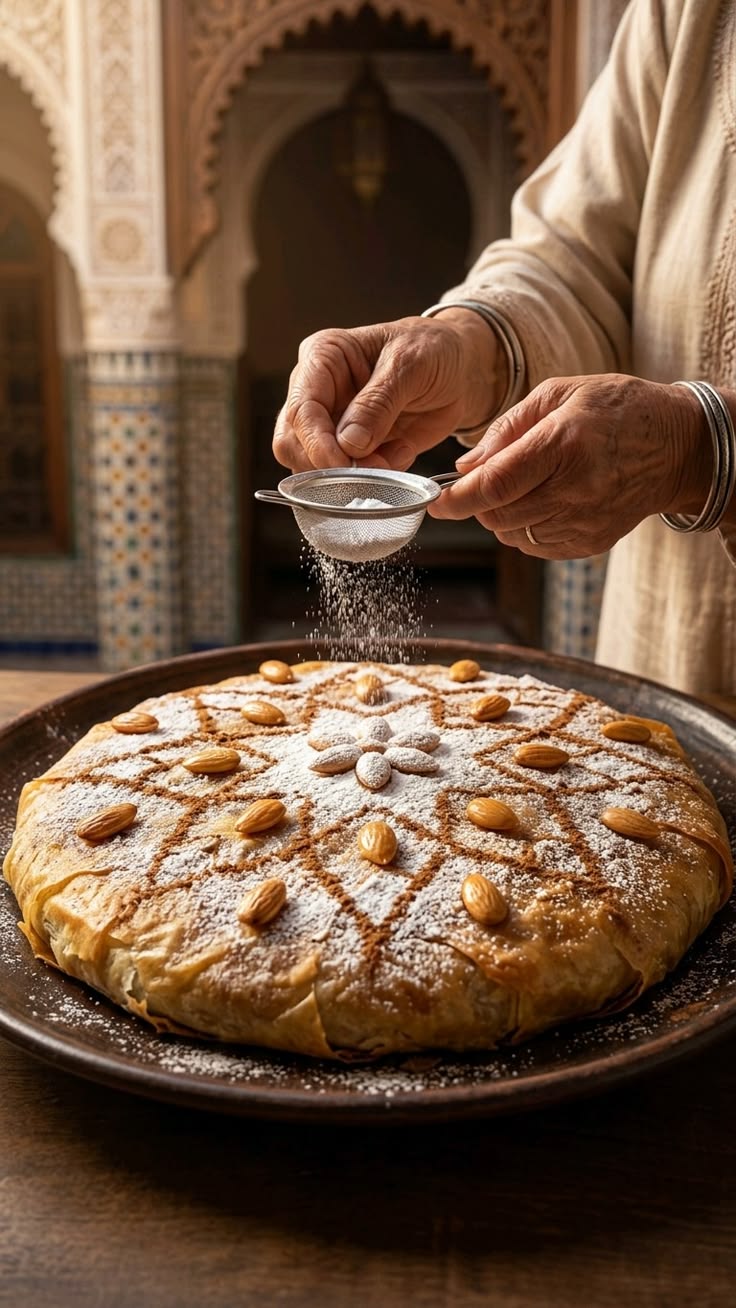
Moroccan Pastilla: Morocco’s Iconic Sweet & Savoury Pie
One of Morocco’s most elegant culinary traditions, Moroccan Pastilla is a masterpiece of delicate pastry, rich fillings and a unique balance of sweet and savoury flavours. This is the definitive guide to experiencing it.
Discover PastillaMoroccan Pastilla at a Glance
Essential information for experiencing one of Morocco’s most prestigious dishes.
Why Moroccan Pastilla is the crown jewel of Moroccan cuisine.
In the vast and varied landscape of Moroccan cuisine, few dishes command the reverence reserved for Moroccan Pastilla. This is not everyday food. It is the dish of royalty, of celebration, of the most important moments in Moroccan family life. To understand Pastilla is to understand something essential about the elegance and sophistication of Moroccan culinary culture.
At its heart, Pastilla is a layered pie built on warqa—paper-thin, hand-rolled pastry sheets that shatter at the touch. Inside, a savoury filling of slow-cooked pigeon (or, in modern versions, chicken or seafood) is combined with almonds, eggs, onions and a complex blend of spices including saffron, ginger, cinnamon and ras el hanout. The pie is baked until golden and crispy, then finished with a dusting of icing sugar and a lattice of ground cinnamon. The result is a dish of extraordinary contrast: crispy and soft, sweet and savoury, rich and delicate.
The Andalusian origins of Pastilla are well documented. When the Moors and Jews were expelled from Spain in the 15th and 17th centuries, they brought with them the culinary traditions of Al-Andalus, including the art of layered pastry. In Fes, these traditions merged with indigenous Amazigh cooking to create something entirely new. The Pastilla as we know it today is a product of this remarkable cultural exchange.
The traditional pigeon Pastilla (Pastilla au Pigeon) remains the most prestigious version. Pigeon is braised with spices, then shredded and combined with a cooked egg and onion mixture and fried almonds. The assembly is labour-intensive: layer upon layer of warqa is brushed with butter, filled, folded and baked. The final decoration—a precise lattice of cinnamon over a snow-white field of icing sugar—transforms the pie into edible art.
Modern variations have expanded the Pastilla repertoire. Chicken Pastilla is now the most commonly served version, more accessible and milder in flavour. Seafood Pastilla, found along the Atlantic coast, combines shrimp, fish and calamari with the traditional pastry. Mini Pastillas serve as elegant appetisers, while sweet versions filled with almonds and honey offer a dessert interpretation.
For the traveller, Pastilla is a must-experience dish. It represents the pinnacle of Moroccan culinary craftsmanship—the precision of the warqa, the complexity of the filling, the beauty of the presentation. To eat an authentic Pastilla in Fes, Marrakech or Rabat is to taste centuries of history, refinement and passion in a single bite.
Six classic Moroccan Pastilla variations to discover.
Each version reflects a different tradition, region and occasion in Moroccan culinary life.
Traditional Pigeon Pastilla
The most prestigious version. Slow-braised pigeon, shredded and combined with spiced eggs, onions and fried almonds, wrapped in paper-thin warqa pastry and finished with cinnamon and icing sugar.
Chicken Pastilla
The most widely available version. Chicken braised with saffron, ginger and onions replaces pigeon, creating a milder but equally satisfying pie. This is the Pastilla most Moroccans eat today.
Seafood Pastilla
A coastal variation found in Essaouira, Casablanca and other port cities. Shrimp, fish and calamari replace meat, creating a lighter, Mediterranean-influenced interpretation.
Mini Pastillas
Individual-sized Pastillas, perfect as appetisers or part of a buffet. The same ingredients and techniques as the full-sized version, but scaled down into elegant, bite-sized parcels.
Modern Interpretations
Chefs in Marrakech and Casablanca are reimagining Pastilla with contemporary techniques, new fillings and artistic presentations while honouring the traditional foundations.
Festive Pastilla
The grand centrepiece of Moroccan celebrations. Larger, more elaborate and more generously filled than everyday versions, the festive Pastilla is the star of weddings, religious holidays and family gatherings.
The best cities for authentic Moroccan Pastilla.
Every Moroccan city offers its own interpretation of this iconic dish.
Fes
The spiritual home of Pastilla. Fes is renowned for the most refined and traditional versions, where family recipes dating back centuries are still faithfully followed in the heart of the medina.
Marrakech
The Red City offers Pastilla in settings ranging from humble family restaurants to luxurious palace dining rooms. Marrakech versions tend to be richer and more heavily spiced.
Rabat
The capital’s Pastilla reflects the city’s refined culinary traditions. The restaurants near the Kasbah serve elegant versions with careful attention to presentation and balance.
Casablanca
Morocco’s largest city offers both traditional and contemporary Pastilla. The fine dining restaurants along the Corniche serve innovative versions alongside the classics.
Chefchaouen
The Blue Pearl offers rustic, mountain-style Pastilla reflecting strong Amazigh traditions. The portions are generous and the atmosphere is unforgettable.
Essaouira
Coastal Essaouira excels at seafood Pastilla. Fresh fish and shellfish replace traditional meat, creating a lighter, Mediterranean-influenced version of this classic dish.
A dish born from centuries of cultural exchange.
The story of Moroccan Pastilla begins not in Morocco but across the Mediterranean, in the courts of Moorish Spain. When the Moors ruled the Iberian Peninsula, they brought with them the art of layered pastry—thin sheets of dough stretched until translucent, then layered with fillings of meat, nuts and spices. This tradition, known as pastela in Spanish, would eventually cross the Strait of Gibraltar and take root in Moroccan culinary culture.
The expulsion of the Moors and Jews from Spain in the 15th and 17th centuries brought waves of Andalusian refugees to Moroccan cities, particularly to Fes, home to the UNESCO World Heritage-listed Medina of Fez. They brought with them the refined culinary traditions of Al-Andalus, including the art of making warqa—the paper-thin pastry that forms the foundation of Pastilla. In the kitchens of Fes, these Andalusian techniques merged with the rich spice traditions of Morocco to create something entirely new.
The imperial kitchens of Morocco played a crucial role in elevating Pastilla to its current status. In the royal courts of Fes, Marrakech, Meknes and Rabat, chefs refined the dish to extraordinary levels of sophistication. Pigeon was chosen for its delicate flavour, almonds for their crunch and sweetness, and the combination of cinnamon and sugar for its elegant contrast. The result was a dish worthy of kings.
Today, Pastilla remains the centrepiece of Moroccan celebrations. At weddings, the Pastilla is often the first course served, symbolising the sweetness and abundance of the new union. At religious holidays, family gatherings and important milestones, Pastilla appears as a sign of respect and celebration. To prepare a Pastilla is an act of love and dedication, and to serve one is an honour reserved for the most important occasions.
The Moroccan culinary heritage that Pastilla represents is one of the richest in the world. It is a dish that tells the story of cultural exchange, of the meeting between Amazigh, Arab, Andalusian and Ottoman traditions. To eat Pastilla is to taste centuries of history, artistry and passion in a single bite.

How Moroccan Pastilla differs across Morocco.
Like every Moroccan dish, Pastilla changes from city to city, reflecting local traditions, ingredients and tastes.
Fes is considered the spiritual home of Pastilla. The city’s versions are the most traditional, following recipes that have been passed down through generations of Fassi families. The pigeon Pastilla of Fes is considered the gold standard—a dish of extraordinary refinement, with perfectly balanced flavours and a decoration that approaches art.
Rabat’s Pastilla tradition is elegant and understated. The capital’s chefs favour a lighter touch, with thinner warqa, a more delicate filling and a presentation that emphasises clean lines and geometric precision. Rabat Pastilla is often considered the most refined of all the imperial city versions.
Casablanca, as Morocco’s most cosmopolitan city, offers both traditional and innovative Pastilla. The fine dining restaurants serve contemporary interpretations alongside the classics, while the old medina restaurants maintain the traditional preparations.
Northern Morocco—around Tangier and Tetouan—shows strong Andalusian influence in its Pastilla, with more pronounced Mediterranean flavours and sometimes lighter spice profiles that reflect the region’s multicultural heritage.
The Atlantic Coast brings seafood into the equation. Essaouira and Casablanca serve excellent seafood Pastilla, where fresh fish and shellfish replace the traditional pigeon, creating a lighter, Mediterranean-influenced version of this classic dish.
How to enjoy Moroccan Pastilla like a local.
Understanding the rituals around Moroccan Pastilla deepens your appreciation of this extraordinary dish.
The Grand Presentation
Pastilla is presented whole at the table, its golden surface decorated with a precise lattice of cinnamon over a field of white icing sugar. The visual impact is part of the experience.
Cutting & Serving
The Pastilla is cut into wedges at the table, revealing the layers of warqa, filling and almonds. Each piece is a perfect cross-section of the dish’s architecture.
Celebration Centrepiece
Pastilla is the centrepiece of celebrations. At weddings, religious holidays and family gatherings, it is served with great ceremony and pride.
Tea Afterwards
No Moroccan meal is complete without mint tea. After Pastilla, tea is served to extend the pleasure of the gathering and complement the rich flavours.
A Moroccan Pastilla meal is a ceremonial event. The Pastilla arrives at the table whole, its golden surface a canvas of cinnamon and sugar, and the room falls silent for a moment of appreciation. This is not just food—it is a performance, a celebration, a statement of culinary artistry.
The cutting of the Pastilla is a ritual in itself. A sharp knife slices through the crisp warqa with an audible crack, revealing the layers within: the flaky pastry, the savoury filling, the crunch of almonds. Each wedge is placed on a plate, and the cinnamon-sugar pattern on top ensures that every piece is as beautiful as the whole.
Side dishes are deliberately simple. A light salad of tomatoes, onions and cress provides freshness. Khobz (bread) is always present. The Pastilla is rich enough to be the star, and the accompaniments serve only to balance and refresh. Some restaurants offer harissa on the side for those who prefer more heat.
Restaurant etiquette is relaxed but respectful. In traditional restaurants, Pastilla is often prepared to order and may take 30–45 minutes. Calling ahead to confirm availability is advisable, especially for the traditional pigeon version. Tipping 10–15% is customary.
The atmosphere of a Pastilla meal is one of occasion and celebration. Whether you are eating in a family home, a traditional restaurant in Fes or a luxurious riad in Marrakech, the experience connects you to centuries of Moroccan culinary refinement.
Everything you need to know before ordering.
Common questions about Moroccan Pastilla.
What is Moroccan Pastilla?
Pastilla is a layered Moroccan pie made with paper-thin warqa pastry, filled with slow-cooked pigeon or chicken, almonds, eggs and spices, then finished with a dusting of icing sugar and a lattice of cinnamon. It is one of Morocco’s most prestigious dishes.
Why is it both sweet and savoury?
The combination of sweet (icing sugar, cinnamon, almonds) and savoury (spiced meat, eggs, onions) is a hallmark of Moroccan cuisine. Pastilla represents this balance at its most refined and elegant.
Is traditional Pastilla made with pigeon?
Yes. The most prestigious and traditional version uses pigeon, which is braised and shredded. However, chicken Pastilla is now the most commonly served version and is equally delicious.
Can I find chicken Pastilla?
Yes. Chicken Pastilla is the most widely available version throughout Morocco. It is milder and more accessible than the traditional pigeon version, making it ideal for first-time visitors.
Is Pastilla served as a main course?
Pastilla can be served as a starter, a main course or as part of a celebration feast. In traditional settings, it is often the first course of a multi-course meal.
Where should I try authentic Pastilla?
Fes is considered the spiritual home of Pastilla, but excellent versions are found in Marrakech, Rabat and Casablanca.
Is seafood Pastilla common?
Seafood Pastilla is a specialty of the Atlantic coast, particularly in Essaouira and Casablanca. It is less common inland but increasingly available.
What makes Pastilla unique?
Pastilla is unique for its combination of paper-thin warqa pastry, the contrast between sweet and savoury flavours, and its status as a celebratory dish. No other Moroccan dish combines these elements in quite the same way.
Is Pastilla suitable for first-time visitors?
Absolutely. Pastilla offers a window into the most refined traditions of Moroccan cuisine. Chicken Pastilla is accessible and delicious, making it an excellent introduction to Moroccan gastronomy.
What drink pairs best with Pastilla?
Moroccan mint tea is the traditional accompaniment. Its sweetness and freshness complement the rich, nutty flavours of the Pastilla beautifully.
What is warqa?
Warqa is paper-thin Moroccan pastry, similar to filo dough, made by dipping a ball of dough into a hot pan and rotating it to create a single, paper-thin sheet. It forms the foundation of Pastilla and is considered one of the most difficult Moroccan pastry techniques to master.
How is Pastilla different from tagine?
Tagine is a slow-cooked stew served in its clay pot. Pastilla is a layered pie made with warqa pastry, filled with spiced meat, almonds and eggs, and finished with cinnamon and sugar. They are entirely different dishes with different cultural roles.
Discover Morocco Through Its Most Elegant Dish.
Every Moroccan Pastilla carries centuries of history, from the courts of Moorish Spain to the imperial kitchens of Fes. Its delicate warqa, rich fillings and elegant cinnamon decoration represent the pinnacle of Moroccan culinary artistry. Begin your culinary journey today.