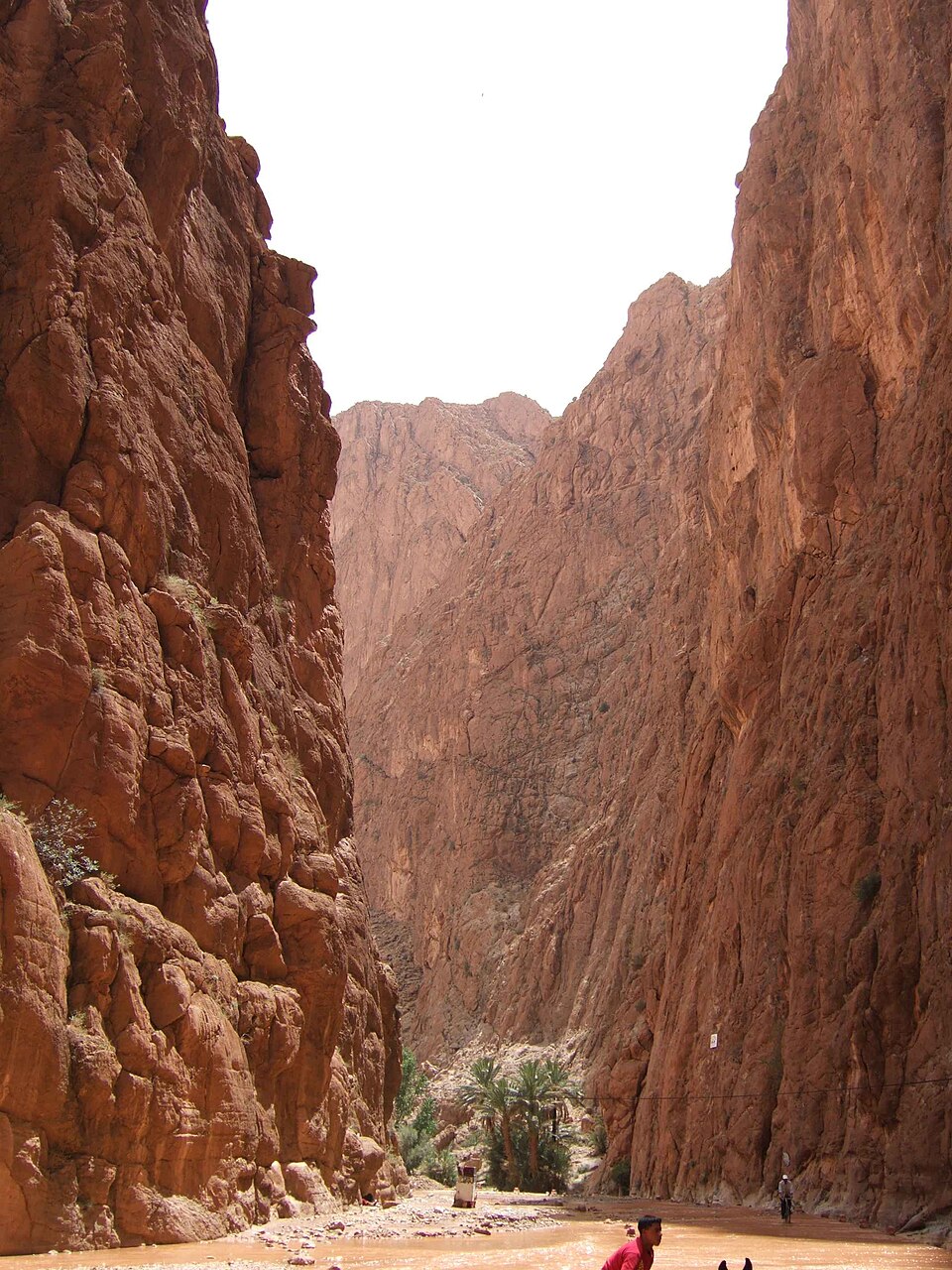
Todra Gorge, Morocco
One of Morocco's most spectacular natural attractions, Todra Gorge is a towering canyon where limestone cliffs rise 300 metres from the valley floor, narrowing to just 10 metres at their most dramatic. Carved over millennia by the Todra River through the eastern High Atlas, this colossal cleft in the rock is an essential stop on any southern Morocco road trip — a place where the scale of the landscape humbles every traveller who walks beneath its sheer walls. Beyond the canyon itself, a lush palm oasis, traditional Berber villages, and some of North Africa's best rock climbing routes make Todra Gorge far more than a passing sight. It is a destination that rewards those who linger.
Why Visit Todra Gorge?
Sheer canyon walls, world-class climbing, a palm oasis at its mouth — Todra Gorge is where Morocco's geology reaches its most awe-inspiring expression.
Towering Limestone Cliffs
Rising nearly 300 metres on either side, the canyon walls narrow to just 10 metres apart at their tightest point, creating one of the most dramatic natural corridors in all of North Africa.
World-Class Hiking
Marked trails follow the river through the canyon floor and branch into the surrounding valleys, offering routes that range from gentle riverside stambles to demanding full-day treks through remote mountain terrain.
Rock Climbing Mecca
With over 600 bolted routes across every difficulty grade, the gorge walls attract climbers from around the world. The quality of the limestone and the reliability of the conditions make this one of the continent's premier climbing destinations.
Palm Oasis Setting
At the mouth of the gorge, a dense palm grove of over 10,000 trees lines the river, creating a striking contrast of green canopy against bare rock that is uniquely photogenic and wonderfully shaded.
Berber Villages
The surrounding valley is home to traditional Berber communities whose stone and pisé villages cling to terraced hillsides, offering genuine encounters with a way of life shaped by the mountain landscape for centuries.
Road Trip Highlight
Sitting just 45 minutes east of the Dades Valley on the classic Marrakech-to-Sahara route, the gorge is one of the most rewarding stops on Morocco's greatest driving corridor.
Todra Gorge at a Glance
The essentials before you descend into the canyon.
Top Things to Do in Todra Gorge
Ten experiences that capture the power, beauty, and culture of Morocco's most dramatic canyon.
Walk the Canyon Floor
The signature experience of Todra Gorge. A flat, well-worn path follows the shallow river through the narrowest section of the canyon, where 300-metre walls converge to just 10 metres overhead. The scale is staggering, and the sound of the river echoing off the rock is unforgettable.
Hiking Trails
Beyond the canyon floor, marked trails lead into the surrounding valleys and up the canyon walls to high-level viewpoints. Routes range from gentle riverside walks to demanding treks to the plateau above, where the landscape opens into vast, empty spaces of wind-sculpted rock.
Rock Climbing
The gorge walls host over 600 bolted routes on limestone that ranges from smooth, vertical faces to heavily featured overhangs. Routes span every difficulty from beginner-friendly slabs to multi-pitch test pieces, making this one of the most versatile climbing venues in the world.
Palm Oasis Walk
At the western mouth of the gorge, a dense palm grove of over 10,000 date palms stretches along the Todra River. Shaded paths wind through the canopy, crossing irrigation channels and passing small garden plots where locals grow pomegranates, figs, and olives beneath the fronds.
Tinghir Village
The gateway town to the gorge sits on a plateau above the canyon, with narrow winding streets, a weekly souk, and panoramic views across the palm oasis and the surrounding Atlas foothills. It is the natural base for exploring the region.
River Walk
The Todra River flows shallow and clear through the valley, with flat, stony banks that make for a pleasant stroll. In the warmer months, the water is refreshing enough for a wade, and the sound of the current accompanies the walk through the palm grove.
Valley Viewpoints
The road approaching the gorge offers a series of informal pullouts with sweeping views across the canyon, the palm oasis, and the terraced Berber villages scattered on the surrounding hillsides. Each perspective reveals a different aspect of the landscape.
Berber Villages
The hills surrounding the gorge are dotted with traditional Berber settlements built from local stone, their terraced fields and walnut orchards climbing the steep slopes above the river. Visiting these villages offers a window into a way of life that has endured for centuries.
Photography Spots
From the vertiginous canyon floor to the sweeping viewpoints above the palm oasis, Todra Gorge is a photographer's paradise. The interplay of light and shadow on the limestone walls changes hour by hour, creating endlessly shifting compositions.
Day Trip to Dades
The Dades Valley sits just 45 minutes west of Todra Gorge, connected by one of Morocco's most scenic valley roads. The pairing of both gorges in a single day or overnight is one of southern Morocco's greatest short itineraries.
Explore the Canyon
There are few places on Earth where geology makes its presence felt quite so viscerally as inside Todra Gorge. The limestone walls rise 300 metres on either side, narrowing to just 10 metres apart at their tightest point — a natural corridor so narrow that the sky above becomes a thin ribbon of blue against the towering rock. Walking through the canyon floor is an experience that begins with awe and ends with something closer to reverence. The walls are not merely tall; they are alive with colour and texture. Bands of ochre, cream, grey, and rose wind through the limestone like the rings of an ancient tree, each layer recording a different epoch of the region's geological history.
- Formation — the gorge was carved over millions of years by the Todra River cutting through thick layers of Jurassic limestone deposited when this region lay beneath a tropical sea, gradually deepening the canyon as the Atlas Mountains rose around it
- The narrowest point — at the gorge's tightest, the walls close to just 10 metres apart while soaring nearly 300 metres overhead, creating a vertical slot canyon that ranks among the most dramatic in Africa
- Light and shadow — the canyon's orientation means direct sunlight only reaches the floor for a few hours each day, creating constantly shifting patterns of warm gold and cool blue shadow that transform the rock face minute by minute
- The river — the Todra River still flows through the canyon floor, though much of its water is now diverted for irrigation. In the wet season the flow is stronger; in summer it is a shallow, crystal-clear stream that winds between smooth boulders
- Scale — photographs rarely convey the true scale of the gorge. Standing on the canyon floor and looking up, the walls appear to lean inward, creating a sense of enclosure that is both exhilarating and profoundly humbling
- Access — the canyon floor walk is flat and requires no specialist equipment. It is accessible to visitors of most fitness levels, though the rocky path requires sturdy footwear and care in wet conditions
Hiking & Rock Climbing
Todra Gorge has earned its reputation as one of North Africa's premier adventure destinations. The combination of dramatic limestone walls, a well-watered valley, and a vast network of trails and climbing routes makes it equally compelling for dedicated mountaineers and casual walkers. The canyon itself offers an accessible, flat walk that requires no guide or special preparation, while the surrounding hills and high plateaux provide routes that challenge even experienced hikers. For climbers, the gorge is simply world-class — over 600 bolted routes on pristine limestone, with lines ranging from introductory slabs to multi-pitch test pieces on the main canyon wall.
- Trail network — marked routes fan out from the gorge in every direction: along the river through the palm oasis, up the valley to remote Berber villages, and onto the high plateau above the canyon for panoramic views of the Atlas foothills
- Difficulty levels — the canyon floor walk is flat and suitable for all ages; the valley trails are moderate with some uneven terrain; the high plateau routes demand good fitness and a head for exposed ridgelines
- Climbing routes — the limestone walls offer sport climbing from grade 4 to 8b+, with single-pitch routes on the lower walls and multi-pitch lines of up to eight pitches on the main canyon face. The Tourist sector near the entrance is ideal for intermediates
- Local guides — certified mountain and climbing guides operate from Tinghir and can be arranged through your accommodation. For any route beyond the canyon floor walk, a guide is strongly recommended
- Equipment — climbers should bring their own rack, harness, and helmet. Rope and quickdraws can be rented from a small number of outfitters in Tinghir, though availability is limited compared to European climbing centres
- Best season for climbing — October through May offers the most comfortable conditions. Summer temperatures on the exposed canyon walls can exceed 40 degrees, making climbing inadvisable during midday hours
Palm Oasis & Local Villages
At the mouth of the gorge, the landscape transforms abruptly. The bare rock of the canyon gives way to one of Morocco's densest palm groves — over 10,000 date palms standing shoulder to shoulder along the banks of the Todra River, their fronds forming a continuous green canopy above irrigation channels that have fed this oasis for centuries. The oasis is not merely scenic; it is a living agricultural system where pomegranates, figs, olives, and walnuts grow in the shade of the palms, tended by families whose connection to this land runs generations deep. This oasis landscape around Todra Gorge forms part of the Oasis du Sud Marocain UNESCO Biosphere Reserve, recognised for its ancient irrigation heritage.
- Tinghir oasis — the palm grove stretches for nearly 20 kilometres along the river, one of the longest oases in Morocco, creating a lush corridor of cultivation between the bare Atlas foothills
- Palm groves — the date palms are harvested each autumn, producing the sweet, sun-dried dates that are a staple of the local diet and a key product of the valley economy
- Berber villages — stone and pisé settlements cling to the hillsides above the oasis, their terraced fields and flat-roofed homes stacked in organic layers that follow the contours of the terrain
- Local life — the oasis communities maintain traditional irrigation systems called khettara, ancient underground channels that bring water from mountain springs to the terraced fields below
- Souk culture — Tinghir's weekly souk is a vibrant gathering of Berber farmers, traders, and artisans, selling everything from spices and olives to hand-woven carpets and silver jewellery
- Architecture — the villages display the characteristic Berber building tradition of pisé (rammed earth) construction, with homes and small kasbahs that blend seamlessly into the surrounding rock
Best Time to Visit
Todra Gorge sits at approximately 1,200 metres in the eastern Atlas — altitude moderates the summer heat, but the canyon's depth means conditions vary significantly with the seasons. Each period offers something different.
Spring & Autumn
- March–May — the ideal window. Comfortable walking temperatures (18–25 degrees), wildflowers in the surrounding hills, and the river flowing strongly enough to create a refreshing atmosphere in the canyon. The light is golden and clear for photography
- September–November — equally pleasant, with warm days and cool evenings, fewer visitors than spring, and the autumn harvest bringing a rich palette of colour to the oasis and valley terraces
Summer & Winter
- June–August — the altitude keeps temperatures manageable in the upper valley (28–38 degrees), but the canyon floor can feel intensely hot during midday. Early morning and late afternoon walks are essential; climbing is inadvisable in direct midday sun
- December–February — cool but pleasant days (10–16 degrees) with cold nights that can approach freezing. The clear winter skies and low-angle light create exceptional conditions for canyon photography, and the gorge is at its quietest
Where to Stay
From cliffside kasbahs with canyon views to simple village guesthouses in the oasis — Todra Gorge offers accommodation that places you inside the landscape rather than merely observing it.
Luxury Hotels
Cliffside properties and restored kasbahs with panoramic terraces overlooking the canyon, plunge pools carved into the rock, and interiors that blend contemporary design with traditional Berber craftsmanship.
Boutique Kasbahs
Small, characterful properties within and near the palm grove, offering individually styled rooms, valley views, and the intimate atmosphere that larger hotels cannot replicate. Many are restored family homes with centuries of history.
Mid-Range Hotels
Comfortable, well-maintained options in Tinghir and along the gorge road with air conditioning, terraces, and easy access to the canyon, the oasis, and the surrounding hiking trails.
Camps & Budget Stays
Simple bivouac camps in the surrounding desert and basic village guesthouses offering clean rooms, home-cooked meals, and an authentic glimpse into Berber hospitality at modest prices.
Food & Local Culture
Mountain Berber cuisine at Todra is hearty, seasonal, and shaped by the oasis agriculture — a diet of root vegetables, dried fruits, fresh herbs, and slow-cooked meats prepared with the patience that valley life demands.
- Berber cuisine — slow-cooked lamb or goat tagine with preserved lemons and olives, hand-rolled couscous with seasonal vegetables, and tanjia prepared in traditional clay vessels buried in hot embers at the local hammam
- Local restaurants — family-run establishments in Tinghir and the villages near the gorge serve generous portions of traditional dishes at modest prices; look for the places filled with local families at mealtimes
- Mint tea ceremony — freshly brewed with generous amounts of sugar and fresh mint, poured from a height in the traditional Berber fashion — offered as a gesture of welcome in every home, guesthouse, and café in the valley
- Valley specialties — dates from the palm grove, walnuts from the mountain orchards, and argan oil pressed in local cooperatives appear in everything from tagines to pastries and traditional remedies
- Street food — freshly baked msemen, grilled kefta from roadside stalls, and seasonal fruit from valley farms offer an affordable and delicious way to eat like a local between canyon explorations
- Weekly souk — Tinghir's market day brings Berber farmers, traders, and artisans together with spices, olives, fresh produce, hand-woven textiles, and traditional breads baked in communal clay ovens
Getting to Todra Gorge
Sitting in the eastern Atlas between the Dades Valley and the Sahara, Todra Gorge is accessible from multiple directions — though the journey itself is part of the experience.
- From Dades Valley — the drive east along the scenic valley road takes approximately 45 minutes (60 km), passing through the gorge's palm oasis approach with spectacular views of the canyon walls ahead
- From Ouarzazate — the drive east via the N10 through Boumalne Dades takes approximately 3 hours (230 km), passing through some of southern Morocco's most varied mountain landscapes
- From Tinghir — the gateway town sits just 15 minutes west of the gorge entrance on a well-maintained road that descends into the oasis and along the river to the canyon
- Rental car — the most flexible and rewarding way to reach the gorge. The road is paved and well-maintained, and a rental car gives you the freedom to explore the surrounding valley at your own pace
- Bus — CTM and Supratours operate services along the Ouarzazate–Tinghir route, though infrequent schedules make independent travel to the gorge less convenient without a car
- Guided tours — multi-day tours from Marrakech combine Todra Gorge with the Dades Valley, Ouarzazate, and the Sahara — ideal for travellers who prefer a curated experience through southern Morocco
Getting Around
Todra Gorge is compact enough to explore on foot, but the surrounding valley and nearby attractions reward a car or a guided approach.
- Walking — the canyon floor, the palm oasis, and the village paths are all best explored on foot. The main canyon walk is flat and accessible; the surrounding hiking trails require more effort and preparation
- Rental car — essential for exploring the wider valley, visiting the Dades Gorge, making the drive to Merzouga and the Sahara, and stopping at viewpoints along the approach roads
- Guided tours — local guides in Tinghir offer walking tours of the canyon, climbing instruction, hikes to the high plateau, and cultural visits to Berber villages that reveal details you would miss travelling independently
- Day trips — the Dades Valley, Tinghir Oasis, Kelaat M'Gouna, and the Sahara gateway at Erfoud are all within easy driving distance and pair naturally with Todra for a comprehensive southern Morocco itinerary
Suggested Itineraries
Whether you are passing through on the road to the Sahara or lingering in the canyon, here is how to make the most of your time at Todra Gorge.
Half Day
- Walk through the canyon floor
- Explore the palm oasis at the gorge mouth
- Visit Tinghir village
- Sunset viewpoint on the approach road
1 Day
- Morning: canyon floor walk and photography
- Palm oasis stroll and village visit
- Lunch in Tinghir
- Afternoon: hiking trail to the plateau viewpoint
- Sunset from the gorge entrance viewpoint
Dades + Todra
- Day 1: drive the Dades Gorge hairpin road & Monkey Fingers
- Day 1 evening: overnight in a Dades Valley kasbah
- Day 2: drive to Todra Gorge via the valley road
- Day 2 afternoon: Todra canyon walk & oasis stroll
Marrakech to Sahara
- Day 1: Marrakech to Ouarzazate via Tizi n'Tichka
- Day 2: Ouarzazate to Dades Valley via Skoura
- Day 3: Dades Gorge & drive to Todra Gorge
- Day 4: Merzouga & Sahara dunes
- Day 5: Return via the Draa Valley
Destinations Across Morocco
From imperial cities to desert dunes and Atlantic coast — discover more of what Morocco has to offer.
Practical Tips for Visiting
Canyon travel demands preparation. A few essential tips to help you explore Todra Gorge and the surrounding Atlas landscape with confidence and comfort.
- Clothing — lightweight, breathable layers for daytime walking; a warm jacket for canyon evenings when temperatures drop quickly once the sun disappears behind the towering walls
- Sun protection — even within the canyon, reflected UV off the limestone walls is intense. SPF 50+, a wide-brimmed hat, and sunglasses are essential regardless of the season
- Cash — larger hotels accept cards, but most village guesthouses, restaurants, and the Tinghir souk are cash-only. Withdraw dirhams in Ouarzazate or Tinghir before heading to the gorge
- Photography — the best canyon light is in the first and last two hours of daylight. Midday sun flattens the walls and washes the rich limestone tones to a pale, featureless beige
- Guided vs independent — the canyon floor walk and main viewpoints are easy to navigate alone, but hiking to the plateau, rock climbing, and visiting remote Berber villages benefit greatly from a local guide
- Family travel — the gorge is well-suited for families. The canyon walk, palm oasis stroll, and river path are engaging for children of all ages, though higher hiking trails require careful supervision
- Climbing gear — bring your own rack, harness, and helmet if you plan to climb. Rope and quickdraws can be rented in Tinghir, but selection is limited. Check conditions locally before heading to the walls
Related Travel Guides
Practical planning resources to help you navigate Morocco with confidence.
Frequently Asked Questions
Is Todra Gorge worth visiting?
Absolutely. Todra Gorge is one of Morocco's most awe-inspiring natural landmarks — a place where 300-metre limestone walls narrow to create a corridor of staggering scale. Whether you come for the walking, the climbing, the photography, or simply to stand beneath the towering rock, it delivers an experience that stays with you long after you leave.
How many days should I spend at Todra Gorge?
1–2 days is ideal. A single day covers the canyon walk, the palm oasis, and Tinghir village. Two days allow you to tackle the hiking trails, combine with the Dades Valley, and explore the surrounding Berber settlements at a more relaxed pace.
What is Todra Gorge famous for?
Its towering limestone canyon walls that rise 300 metres and narrow to just 10 metres apart, its world-class rock climbing with over 600 bolted routes, the lush palm oasis at its mouth, and its position as one of the essential stops on the Marrakech-to-Sahara road through southern Morocco.
Is Todra Gorge safe?
Yes. Todra Gorge is one of southern Morocco's most popular tourist destinations and is very safe for visitors. Exercise normal precautions — carry water, wear sun protection, stay on marked paths, and be cautious on the canyon floor when the river level is high.
What is the best time to visit Todra Gorge?
Spring (March–May) and autumn (September–November) offer the most comfortable temperatures for walking and climbing, with golden light that is ideal for photography. Summer is warm but manageable with early starts; winter is quieter with cool, clear days.
Can I visit Todra Gorge as a day trip from Marrakech?
Technically possible but not recommended. The drive is approximately 5–6 hours each way. A 3- or 4-day itinerary combining the Tizi n'Tichka pass, Ouarzazate, the Dades Valley, and Todra Gorge before continuing to the Sahara is far more rewarding.
Is Todra Gorge family friendly?
Yes. The canyon floor walk is flat and accessible for children of all ages, the palm oasis provides shade and gentle exploration, and the river walk is shallow enough for wading in warmer months. Higher hiking trails require supervision for younger children.
Do I need a guide for Todra Gorge?
For the canyon floor walk and main viewpoints, no guide is necessary. For hiking to the plateau, rock climbing, or visiting remote Berber villages, a local guide is strongly recommended. Guides can be arranged through your accommodation in Tinghir.
Can I combine Todra Gorge with the Dades Valley?
Perfectly. The two gorges sit just 45 minutes apart along one of Morocco's most scenic valley roads. Combining both in a single day or overnight is one of the great short itineraries in southern Morocco, and many visitors consider them complementary experiences.
Do I need a rental car at Todra Gorge?
Highly recommended. While the canyon walk and Tinghir village are accessible on foot, a rental car gives you the freedom to explore the surrounding valley, visit the Dades Gorge, stop at viewpoints along the approach road, and travel onward to the Sahara at your own pace.
Is rock climbing at Todra Gorge suitable for beginners?
Yes, though basic instruction is essential. The Tourist sector near the canyon entrance offers routes in the lower grades on well-protected limestone, and local climbing guides in Tinghir offer instruction and guided sessions for those new to the sport.
What is the altitude of Todra Gorge?
The gorge sits at approximately 1,200 metres above sea level, with the surrounding hills and plateau rising higher. The altitude keeps temperatures cooler than the pre-Saharan lowlands to the east but intensifies UV exposure — sun protection is essential regardless of the season.
Ready to Explore Todra Gorge?
From the towering 300-metre canyon walls and world-class rock climbing to the lush palm oasis and ancient Berber villages — Todra Gorge is Morocco's most dramatic natural corridor, waiting to be explored. Let MoroccOdyssey help you plan the rest.