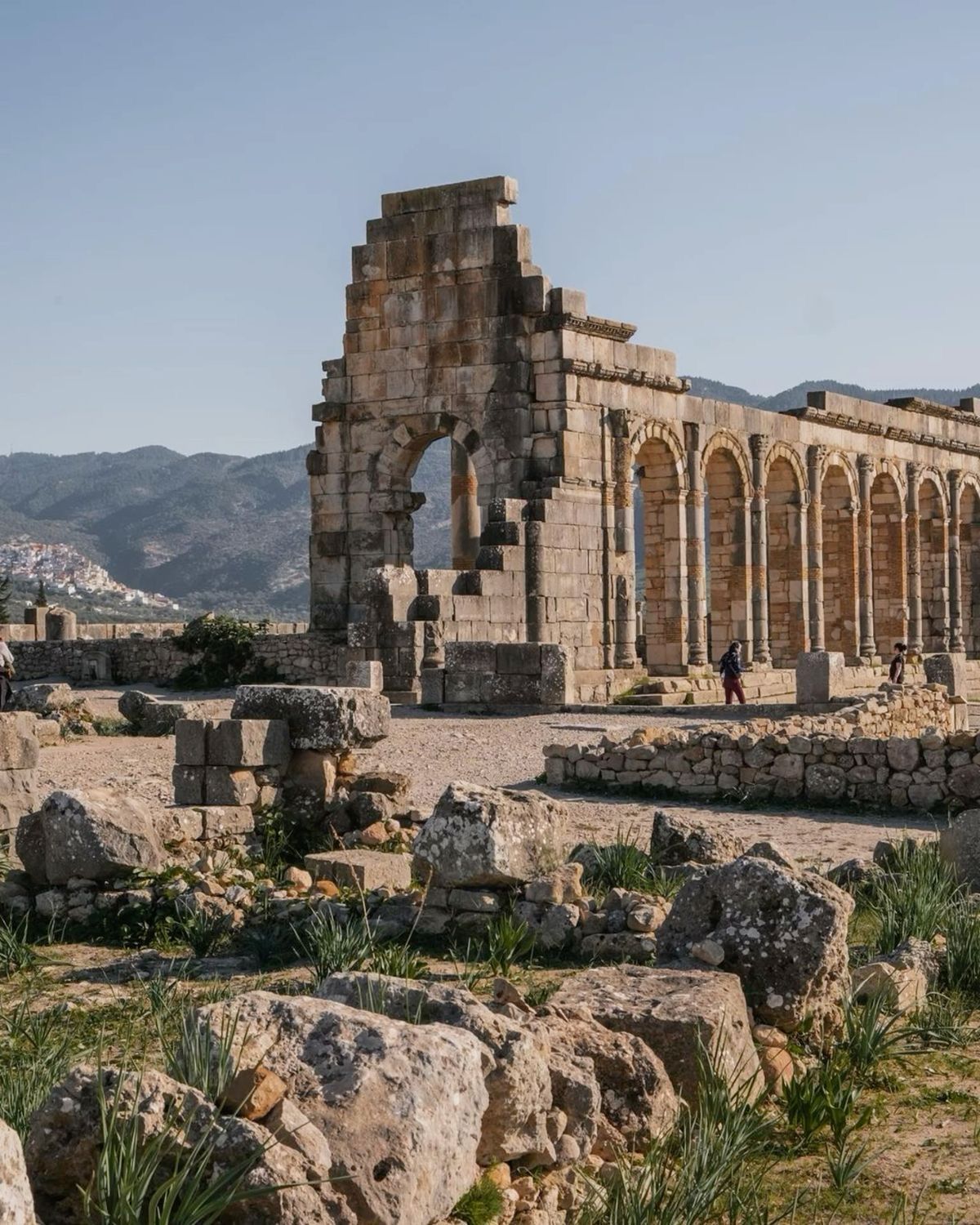
Volubilis, Morocco
Scattered across a fertile plain at the foot of the Middle Atlas foothills, Volubilis is Morocco's most important Roman archaeological site and one of the best-preserved ancient cities in North Africa.
Designated a UNESCO World Heritage Site in 1997, this sprawling open-air museum preserves over two millennia of layered history — from a Moorish settlement to a thriving Roman provincial capital to a medieval Islamic town — all set against a landscape of olive groves, rolling hills, and the whitewashed silhouette of Moulay Idriss Zerhoun on the horizon. The mosaics alone would justify the visit: intricate, vibrantly coloured floor pavements depicting mythological scenes, still remarkably intact after nearly two thousand years beneath Moroccan soil.
But Volubilis rewards on every level — the monumental arches, the sweeping forum, and the dramatic hilltop position with views that stretch to the Rif Mountains — making it an essential destination for anyone seeking to understand the extraordinary depth of Morocco's cultural inheritance.
Why Visit Volubilis?
Two thousand years of layered history, some of the finest Roman mosaics in the world, and a setting among olive groves beneath the Middle Atlas — Volubilis is where Morocco's ancient past comes vividly to life.
UNESCO World Heritage
Inscribed in 1997, Volubilis is recognised by UNESCO as an outstanding example of a Roman provincial city that retained its urban character long after the fall of the empire, offering an irreplaceable window into North African antiquity.
Roman Mosaics
Over 30 mosaics remain in situ across the site, including the famous Orpheus mosaic, the Labours of Hercules, and the nine Labours of Dionysus — among the most complete and vividly preserved Roman floor pavements anywhere in the former empire.
Ancient Architecture
The Triumphal Arch of Caracalla, the Capitol temple, the Basilica, the House of Venus, and the extensive city walls reveal the ambition and engineering skill of a Roman colonial capital at the western edge of empire.
Panoramic Landscapes
The site occupies a commanding hilltop position overlooking the Zerhoun plain, with views that extend across olive groves to the whitewashed town of Moulay Idriss and the hazy ridgeline of the Rif Mountains beyond.
Proximity to Meknes
Just 30 minutes from the imperial city of Meknes, Volubilis pairs naturally with a visit to the Medina, the Heri es-Souani granaries, and the Mausoleum of Moulay Ismail for a richly layered day trip.
Living History
This is not a museum behind glass. You walk freely among the columns, stand inside the basilica, and trace the figures of ancient myths with your fingers on mosaics that have lain undisturbed for centuries — history made tangible.
Volubilis at a Glance
The essentials for planning your visit to Morocco's greatest Roman site.
Top Things to Do in Volubilis
Ten experiences that capture the grandeur, the artistry, and the quiet beauty of Morocco's greatest Roman ruin.
Explore the Mosaics
The undisputed highlight. Over 30 floor mosaics remain in the houses and public buildings where they were laid nearly two thousand years ago, depicting scenes from Greek mythology with startling colour and detail. The Orpheus mosaic, the Labours of Hercules, and the Nine Labours of Dionysus are among the finest Roman artworks surviving in situ anywhere in the world.
Arch of Caracalla
The monumental triumphal arch erected in 216 AD to honour Emperor Caracalla and his mother Julia Domna stands at the western entrance to the decumanus maximus, the city's main thoroughfare. Flanked by Corinthian columns and topped by a carved eagle, it remains the most photographed structure on the site.
The Capitol
The Temple of Jupiter, Juno, and Minerva dominates the forum from its elevated podium, its three naves still partially standing with reconstructed Corinthian columns that evoke the scale of the original sanctuary. The view from the Capitol steps across the forum to the surrounding plain is one of the site's most memorable panoramas.
The Basilica
The largest building on the site, the Basilica served as the seat of Roman justice and administration in the province. Its towering walls and divided interior — a public court separated from a judicial chamber — reveal the sophistication of provincial Roman governance and the importance of Volubilis as a colonial capital.
House of Venus
Named for the mosaic of Venus bathing discovered in its principal room, this wealthy private residence offers an intimate glimpse into elite Roman domestic life in North Africa. The house features multiple rooms arranged around a central peristyle courtyard, with fragments of painted plaster and elegant floor mosaics throughout.
Olive Presses
Volubilis was the centre of a vast olive oil industry that supplied the Roman army and civilian markets across the western Mediterranean. The remarkably preserved olive presses — massive stone grinding wheels and press beds — reveal the industrial scale of production that made this city wealthy.
City Walls
The defensive walls that once encircled the entire city extended for nearly two kilometres and are still partially visible along several stretches, particularly on the eastern and southern flanks. The walls reveal multiple construction phases, from the original Moorish period through Roman rebuilding and medieval reinforcement.
Archaeological Museum
The small but thoughtfully curated museum at the site entrance houses artefacts excavated from the ruins — carved capitals, bronze statuettes, ceramic fragments, and architectural elements that provide context and depth to what you see among the standing remains.
Photography Walk
Volubilis is one of the most photogenic archaeological sites in the world. The interplay of ancient stone, golden light, wildflowers in the mosaic beds, and the mountain backdrop creates compositions that shift with every hour of the day. Early morning and the hour before sunset are the golden hours.
Combine with Moulay Idriss
Just five minutes' drive from Volubilis, the sacred hilltop town of Moulay Idriss Zerhoun is Morocco's most venerated Islamic pilgrimage site. The town's dramatic twin-peaked setting and whitewashed architecture create a powerful visual and spiritual counterpoint to the Roman ruins.
Roman Mosaics
Volubilis is celebrated above all for its mosaics — a collection of over 30 floor pavements that rank among the finest and most complete surviving examples of Roman decorative art in the former empire. Laid by master craftsmen between the 1st and 3rd centuries AD, these intricate works depict scenes from Greek and Roman mythology with a vividness and technical sophistication that still astonishes archaeologists and visitors alike.
The Orpheus mosaic in the House of Orpheus is among the site's most famous works, showing the legendary musician surrounded by animals charmed by his song, each creature rendered with individual character and naturalistic detail. The Labours of Hercules, spread across multiple rooms in a wealthy private residence, narrate the hero's twelve tasks in a sequence of panels that demonstrate both the narrative ambition and the colouristic range of the mosaic tradition.
Perhaps most remarkable is the Nine Labours of Dionysus, discovered in the House of the Ephebe, which depicts the god of wine and ecstasy in scenes of extraordinary dynamism and sensuality, the tesserae still vivid after nearly two millennia beneath Moroccan soil.
What makes these mosaics particularly valuable is their context. Unlike many Roman mosaics that survive only in museum collections, disconnected from the spaces they were designed to inhabit, the Volubilis pavements remain exactly where they were laid. You walk through the rooms, stand on the thresholds, and see the mosaics as their makers intended — as integrated elements of living spaces, catching the light that floods through the same doorways it entered two thousand years ago.
The preservation is partly due to the site's relative isolation after its abandonment in the 11th century, and partly to the quality of the original construction. The tesserae — small cubes of stone, marble, and coloured glass — were set into carefully prepared mortar beds that have protected them from the elements for centuries. The result is a collection that offers an unparalleled window into the artistic sophistication and cultural ambition of a Roman provincial capital at the far western edge of the known world.
- Orpheus Mosaic — the legendary musician surrounded by charmed animals, one of the most famous and beautifully preserved Roman mosaics in Africa
- Labours of Hercules — a multi-panel narrative depicting the hero's twelve tasks with extraordinary colour range and naturalistic detail
- Nine Labours of Dionysus — scenes of the god of wine and ecstasy that demonstrate the dynamic and sensuous possibilities of the mosaic medium
- Orpheus mosaic — the musician's lyre and the surrounding animals are rendered with individual character that reveals the master craftsmanship of the artisans
- In situ preservation — unlike most Roman mosaics, the Volubilis pavements remain in the rooms where they were laid, offering an unmediated encounter with the ancient past
- Morning light — the east-facing rooms are best viewed in the first hours of daylight, when the low sun illuminates the tesserae without harsh shadows
Arch of Caracalla
Standing at the western entrance to the city's main street, the Triumphal Arch of Caracalla is Volubilis's most imposing structure and the monument that has come to symbolise the entire site.
Erected in 216 AD to honour Emperor Caracalla and his mother Julia Domna — both of whom granted the citizens of Volubilis Roman citizenship — the arch marks the moment when this provincial city was formally recognised as part of the Roman imperial family.
The arch itself is a study in Roman architectural ambition compressed into a relatively modest scale. Two fluted Corinthian columns on each side support an entablature carved with dedicatory inscriptions, while an eagle with outstretched wings crowns the central bay.
The proportions are balanced and confident, projecting an authority that belies the arch's position at the far western edge of the Roman world. It was, in its way, a statement of civilisation — Rome's message to the frontier that even here, in the fertile plains of Mauretania Tingitana, the empire's values and standards held firm.
Beyond the arch, the decumanus maximus stretches eastward through the heart of the city, a broad colonnaded avenue that once connected the western gate to the public buildings at the far end. Walking this street, you follow the same path that Roman soldiers, merchants, and civic officials walked for centuries, passing between the columns that once supported shaded stoas on either side.
The Capitol, or Temple of Jupiter, Juno, and Minerva, rises on its podium to the north of the forum at the street's eastern terminus, its three reconstructed Corinthian columns standing as the site's most recognisable silhouette against the sky. The Basilica — the largest building on the site, and the seat of provincial justice — stands adjacent, its towering walls and divided interior revealing the administrative complexity of a Roman colonial capital.
Together, these structures form a civic ensemble that, while smaller than the great monuments of Rome itself, captures the essential elements of Roman urban design with remarkable completeness. Volubilis was a city built to Roman specifications and maintained to Roman standards, and the arch, the forum, and the Capitol make that ambition visible in stone.
- Triumphal arch — erected in 216 AD to honour Emperor Caracalla and his mother Julia Domna, marking the grant of Roman citizenship to Volubilis
- Corinthian columns — fluted columns with ornate capitals frame the central bay, demonstrating the architectural standards maintained at the empire's western frontier
- The Capitol — the Temple of Jupiter, Juno, and Minerva dominates the forum from its elevated podium, with three reconstructed columns that form the site's most recognisable silhouette
- The Basilica — the largest structure on the site, serving as the seat of Roman justice and administration, its towering walls revealing the scale of provincial governance
- Decumanus maximus — the main colonnaded avenue connects the arch to the forum, preserving the original Roman street plan in remarkable detail
- Roman engineering — the precision of the column placement, the drainage channels, and the foundation work reveal engineering standards that have endured for nearly two millennia
History & UNESCO Heritage
Volubilis occupies one of the most significant archaeological positions in North Africa — a site where the layers of civilisation that shaped Morocco are preserved in stone, from the earliest Moorish settlement through the Roman period to the medieval Islamic era that followed.
The site's history begins long before the Romans arrived. Archaeological evidence suggests habitation from the 3rd century BC, when a Moorish — or Berber — settlement occupied the hilltop, taking advantage of the fertile agricultural land and the natural defences offered by the terrain.
When Rome annexed the region of Mauretania Tingitana in the 1st century AD, Volubilis was developed into the administrative capital of the province, a role it held for nearly three centuries.
At its height, the city was home to an estimated 20,000 people, supported by a prosperous agricultural economy centred on olive oil production. The olive presses that survive on the site attest to the scale of this industry — Volubilis was one of the principal suppliers of olive oil to the Roman military, and the wealth generated funded the public buildings, temples, and private houses that give the site its extraordinary richness.
The city's decline began in the late 3rd century, when Roman forces withdrew from Mauretania Tingitana and the provincial administration was relocated. Volubilis was not abandoned overnight — archaeological evidence suggests a gradual transition, with Roman structures repurposed and maintained by subsequent inhabitants.
By the medieval period, the site had become associated with Idris I, the founder of the first Moroccan dynasty, who is believed to have established his capital in the area before founding the nearby town of Moulay Idriss Zerhoun. It was this Islamic layer, combined with the remarkably preserved Roman remains, that led UNESCO to inscribe Volubilis as a World Heritage Site in 1997, recognising its outstanding universal value as a testimony to the cultural exchanges that shaped the western Mediterranean.
- 3rd century BC origins — the earliest settlement was a Moorish or Berber community, establishing a habitation pattern that would persist through successive civilisations
- Roman provincial capital — from the 1st century AD, Volubilis served as the administrative centre of Mauretania Tingitana, governing a territory that stretched across northern Morocco
- Olive oil economy — the city's wealth was built on olive cultivation, with the oil exported across the Mediterranean to supply Roman armies and markets
- UNESCO inscription — inscribed in 1997 for its exceptional testimony to Roman urbanism in North Africa and the cultural transitions that followed
- Medieval transition — after the Roman withdrawal, the site was occupied by successive cultures, including the early Islamic dynasty of Idris I in the 8th century
- Layered heritage — Roman, Moorish, and Islamic remains coexist on the site, making Volubilis a uniquely complete record of North African cultural succession
Best Time to Visit
Volubilis sits in the fertile Zerhoun plain of northern Morocco, with a climate that makes the site accessible year-round — but the experience varies significantly by season.
Spring & Autumn
- March–May — the ideal time. Temperatures are warm but comfortable (18–24 degrees), the surrounding olive groves and wildflowers are in bloom, and the light has a golden clarity that makes the mosaics glow. The site is uncrowded and the walking is pleasant throughout the day.
- September–November — equally rewarding. The summer heat has broken, the harvest season lends the landscape a warm amber tone, and the lower angle of the sun creates the dramatic shadows and warm light that photographers favour. Fewer tour groups visit during these months.
Summer & Winter
- June–August — hot and exposed (30–40 degrees), with almost no shade across the open site. Early morning visits (before 10am) are essential; by midday the heat makes extended walking uncomfortable. Bring water, a hat, and sunscreen. The mosaics are at their most vivid in the harsh overhead light, but the experience of exploring the ruins is significantly less pleasant.
- December–February — cool and occasionally wet (8–14 degrees), with the possibility of rain that makes the stone paths slippery. The site is quiet and atmospheric, with the bare olive trees and grey skies lending a melancholy beauty, but visitors should bring warm layers and waterproof footwear.
Nearby Attractions
Volubilis sits in one of Morocco's richest cultural corridors — the imperial cities, sacred towns, and mountain landscapes of the north are all within easy reach.
Meknes Medina
Just 30 minutes south, the imperial city of Meknes offers a dramatically different experience: the grand gate of Bab Mansour, the vast Heri es-Souani granaries and stables built by Sultan Moulay Ismail, and a medina that blends monumental architecture with the intimate bustle of daily Moroccan life.
Moulay Idriss Zerhoun
Five minutes from Volubilis, this sacred hilltop town cascading down two peaks is Morocco's most venerated Islamic pilgrimage site. The whitewashed buildings, terraced cafés, and sweeping views of the Zerhoun plain create a setting of extraordinary beauty and spiritual resonance.
Moulay Ismail Mausoleum
Located in Meknes, this ornate mausoleum houses the tomb of Sultan Moulay Ismail, the powerful 17th-century ruler who made Meknes his imperial capital. The decorated rooms, peaceful courtyards, and exquisite tilework make it one of the finest Islamic monuments in Morocco — and one of the few that non-Muslims may enter.
Chefchaouen
The famous blue-washed town in the Rif Mountains lies roughly two hours north of Volubilis. While a longer excursion, the journey through the mountain passes is spectacular and Chefchaouen's medina — painted in every shade of blue — offers one of the most visually striking urban experiences in all of Morocco.
Getting to Volubilis
Sitting in the fertile Zerhoun plain of northern Morocco, Volubilis is accessible from several major cities, though its relative isolation is part of its enduring charm.
- From Meknes — the shortest and most common route, approximately 30 km north via the R412 road through the Zerhoun plain. The drive takes around 30 minutes and passes through olive groves with views of Moulay Idriss appearing on the horizon as you approach
- From Fes — roughly 60 km west, the drive takes approximately 1–1.5 hours via Meknes or the more scenic route through the foothills. Most visitors combine both cities in a single itinerary, with Fes as the base
- From Rabat — approximately 150 km northeast, a drive of around 2 hours via the A2 motorway and the regional roads through the Gharb plain. This is a comfortable day trip from the capital
- Guided tours — organised day trips from Meknes, Fes, and even Marrakech include transport, a licensed guide, and often a stop at Moulay Idriss Zerhoun. This is the most convenient option for visitors without a car
- Rental car — the most flexible way to visit, allowing you to combine Volubilis with Meknes, Moulay Idriss, and Chefchaouen at your own pace. The roads are well-maintained and well-signed from Meknes
- Local transport — grand taxis run between Meknes and the town of Moulay Idriss Zerhoun, from which a short taxi ride reaches the site. This is an affordable but slower option that adds to the adventure
Suggested Itineraries
Whether you are passing through northern Morocco or building a dedicated history-focused trip, here is how to make the most of your time at Volubilis.
Half Day
- Early morning arrival at Volubilis
- Walk the decumanus and explore the mosaics
- Visit the Capitol and the Basilica
- Short drive to Moulay Idriss for lunch
Full Day
- Morning: Meknes — Bab Mansour and the medina
- Lunch in Meknes medina
- Afternoon: Volubilis exploration
- Evening: Moulay Idriss sunset and dinner
Meknes + Volubilis
- Day 1 morning: Meknes — Heri es-Souani granaries
- Day 1 afternoon: Volubilis full site walk
- Day 1 evening: Moulay Idriss Zerhoun
- Day 2 morning: Moulay Ismail Mausoleum
- Day 2 afternoon: Meknes medina and souks
Imperial Cities Tour
- Day 1: Rabat — Hassan Tower, Kasbah of the Udayas
- Day 2: Meknes — Bab Mansour, granaries
- Day 3: Volubilis & Moulay Idriss
- Day 4: Fes — medina and tanneries
- Day 5: Chefchaouen — the blue city
Destinations Across Morocco
From imperial cities to desert dunes and Atlantic coast — discover more of what Morocco has to offer.
Practical Tips for Visiting
An open-air archaeological site in the Moroccan countryside demands a different kind of preparation. A few essential tips to help you make the most of your visit to Volubilis.
- Clothing — wear sturdy, closed-toe walking shoes with good grip; the ancient stone paths are uneven and can be slippery after rain. Lightweight, breathable layers are essential in summer, and a warm jacket is advisable in winter months
- Sun protection — the site is almost entirely exposed with virtually no shade. SPF 50+, a wide-brimmed hat, and sunglasses are non-negotiable in every season; carry water and apply sunscreen regularly, especially between 10am and 4pm
- Cash — the site entrance fee, the small museum shop, and local guides at the entrance all require cash in Moroccan dirhams. There are no ATMs near the site; withdraw in Meknes or Moulay Idriss before arriving
- Photography — the mosaics are best photographed in the first two hours after sunrise, when the low light illuminates the tesserae without harsh shadows. A tripod is not permitted on the site, but a small monopod can help in low-light conditions
- Guide recommendation — while the site is well-signposted, a licensed local guide transforms the experience from visually impressive to genuinely enlightening. The guides at the entrance offer fair rates and deep knowledge of the mosaic iconography and site history
- Family travel — children generally enjoy the open space and the mosaics, but the site requires moderate fitness for walking across uneven terrain. Bring snacks, water, and entertainment for younger children during the longer walks between sections
Related Travel Guides
Practical planning resources to help you navigate Morocco with confidence.
Frequently Asked Questions
Is Volubilis worth visiting?
Absolutely. Volubilis is one of the most important and best-preserved Roman archaeological sites in North Africa, and the mosaics alone rank among the finest surviving examples of Roman decorative art anywhere in the former empire. The combination of historical significance, artistic richness, and the extraordinary landscape setting makes it an essential stop on any Morocco itinerary.
How long should I spend at Volubilis?
Half a day is the minimum to see the highlights comfortably. A full day allows you to explore every section at a leisurely pace, including the lesser-visited eastern walls and the museum. Most visitors combine Volubilis with a visit to Moulay Idriss Zerhoun and Meknes in a single day.
What is Volubilis famous for?
Its remarkably preserved Roman mosaics, including the Orpheus mosaic and the Labours of Hercules; the Triumphal Arch of Caracalla; the Capitol temple; and its status as the most complete Roman archaeological site in Morocco, inscribed as a UNESCO World Heritage Site in 1997.
Is Volubilis safe?
Yes. Volubilis is one of the safest tourist sites in Morocco, well-managed and well-patrolled. Standard precautions apply: keep valuables secure, carry water, and be aware of uneven ground while walking. The licensed guides at the entrance are vetted and professional.
What is the best time to visit Volubilis?
Spring (March–May) and autumn (September–November) offer the most comfortable conditions, with warm temperatures, beautiful light, and manageable crowds. Summer is hot and exposed; visit early morning. Winter is cool and atmospheric but can be wet.
Can I visit Volubilis as a day trip from Fes?
Yes, and it is one of the most popular day trips from Fes. The drive takes approximately 1–1.5 hours each way, and most visitors combine Volubilis with a stop at Meknes and Moulay Idriss Zerhoun. Organised day tours depart from Fes daily.
Is Volubilis family friendly?
Good for families with older children. The open space and ancient ruins appeal to curious young minds, but the site requires moderate fitness for walking across uneven stone paths over a large area. Bring water, snacks, and sun protection, and plan for the walk to be tiring for younger children.
Do I need a guide for Volubilis?
Not strictly necessary, as the site is well-signposted with information boards. However, a licensed guide significantly enhances the experience by explaining the mosaic iconography, the historical context of the buildings, and the daily life of the ancient city. The guides at the entrance offer competitive rates.
Can I combine Volubilis with Meknes?
Perfectly. Meknes is just 30 minutes south and the two sites complement each other beautifully: the monumental imperial architecture of Meknes and the ancient Roman ruins of Volubilis together tell the story of Morocco's layered heritage in a single day.
Is there shade at Volubilis?
Almost none. The site is entirely open-air and exposed, with no trees or covered areas across the ruins. Bring a hat, sunscreen, and water regardless of the season. Summer visitors should plan to arrive before 10am or after 4pm to avoid the most intense heat.
How far is Volubilis from Marrakech?
Approximately 560 km, a drive of 5–6 hours. While not practical as a day trip from Marrakech, Volubilis fits naturally into a northern Morocco itinerary that includes Fes, Meknes, and Chefchaouen, or into an Imperial Cities tour.
Can I enter the mosque at Moulay Idriss?
Non-Muslims cannot enter the mausoleum or mosque at Moulay Idriss Zerhoun. However, the town itself is open to all visitors, and the views from the upper terraces and cafés are spectacular. The town's whitewashed architecture, terraced gardens, and spiritual atmosphere make it a rewarding visit regardless.
Ready to Discover Volubilis?
From the intricate Roman mosaics and the monumental Arch of Caracalla to the sacred hilltops of Moulay Idriss and the imperial grandeur of Meknes — Volubilis is where Morocco's ancient past comes vividly to life. Let MoroccOdyssey help you plan the rest.