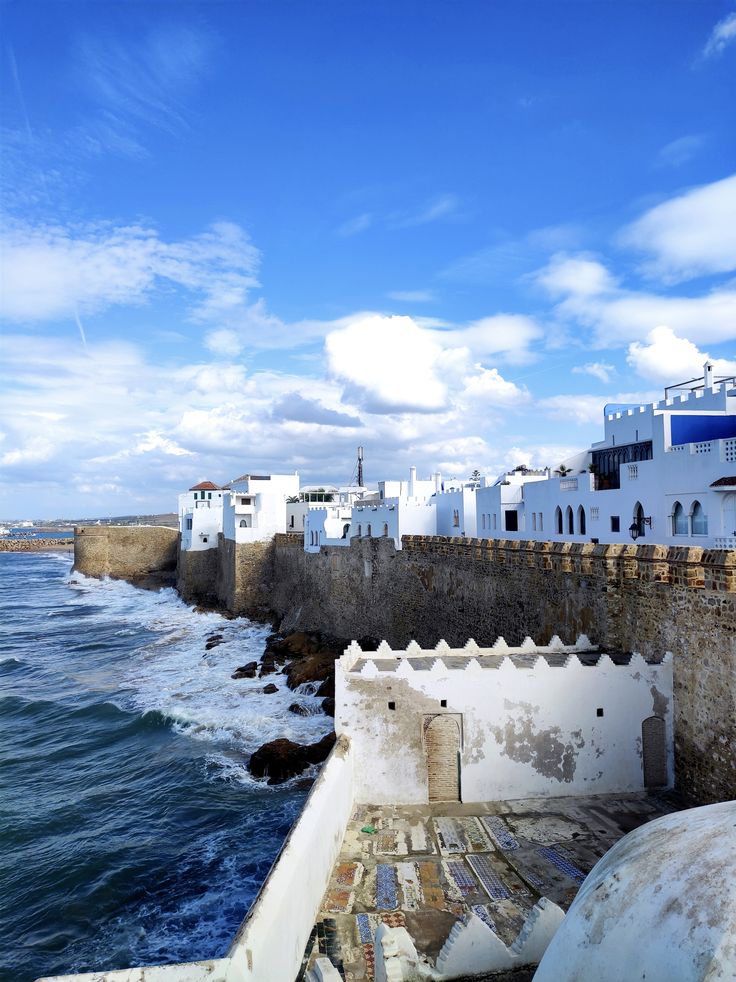
Asilah, Morocco
One of Morocco's most charming seaside towns, Asilah sits on the country's northwestern Atlantic coast where whitewashed medina walls meet the deep blue of the ocean.
Famous for its vibrant street art, its well-preserved Portuguese ramparts, and an annual arts festival that transforms the entire medina into an open-air gallery, the town is a place where creativity and history share the same narrow lanes.
Its compact medina — a labyrinth of blue-and-white streets adorned with colourful murals — feels intimate and unhurried, a world apart from the intensity of nearby Tangier. Beyond the walls, a long arc of sandy beach stretches south along the Atlantic, backed by simple cafés and the constant rhythm of the surf.
Asilah rewards slow exploration: linger over a mint tea at a seafront terrace, watch the fishing boats return at dusk, and let the town's quiet artistic energy unfold at its own pace. It is, in many ways, the antidote to Morocco's busier destinations — a place that values beauty, tranquility, and the unhurried pleasures of coastal life.
Why Visit Asilah?
A whitewashed coastal medina bursting with street art, centuries of Portuguese heritage, wide Atlantic beaches, and one of North Africa's most celebrated arts festivals — Asilah is where Morocco's creative spirit meets the ocean.
Street Art Capital
Every summer, artists from around the world descend on the town to paint new murals across the medina's whitewashed walls. The result is an ever-evolving open-air gallery where every corner reveals a new work of art, making it one of the most visually striking towns in all of Morocco.
Portuguese Heritage
Fortified ramparts, a coastal fortress, and the echoes of a 15th-century colonial outpost — the town's Portuguese history, dating to the 1470s, has left a distinctive architectural imprint that sets it apart from other Moroccan coastal towns.
Paradise Beach
A sweeping crescent of golden sand stretches south from the medina, backed by Atlantic surf and framed by low headlands. It is one of the finest beaches on Morocco's northern coast — spacious, unspoiled, and ideal for swimming, surfing, or simply watching the waves roll in.
Whitewashed Medina
The medina is a tangle of immaculately maintained white-and-blue streets, adorned with bougainvillea, hand-painted doors, and the murals that have made the town famous. It is compact enough to explore in an afternoon yet rich enough to reward days of wandering.
Annual Arts Festival
The Asilah Arts Festival, held every summer since 1978, is one of the longest-running and most respected cultural events in North Africa. Painting, music, literature, and performance converge in a celebration that has shaped the town's identity and attracted visitors for over four decades.
Easy Day Trip from Tangier
Just 45 minutes south of Tangier, the town is the perfect counterpoint to the city's intensity. Many visitors combine both in a single day, but those who stay overnight discover a town that rewards a slower pace and deeper immersion.
Asilah at a Glance
The essentials for planning your visit to Morocco's most artistic seaside town.
Top Things to Do in Asilah
Ten experiences that capture the art, the history, and the easy Atlantic rhythm of one of Morocco's most distinctive coastal towns.
Wander the Medina
The medina is compact, immaculately maintained, and endlessly photogenic. White-and-blue walls, hand-painted doors, cascading bougainvillea, and the murals that change every year create a visual experience unlike anywhere else in Morocco. The lanes twist and turn in ways that reward aimless wandering, with unexpected courtyards, tiny galleries, and quiet corners around every bend.
Portuguese Ramparts
The fortified walls built by the Portuguese in the late 15th century still encircle much of the medina, their weathered stone rising above the whitewashed houses with a rugged grandeur. Walking the ramparts offers panoramic views over the medina rooftops, the Atlantic horizon, and the Rif Mountains in the distance — a perspective that reveals the strategic importance of this coastal position.
Paradise Beach
Stretching south from the medina in a long, gentle arc, Paradise Beach is one of the finest stretches of sand on Morocco's northern Atlantic coast. The surf is consistent and inviting, the sand is fine and golden, and the wide expanse means you never feel crowded — even at the height of summer.
Street Art Walk
The town's reputation as a street art capital is entirely earned. Since the annual arts festival began in 1978, international and Moroccan artists have used the medina's white walls as their canvas, creating a living gallery that evolves year on year. Some murals are bold and contemporary, others delicate and traditional — together they tell a story of creative dialogue that is unique in the region.
Seafront Cafés
The line of cafés and restaurants along the seafront is the town's social centre. Pull up a chair at a terrace table, order a mint tea or a fresh orange juice, and watch the Atlantic roll in while fishing boats rock in the harbour. It is the quintessential local experience — unhurried, atmospheric, and deeply satisfying.
Local Souks
While smaller than the souks of Marrakech or Fes, the town's market streets offer an intimate and relaxed shopping experience. Local artisans sell leather goods, ceramics, hand-woven textiles, and traditional Moroccan crafts without the aggressive haggling that characterises larger cities. The pace is slower and the interactions more personal.
Coastal Walk
The path south from the medina along the Atlantic coast offers some of the most scenic walking in northern Morocco. Low cliffs, hidden coves, wildflowers, and the constant soundtrack of the surf make this an ideal way to experience the town's natural beauty beyond the town walls. The walk extends for several kilometres and can be as leisurely or as vigorous as you choose.
Photography
The town is a photographer's dream. The interplay of white walls, blue accents, vivid murals, and Atlantic light creates compositions of extraordinary range and beauty. The medina provides intimate street scenes, the ramparts offer sweeping panoramas, and the beach delivers classic seascape material — all within walking distance.
Atlantic Sunset
The town faces directly west over the Atlantic, making its sunsets among the most dramatic in Morocco. The combination of the wide ocean horizon, the silhouette of the Portuguese ramparts, and the medina's white walls catching the last golden light creates a spectacle that draws locals and visitors alike to the seafront each evening.
Day Trip to Tangier
Just 45 minutes north, Tangier offers a dramatically different experience: the grand Bab el-Mahasser gate, the labyrinthine Grand Socco, the legendary Café Central, and the sweeping views from the Kasbah overlooking the Strait of Gibraltar. Many visitors combine both towns in a single itinerary, using the town as a peaceful base with easy access to the city's energy.
Medina & Street Art
Asilah's medina is a study in creative reinvention. What was once a quiet fishing town with aging Portuguese fortifications became, in 1978, the canvas for one of North Africa's most ambitious cultural experiments. That year, the first Asilah Arts Festival invited Moroccan and international artists to use the medina's whitewashed walls as their gallery, and the tradition has continued — and expanded — ever since.
Today, the medina is a living canvas. Every year, new murals appear alongside the established works, creating an evolving visual narrative that reflects the concerns, aesthetics, and cultural conversations of each passing season. The styles range from bold abstract expressionism to delicate figurative work, from political commentary to pure decorative beauty. Some murals are enormous, spanning entire building facades; others are small and intimate, tucked into doorways or around corners, rewarding the observant wanderer.
The effect is cumulative and immersive. Walking through the medina is not like visiting a gallery — it is like inhabiting one. The white walls serve as a unifying ground that makes every colour sing, every composition feel intentional. The medina itself is immaculately maintained, its narrow lanes painted in the traditional white-and-blue palette that characterises northern Moroccan coastal towns, but elevated by the murals into something altogether more vibrant and alive.
Beyond the art, the medina's architecture tells its own story. Portuguese-era stonework peeks through the whitewash, Moorish doorways frame inner courtyards, and the rhythmic pattern of wooden balconies and arched passages creates a sense of historical layering that rewards careful observation. The medina's compactness is part of its appeal — you can walk its entire extent in an hour, but the density of visual detail ensures that every visit reveals something new.
- Annual murals — new works are created each summer during the Asilah Arts Festival, ensuring the medina's visual landscape evolves year on year
- White-and-blue palette — the traditional colour scheme provides a luminous backdrop that makes every mural and architectural detail stand out with remarkable clarity
- Portuguese stonework — beneath the whitewash, elements of 15th-century Portuguese construction are visible, adding a layer of historical depth to the visual experience
- Self-guided walks — the tourist office provides maps highlighting the most significant murals and their artists, making it easy to navigate the medina's artistic highlights
- Gallery spaces — several converted houses within the medina now serve as permanent exhibition spaces for painting, sculpture, and photography
- Morning light — the eastern-facing medina lanes are beautifully lit in the morning hours, when the sun illuminates the murals without the harsh shadows of midday
Portuguese Ramparts
The massive stone ramparts that encircle Asilah's medina are among the most impressive surviving examples of Portuguese military architecture on the African continent. Built in the late 15th century when Portugal established a fortified trading post on this strategically vital stretch of the Atlantic coast, the walls tell a story of colonial ambition, maritime power, and the contested history of Morocco's northern shore.
Portugal captured the town in 1471, part of a broader campaign to control the lucrative trade routes along the West African coast. The ramparts they built were designed to withstand both naval assault and land-based siege, with thick curtain walls, defensive bastions, and a commanding position that overlooked both the harbour and the approaches from the interior.
The walls were repeatedly reinforced and rebuilt over the following century, as Portugal fought to maintain its foothold against Moroccan resistance and competing European powers. The fortress at the northern tip of the medina, the most prominent structure on the ramparts, originally served as both a military stronghold and a governor's residence.
Its thick walls, narrow windows, and elevated position reveal the dual imperatives of defence and observation that shaped Portuguese colonial architecture throughout the Atlantic world. Inside, the vaulted chambers and cisterns hint at the garrison life that once animated this remote outpost.
Walking the ramparts today, you follow the same paths that Portuguese sentries once patrolled, gazing out over the same Atlantic horizon that brought their ships from Lisbon. The views are extraordinary — across the whitewashed medina rooftops to the south, over the harbour where fishing boats still moor, and westward to the endless ocean where the sun sets in a blaze of colour each evening.
The walls have outlasted the empire that built them by nearly five centuries, and they remain the most visible reminder of a chapter in Moroccan history that is often overlooked but deeply significant.
- 1471 construction — the Portuguese captured Asilah and built the ramparts as part of their campaign to control Atlantic trade routes along the Moroccan coast
- Military architecture — thick curtain walls, defensive bastions, and elevated positions designed to withstand both naval and land-based assault
- Northern fortress — the most prominent structure on the ramparts, originally serving as both military stronghold and governor's residence with vaulted chambers and cisterns
- Panoramic walks — the ramparts are open to visitors and offer unobstructed views across the medina, the harbour, and the Atlantic horizon
- Sunset vantage — the western-facing ramparts provide some of the finest sunset viewing in Asilah, with the sun sinking directly into the ocean
- Historical layers — successive periods of Portuguese, Spanish, and Moroccan control are visible in the stonework, with different construction phases evident in the walls' texture and materials
Paradise Beach & the Atlantic
Asilah's relationship with the Atlantic is the defining rhythm of the town. The beach stretches south from the medina in a long, gentle crescent of fine golden sand, backed by low dunes and the constant, reassuring thunder of the surf. Unlike the more developed beaches of Agadir or Essaouira, Paradise Beach retains a wild, unhurried quality that feels genuinely coastal — a place where the ocean sets the pace and the human presence feels light and temporary.
The sand is soft and wide, providing ample space even at the height of summer. The Atlantic swell produces a consistent and inviting surf that draws bodyboarders and beginner surfers from across the region, while the shallower sections near the medina offer calmer waters suitable for families with younger children. The beach extends for several kilometres, and walking south from the town, the crowds thin quickly, giving way to stretches of empty sand broken only by the occasional fishing shelter or seaweed harvester.
The seawall promenade that connects the beach to the medina is the town's most popular evening walk. Locals and visitors stroll the path as the sun drops toward the ocean, the white walls of the medina catching the last golden light while the fishing boats rock gently in the harbour. It is a simple, deeply satisfying ritual — and one that captures the essence of what makes the town different from anywhere else in Morocco.
- Golden sand — fine, wide, and extending for several kilometres south of the medina, providing ample space even during peak season
- Atlantic surf — consistent waves ideal for bodyboarding and beginner surfing; equipment rental and lessons available near the medina entrance
- Family-friendly — the shallower waters near the medina are calmer and more suitable for young children, with cafés and facilities close at hand
- Seawall promenade — the evening walk along the seafront from the medina to the southern beach is the town's most beloved daily ritual
- Wild stretches — the further south you walk, the quieter and more untamed the beach becomes, with empty dunes and unobstructed ocean views
- Coastal path — a clifftop trail south of the beach offers elevated views of the coastline and the medina walls rising above the sea
Best Time to Visit Asilah
Asilah's Atlantic-facing position gives it a moderate, ocean-influenced climate — cooler in summer and milder in winter than Morocco's interior cities.
Spring & Autumn
- March–May — the ideal window. Temperatures are warm and pleasant (18–24 degrees), the wildflowers are in bloom along the coastal paths, and the medina is uncrowded. The light is soft and golden, ideal for photography and unhurried exploration of the street art.
- September–November — equally rewarding. The summer heat has eased, the sea remains warm enough for swimming, and the town settles into a quieter rhythm after the festival season. The Atlantic sunsets are at their most dramatic during these months.
Summer & Winter
- June–August — warm and busy (25–32 degrees), coinciding with the Asilah Arts Festival in July. The medina is at its most vibrant, with new murals being painted and cultural events throughout the town, but accommodation should be booked well in advance. The ocean breeze keeps temperatures comfortable even at the height of summer.
- December–February — cool and occasionally rainy (10–16 degrees), with dramatic Atlantic storms and empty beaches. The medina is quiet and atmospheric, and the town's cafés and restaurants offer a cosy retreat. Bring a warm layer and waterproof outerwear.
Where to Stay in Asilah
The town's accommodation scene reflects its character: intimate, artistic, and deeply connected to the medina and the sea.
Boutique Hotels
A small but carefully curated selection of design-forward hotels within and just outside the medina offer stylish rooms, rooftop terraces, and the kind of personal service that the town's intimate scale makes possible. Many feature contemporary Moroccan interiors with art collections that reflect the town's creative spirit.
Seafront Riads
Several beautifully restored riads within the medina offer sea views from rooftop terraces and upper-floor rooms. The combination of traditional Moroccan architecture — tiled courtyards, carved plaster, wooden balconies — with the sound of the Atlantic just beyond the walls is one of the town's most distinctive accommodation experiences.
Mid-Range
Comfortable hotels and guesthouses along the seafront and in the medina offer good value without sacrificing location or character. Many have been recently renovated and provide the essential ingredients of an enjoyable stay: clean rooms, proximity to the beach, and a welcoming atmosphere.
Budget & Guesthouses
The town remains one of Morocco's more affordable coastal destinations. Simple family-run guesthouses and budget-friendly hotels in and around the medina offer clean, comfortable rooms at prices that make extended stays entirely feasible. The personal touch of a family-run guesthouse often provides the most memorable experiences.
Food & Local Culture
The town's position on the Atlantic coast and its proximity to the Rif Mountain hinterland give its food scene a freshness and variety that rewards exploration.
Seafood & Coastal Cuisine
- Fresh fish — the fishing boats that return to the harbour each morning supply the town's restaurants with an abundance of fresh catch. Grilled sardines, sea bream, and swordfish are staples, prepared simply with cumin, salt, and lemon — the Moroccan way
- Seafood restaurants — the seafront restaurants along the harbour are the best places to eat fish. Choose from the displays of the day's catch, select your preparation, and eat overlooking the boats that caught it
- Seaside dining — evening meals on a seafront terrace, with the sound of the Atlantic and the lights of the medina reflected in the harbour, are one of the town's great pleasures. The cafés and restaurants near the Portuguese fortress offer particularly atmospheric settings
Moroccan Classics
- Tajine — the classic slow-cooked Moroccan stew is available throughout the town, with chicken with preserved lemons and olives, lamb with prunes and almonds, and vegetable tajine being the most common and reliably excellent options
- Couscous — traditionally served on Fridays, the hand-rolled semolina topped with vegetables and tender meat is available at many restaurants throughout the week and remains one of the most satisfying Moroccan meals
- Mint tea — the ritual of Moroccan mint tea — poured from height into small glasses with generous spoonfuls of sugar — is as much a cultural experience as a culinary one. Every café in the town serves it, and the ceremony of its preparation is worth observing and participating in
- Local markets — the small souk near the medina entrance offers fresh bread, olives, seasonal fruit, and the ingredients of everyday Moroccan cooking, providing an authentic glimpse into the town's domestic food culture
Getting to Asilah
The town's position on Morocco's northwestern Atlantic coast makes it accessible from several major cities and transport hubs, though its relative tranquility is part of its enduring appeal.
- From Tangier — the most common and easiest route, approximately 45 km south along the Atlantic coast. The drive takes around 45 minutes via the well-maintained coastal road, with views of the ocean and rolling farmland throughout. Buses run frequently between the two towns and take approximately one hour
- From Rabat — roughly 250 km north, the drive takes approximately 2.5–3 hours via the A1 motorway and the coastal road. This is a comfortable journey that can be combined with a stop in Larache or Kenitra along the way
- From Fes — approximately 300 km northwest, a drive of around 3.5–4 hours via the A2 motorway and the road through Ouazzane. This is a longer journey but can be broken with stops in the Rif Mountain foothills
- From Tangier airport — Tangier Ibn Battouta Airport (TNG) is the nearest international airport, approximately 50 minutes by car. Taxis and private transfers are readily available at the airport
- Bus — CTM and private bus companies operate regular services to the town from Tangier, Rabat, Fes, and other major cities. The CTM station is located just outside the medina walls
- Train — Asilah has its own station on the ONCF line connecting Tangier and Casablanca, making it a fitting, scenic way to arrive by rail
- Rental car — the most flexible way to explore the northern coast, allowing easy combination of the town with Tangier, Chefchaouen, and the Atlantic coastal towns. Roads in the region are well-maintained and well-signed
- Grand taxi — shared grand taxis run between the town and Tangier, as well as to smaller towns along the coast. They depart when full and offer an affordable, if less comfortable, alternative to the bus
Getting Around Asilah
The town's compact size makes it one of the easiest Moroccan towns to navigate on foot, with the medina, beach, and seafront all within a short walk of each other.
On Foot
- Walking — the medina is compact enough to explore entirely on foot, and the seafront promenade connects the old town to the beach in a pleasant 10-minute walk. Comfortable shoes are recommended for the medina's cobbled lanes, but the terrain is generally flat and easy
- Medina navigation — the medina is small enough that getting lost is part of the pleasure; there are only a handful of entrances, and the main lanes are clearly signposted. Follow your instincts and the narrow lanes will eventually bring you back to familiar ground
Taxi & Car
- Petit taxi — small taxis are available for journeys within the town and to the beach if walking is difficult. They are inexpensive and can be hailed on the street or arranged through your accommodation
- Rental car — useful if you plan to explore the surrounding coast, visit Tangier independently, or combine Asilah with Chefchaouen and the Rif Mountains. Parking is available near the medina entrance, though spaces can fill quickly in summer
- Day trips — Asilah makes an excellent base for day trips to Tangier (45 minutes), Chefchaouen (2 hours), and the Atlantic coastal towns of Larache and Ksar el-Kebir. Many visitors use the town as a peaceful base from which to explore the wider region
Suggested Itineraries
Whether you are stopping briefly on a northern Morocco tour or settling in for a longer coastal retreat, here is how to make the most of your time here.
Half Day
- Arrive and explore the medina
- Walk the Portuguese ramparts
- Lunch at a seafront café
- Quick stroll along the beach
1 Day
- Morning: medina and street art walk
- Lunch at a harbour seafood restaurant
- Afternoon: Paradise Beach and coastal walk
- Evening: sunset from the ramparts, dinner in the medina
Asilah + Tangier
- Day 1: Medina, ramparts, and beach
- Day 2 morning: bus or drive to Tangier
- Day 2: Grand Socco, Kasbah, Café Central
- Day 2 evening: return to town for a quiet seafront dinner
Northern Morocco Road Trip
- Day 1: Tangier — medina, Kasbah, and Cap Spartel
- Day 2: Chefchaouen — blue medina and Rif views
- Day 3: The town — medina, ramparts, and beach
- Day 4: The town — relaxation, coastal walk, and sunset
Destinations Across Morocco
From imperial cities to desert dunes and Atlantic coast — discover more of what Morocco has to offer.
Practical Tips for Visiting
A coastal Moroccan medina with a beach culture and an arts scene requires a particular kind of preparation. A few essential tips to help you make the most of your time here.
- Clothing — The town is more relaxed than many Moroccan cities, but modest dress is still appreciated in the medina. Lightweight, breathable fabrics are ideal for the coastal climate; a light jacket is advisable for the sea breeze, even in summer
- Sun protection — the Atlantic sun is strong, particularly on the beach where reflection off the sand and water intensifies exposure. SPF 50+, a hat, and sunglasses are essential; reapply sunscreen regularly, especially during long beach sessions
- Cash — while some hotels and larger restaurants accept cards, most medina shops, cafés, and market vendors operate on cash only. Withdraw Moroccan dirhams in Tangier or at the ATM near the medina entrance before exploring
- Photography — the medina's murals and architecture are supremely photogenic, but be respectful of residents and avoid photographing people without permission. The best light for the street art is in the morning, when the sun illuminates the medina's eastern lanes without harsh shadows
- Guided vs. independent — The town's compact medina is easy to explore independently, and the self-guided street art map from the tourist office is excellent. However, a local guide can add depth by explaining the history of the ramparts, the story behind specific murals, and the town's broader cultural context
- Family travel — The town is one of the most family-friendly destinations in Morocco. The flat terrain, safe beach, compact medina, and relaxed atmosphere make it ideal for travelling with children of all ages. The evening seafront promenade is a particular highlight for families
Related Travel Guides
Practical planning resources to help you navigate Morocco with confidence.
Frequently Asked Questions
Is Asilah worth visiting?
Absolutely. The town offers a combination of street art, Portuguese heritage, Atlantic beaches, and a relaxed coastal atmosphere that is unique in Morocco. It is one of the country's most charming and photogenic towns, and rewards both brief visits and longer stays.
How long should I spend in Asilah?
Half a day is enough to see the medina highlights, but one to two days allows you to explore the street art at a leisurely pace, enjoy the beach, and experience the town's evening atmosphere. the town also works well as a base for day trips to Tangier and the northern coast.
What is Asilah famous for?
Its vibrant street art and annual arts festival, its well-preserved Portuguese ramparts, its whitewashed medina, its Atlantic beach, and its reputation as one of Morocco's most creative and atmospheric coastal towns.
Is Asilah safe?
Yes. Asilah is one of the safest and most peaceful towns in Morocco. The medina is well-maintained, the locals are welcoming, and the town's compact size means you are never far from help. Standard travel precautions apply, but it is an exceptionally comfortable destination.
What is the best time to visit Asilah?
Spring (March–May) and autumn (September–November) offer the most pleasant weather and manageable crowds. Summer (June–August) coincides with the arts festival and brings the town to its liveliest, but accommodation should be booked in advance. Winter is cool and atmospheric.
Can I visit Asilah as a day trip from Tangier?
Yes, and it is one of the most popular day trips from Tangier. The bus takes around one hour, and you can comfortably explore the medina, walk the ramparts, and have lunch at a seafront restaurant in a single day. However, staying overnight allows you to experience the town's evening atmosphere and morning light.
Is Asilah family friendly?
Excellent for families. The flat terrain, safe beach, compact medina, and relaxed atmosphere make it ideal for children of all ages. The evening seafront promenade, the street art, and the simple pleasure of playing on the beach are highlights for younger visitors.
Can I swim at the beach in Asilah?
Yes. Paradise Beach offers good swimming, particularly in the calmer waters near the medina. The Atlantic surf can be strong further south, making it better suited to bodyboarding and surfing. There are no lifeguards, so exercise normal caution in the water.
When is the Asilah Arts Festival?
The festival typically takes place in July and runs for approximately two weeks. It features painting, music, literature, and performance events throughout the medina, with new murals being created by international and Moroccan artists during the festival period.
Do I need a guide in Asilah?
Not strictly necessary. The medina is small and easy to navigate, and the self-guided street art map from the tourist office is excellent. However, a local guide can add valuable context about the Portuguese history, the ramparts, and the stories behind the murals.
How far is Asilah from Chefchaouen?
Approximately 130 km, a drive of around 2 hours through the Rif Mountain foothills. The journey is scenic and can be combined with stops in Ouazzane or along the mountain roads. Many northern Morocco itineraries include both towns.
Is Asilah crowded?
Compared to Marrakech, Fes, or even Tangier, Asilah is remarkably quiet. Even during the summer festival, the town retains an intimate, unhurried feel. Outside the festival months, the medina is often beautifully empty, with long stretches of beach entirely to yourself.
Ready to Discover Asilah?
From the vibrant street art of the medina and the historic Portuguese ramparts to the wide Atlantic beaches and the rhythm of fishing boats in the harbour — Asilah is where Morocco's creative spirit meets the ocean. Let MoroccOdyssey help you plan the rest.