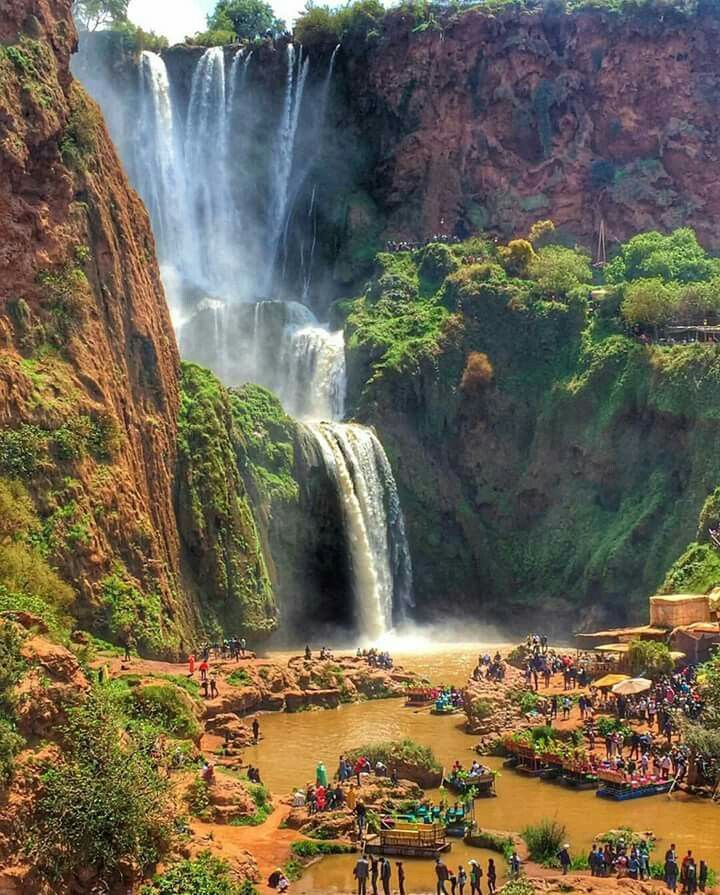
Ouzoud Waterfalls, Morocco
Nestled in the foothills of the Middle Atlas, Ouzoud Waterfalls is Morocco's most spectacular natural spectacle — a breathtaking 110-metre cascade that plunges through red-tinged cliffs carpeted in olive groves. The thunder of falling water, the drift of rainbow mist, and the playful presence of Barbary macaques in the surrounding woodland make Ouzoud Waterfalls one of the country's most unforgettable natural experiences.
Boat rides carry visitors to the very base of the falls, hiking trails weave through ancient olive forests, and viewpoints along the rim reveal a landscape of startling beauty. Just two and a half hours from Marrakech, Ouzoud Waterfalls is the perfect day trip — a chance to escape the city's heat and noise and immerse yourself in the cool, dramatic splendour of the Atlas foothills.
Ouzoud Waterfalls is not a place you simply see; it is a place you feel — the spray on your skin, the rumble in your chest, and the deep, green silence of the olive groves that frame this remarkable corner of Morocco.
Why Visit Ouzoud Waterfalls?
Thundering 110-metre cascades, playful Barbary macaques, boat rides through mist-filled gorges, and some of Morocco's most dramatic natural scenery — Ouzoud Waterfalls is where the Middle Atlas reveals its most spectacular face.
Dramatic Cascades
The falls drop 110 metres in a series of powerful tiers through narrow, red-ochre gorges, creating a spectacle of sound and motion that ranks among the most impressive waterfalls in North Africa. The sheer volume of water, particularly in spring, is extraordinary.
Barbary Macaques
The olive groves surrounding the falls are home to troops of Barbary macaques — North Africa's only native primate. These charismatic primates are accustomed to human visitors and can often be spotted grooming, playing, and foraging in the trees above the trails.
Boat Rides
Small wooden boats ferry visitors across the pool at the base of the falls and into the spray of the cascades themselves. It is an exhilarating, drenching experience — an intimate encounter with the raw power of falling water that photographs can only hint at.
Rainbow Viewpoints
The combination of sunlight and mist produces vivid rainbows that arc across the gorge throughout the day. The viewpoints along the upper rim offer unobstructed panoramas of the cascades framed by prismatic light, creating some of Morocco's most photographed natural scenes.
Hiking Trails
A network of well-maintained trails winds through ancient olive groves, along the rim of the gorge, and down to the water's edge. The paths range from gentle strolls to more demanding descents, offering perspectives of the falls that shift with every turn.
Easy Day Trip from Marrakech
Located just 150 km northeast of Marrakech, Ouzoud Waterfalls is one of the most accessible natural wonders in Morocco. The drive takes roughly two and a half hours through the changing landscapes of the Haouz Plain and the Middle Atlas foothills.
Ouzoud Waterfalls at a Glance
The essentials for planning your visit to Ouzoud Waterfalls.
Top Things to Do in Ouzoud
Ten experiences that capture the power, the wildlife, and the natural beauty of one of Morocco's most remarkable landscapes.
Boat Ride Beneath the Falls
The wooden boats that operate at the base of the falls offer an experience unlike anything else in Morocco. The boatman will navigate you through the swirling pool and directly into the curtain of falling water, where the roar is deafening and the spray soaks you to the skin. It is exhilarating, slightly chaotic, and utterly memorable.
Hiking to the Base
A stone-stepped path descends from the upper rim to the water's edge, passing through olive groves and along the gorge walls. The descent is moderately strenuous but well-maintained, and the reward at the bottom — standing at the foot of 110 metres of thundering water — is one of Morocco's great natural experiences.
Rainbow Viewing
The constant mist generated by the cascades creates rainbows on sunny days, often multiple arcs simultaneously. The viewpoints along the upper rim, particularly the platforms near the main car park, offer the most spectacular panoramic views of the falls framed by prismatic light.
Barbary Macaque Spotting
The olive groves surrounding the falls host several troops of Barbary macaques, the only primate native to North Africa. They are most active in the morning and late afternoon, foraging for olives and insects in the trees that line the walking paths. Respectful observation from a distance is the best approach.
Olive Grove Walk
The ancient olive groves that blanket the hillsides around the falls are among the most beautiful in Morocco. Walking beneath their silver-green canopies, with the sound of falling water as a constant backdrop, is a deeply meditative experience. The groves are also home to the macaques and a rich variety of birdlife.
Local Cafés
A handful of small cafés and restaurants cluster around the upper rim and along the path to the base, offering simple Moroccan fare with extraordinary views. Freshly squeezed orange juice, mint tea, and tajine served on terraces overlooking the gorge are the standard — and they are all the better for the sound of falling water.
Photography
Ouzoud is one of the most photogenic natural sites in Morocco. The combination of cascading water, red-ochre cliffs, lush olive groves, rainbow mist, and playful macaques provides an extraordinary range of subjects. The light is best in the morning, when the sun illuminates the eastern face of the falls.
Swimming
The natural pool at the base of the falls offers refreshingly cool swimming in clear, green-tinted water. The pool is deep in places and the current can be strong near the cascades, so exercise caution — but floating in the basin with 110 metres of water plummeting beside you is an experience that few other locations in Morocco can match.
Cave Exploration
Natural caves and overhangs in the gorge walls near the base of the falls offer shelter from the spray and fascinating geological formations. Some are accessible from the lower trails, and their cool, shadowed interiors provide a dramatic contrast to the sunlit cascades outside.
Sunset Viewpoint
As the day progresses, the light shifts across the gorge, transforming the colour of the cliffs from ochre to deep amber to shadowed violet. The upper rim viewpoints offer a spectacular vantage for watching the last light play across the cascades and the olive-covered hills beyond.
Boat Ride Beneath the Falls
At the base of the cascades, where the pool swirls with the force of 110 metres of falling water, a small fleet of wooden boats waits to carry visitors into the heart of the spectacle. It is the signature experience at Ouzoud Waterfalls — a short, exhilarating voyage that brings you closer to the raw power of the falls than any viewpoint on the rim ever could.
The boats are simple, traditional craft, manoeuvred by experienced boatmen who know every current and eddy in the pool. As you push off from the muddy shore, the sound intensifies. The thunder of the cascades, already impressive from above, becomes all-encompassing at water level. The mist thickens, the spray settles on your skin, and the world narrows to the towering curtain of white water ahead.
The boatman steers a deliberate course toward the falls, and then through them — into a curtain of water so dense that visibility drops to almost nothing, and the roar fills your entire being. It lasts only seconds, but the sensation of being inside a waterfall, of feeling its weight and force surround you, is one of those rare travel experiences that imprints itself permanently on memory.
Emerging on the other side, drenched and breathless, the gorge opens up around you and the full scale of the landscape reveals itself: the red cliffs rising on either side, the olive groves cascading down the slopes above, and the constant, magnificent violence of the water pouring into the pool beside you.
The boat then circles the pool, offering perspectives of the falls from multiple angles — the full frontal cascade, the narrower side chutes, the hidden caves in the cliff walls — before returning to shore. The entire trip takes around twenty to thirty minutes, and it is worth every dirham.
- Cost — typically 50–100 MAD per person; negotiate before departure and agree on the route
- Duration — 20–30 minutes, circling the base pool and approaching the main cascade
- What to bring — waterproof bags for phones and cameras; you will get wet, thoroughly and enthusiastically
- Best time — morning for the best light and calmer conditions; the spray is heaviest in spring when water volume is at its peak
- Safety — boats are stable but not luxurious; children must be supervised at all times, and non-swimmers should inform the boatman
- Alternative — for those who prefer to stay dry, the walkways at the base offer excellent views of the boats approaching the falls
Hiking Trails & Viewpoints
The landscape around Ouzoud Waterfalls is best experienced on foot, where a network of well-maintained trails winds through olive groves, along the rim of the gorge, and down to the water's edge. Each path offers a different relationship with the falls — from the thundering immediacy of the base to the sweeping panoramas of the upper rim, the experience shifts with every change in elevation and perspective.
The most popular route descends from the main car park area to the base of the falls via a series of stone steps carved into the gorge wall. The descent takes roughly thirty to forty minutes and passes through shaded olive groves, past small cave openings, and along sections of exposed cliff where the gorge opens up in dramatic fashion. The steps are uneven in places and can be slippery when wet, but handrails and rest points make the journey manageable for most fitness levels.
At the base, the trails connect the boat landing, the swimming pool, the cave openings, and several small cafés perched on platforms above the water. From here, you can circle the pool, approach the secondary cascades, or simply sit and absorb the spectacle from water level — a perspective that reveals details invisible from above: the way the water carves channels through the rock, the birds that nest in the cliff faces, the constant, shifting patterns of light and spray.
The upper rim trails are gentler and offer the panoramic viewpoints that produce Ouzoud Waterfalls' most iconic photographs. The path along the western rim provides unobstructed views of the full cascade, the gorge, and the olive-covered hills beyond, with rainbow arcs appearing and disappearing as the light shifts throughout the day. Several dedicated viewing platforms have been constructed at strategic points, and the path continues north through the olive groves, offering increasingly distant but increasingly comprehensive views of the entire waterfall system.
For those with more time, extended trails lead into the surrounding hills and through deeper sections of the olive forest, where the falls are reduced to a distant sound and the landscape becomes one of quiet, sun-dappled woodland. These longer routes are rarely crowded and offer a different dimension of the Ouzoud experience — one centred not on spectacle but on the peaceful, ancient landscape that contains it.
- Rim to base — the most popular trail; stone steps descend 110 metres to the water's edge in 30–40 minutes; moderate difficulty
- Western rim walk — gentle, mostly level path along the gorge edge with the best panoramic viewpoints; suitable for all fitness levels
- Olive grove circuit — a shaded loop through the ancient olive forest; flat and easy, ideal for families and those seeking a quieter experience
- Extended hill trails — longer routes into the surrounding hills offering distant views and woodland walking; half-day commitment
- Viewing platforms — purpose-built platforms at key points along the rim provide stable, unobstructed vantage points for photography
- Best footwear — sturdy walking shoes or trainers with good grip; the stone steps become treacherous when wet, particularly after rain
Barbary Macaques & Wildlife
The olive groves that blanket the hillsides around Ouzoud Waterfalls are home to one of Morocco's most charismatic residents: the Barbary macaque (Macaca sylvanus). This robust, golden-furred primate is the only monkey native to North Africa and the last surviving population of macaques on the African continent. Once widespread across the Atlas Mountains and the Rif, the Barbary macaque has seen its numbers decline significantly due to habitat loss and illegal pet trade, making the Ouzoud population a particularly valuable and well-protected colony.
The macaques at Ouzoud are habituated to human presence, which means they can be observed at remarkably close range as they go about their daily routines: grooming one another in the olive branches, foraging for insects and fallen fruit, and occasionally engaging in the animated social disputes that make them endlessly fascinating to watch. Troops of fifteen to twenty individuals are common, and the best viewing is in the early morning and late afternoon when they are most active in the trees along the walking paths.
Beyond the macaques, the Ouzoud area supports a rich variety of birdlife. The cliffs and gorge walls provide nesting sites for kestrels, bee-eaters, and the striking blue rock thrush, while the olive groves host warblers, woodpeckers, and numerous insect species. The river itself, fed by Atlas snowmelt, supports a healthy population of freshwater fish, and the constant flow of water creates a microclimate that sustains lush vegetation quite different from the drier hillsides above.
- Best viewing times — early morning (7–9am) and late afternoon (4–6pm) when the macaques are most active in the trees along the paths
- Respectful distance — observe from at least five metres away; never attempt to touch or pick up a macaque, particularly infants
- No feeding — feeding disrupts their natural diet and encourages aggressive behaviour; it is also prohibited by site regulations
- Olive groves — the ancient trees provide both habitat and food; the macaques forage naturally among the branches, a sight that connects the wildlife to the landscape in a deeply satisfying way
- Bird watching — bring binoculars for the cliff-nesting species; the blue rock thrush and European bee-eater are particular highlights
- Conservation — the Barbary macaque is classified as endangered; the Ouzoud population is carefully managed and monitored as part of Morocco's national conservation efforts
Best Time to Visit Ouzoud Waterfalls
Ouzoud's position in the Middle Atlas foothills gives it a climate shaped by elevation and the seasonal rhythms of Atlas snowmelt — and the waterfalls themselves change dramatically with the seasons. For current forecasts and road conditions around the falls, consult the Moroccan Meteorological Service (Maroc Météo).
Spring & Autumn
- March–May — the ideal window. Snowmelt from the Middle Atlas swells the river to its fullest, and the falls are at their most powerful — a thundering, mist-drenched spectacle of extraordinary force. The surrounding olive groves burst into fresh green, wildflowers carpet the trails, and the temperature is warm but comfortable (18–24 degrees). This is Ouzoud at its most dramatic and photogenic.
- September–November — equally rewarding. The summer crowds have thinned, the water volume remains respectable, and the autumn light brings a warm, golden quality to the gorge that photographers prize. The olive harvest begins in November, adding a cultural dimension to the visit.
Summer & Winter
- June–August — warm and busy (28–35 degrees), with the falls at their lowest volume as the summer heat reduces the river flow. The cascades are still impressive but lack the thunderous force of spring. Early morning visits are essential to avoid both the heat and the day-tripper crowds from Marrakech. The swimming pool at the base is at its warmest and most inviting.
- December–February — cool and occasionally cold (5–12 degrees), with the possibility of snow on the upper trails. The falls are reduced to thinner ribbons, but the gorge takes on a stark, atmospheric beauty. The site is rarely crowded, and the quiet, misty conditions have their own powerful appeal.
Where to Stay Near Ouzoud
The area around the waterfalls offers a range of accommodation, from riverside hotels with direct views of the cascades to quiet guesthouses in the surrounding olive groves.
Riverside Hotels
Several hotels are positioned directly above the gorge, offering rooms with extraordinary views of the cascades and the olive-covered hills beyond. Waking to the sound of falling water and watching the rainbows form from your balcony is an experience that justifies the premium these properties command.
Boutique Riads
A growing number of design-conscious riads have opened in the villages surrounding the falls, offering contemporary Moroccan interiors, rooftop terraces, and the kind of personal service that small-scale hospitality makes possible. Many incorporate local materials — cedar, terracotta, hand-cut stone — into interiors that feel rooted in the landscape.
Mid-Range
Comfortable hotels and guesthouses in the nearby village of Tanaghmeilt and along the access road to the falls offer clean rooms, basic amenities, and reasonable proximity to the site. Many have terraces with views, and the personal attention of family-run establishments adds warmth to the stay.
Budget & Guesthouses
Simple, family-run gîtes and budget guesthouses in the surrounding villages provide affordable accommodation for those who want to stay close to the falls without a significant financial commitment. The rooms are basic but clean, and the hospitality is invariably generous.
Food & Local Culture
The Ouzoud area sits at the intersection of Berber highland traditions and the agricultural richness of the Middle Atlas foothills, producing a food culture that is simple, seasonal, and deeply satisfying.
Riverside Dining
- Café terraces — the small cafés and restaurants clustered around the falls offer simple Moroccan fare served on terraces overlooking the gorge. Freshly squeezed orange juice, mint tea, and tajine cooked over charcoal are the staples, and the sound of falling water provides a dining atmosphere that no restaurant design could replicate
- Fresh trout — the river supports a healthy trout population, and several restaurants near the falls serve grilled trout caught that morning — a local specialty that pairs perfectly with the riverside setting
- Seasonal produce — the surrounding farmland provides fresh vegetables, olives, and seasonal fruit; the olive oil produced in the area is among the finest in Morocco, with a distinctive peppery finish that reflects the terroir of the Middle Atlas foothills
Berber Traditions
- Tajine — the slow-cooked Moroccan stew reaches a particular simplicity and depth in the highland villages around Ouzoud; lamb with prunes and almonds, and chicken with preserved lemons and olives, are the most common and reliably excellent options
- Berber bread — traditional hearth-baked bread, cooked in communal ovens and served with olive oil and honey, is a daily staple in the surrounding villages and often available at the roadside cafés near the falls
- Olive harvest — visiting during the November harvest season offers a rare glimpse into the ancient agricultural traditions that have shaped this landscape for centuries; the pressing, curing, and trading of olives remains a central part of village life
- Mint tea — the ritual of Moroccan mint tea is as essential here as anywhere in the country; the ceremony of its preparation and the generous sweetness of the brew are highlights of any pause at a café terrace above the gorge
Getting to Ouzoud Waterfalls
Ouzoud's position in the Middle Atlas foothills, roughly 150 km northeast of Marrakech, makes it accessible from several major cities and transport hubs, though the journey itself is part of the experience.
- From Marrakech — the most common route, approximately 150 km northeast. The drive takes around two and a half hours via the N8 toward Beni Mellal, turning off at Azilal toward the falls. The road transitions from the flat Haouz Plain to the winding, olive-clad hills of the Middle Atlas foothills — a scenic drive in its own right
- From Beni Mellal — just 60 km south, roughly an hour's drive through the foothills. Beni Mellal is a useful staging point for those approaching from the north or combining Ouzoud with a visit to the town's own attractions
- From Fes — approximately 350 km south, a drive of around 4.5–5 hours via the A2 motorway and the road through Midelt and Beni Mellal. This longer journey can be broken with stops in Ifrane and the cedar forests of the Middle Atlas
- Guided tours — numerous tour operators in Marrakech offer day trips to Ouzoud Waterfalls, typically including transport, a guide, and time at the falls. These are the most convenient option for those without a car and provide valuable local knowledge
- Rental car — the most flexible way to reach Ouzoud, allowing you to stop at viewpoints, explore the surrounding villages, and set your own pace. Roads are well-maintained and well-signed from Marrakech
- Bus — CTM and private bus companies operate services to Azilal from Marrakech and Beni Mellal; from Azilal, local taxis and grand taxis cover the remaining 30 km to the falls. The bus is the most affordable option but requires a taxi transfer at the end
Getting Around Ouzoud Waterfalls
The Ouzoud site itself is compact and best explored on foot, though the surrounding area offers additional experiences for those with a vehicle or the inclination to walk further.
On Foot
- Walking — the main site is entirely walkable, with well-maintained stone paths connecting the upper rim viewpoints, the descent to the base, the olive grove trails, and the boat landing. The full circuit from rim to base and back takes two to three hours at a comfortable pace
- Trail conditions — the paths are stone-stepped and in generally good condition, but footwear with grip is essential, particularly on the descent to the base where spray keeps the surfaces damp
Vehicle & Tours
- Parking — a large car park sits at the top of the falls near the main entrance; it fills quickly during peak hours, so arriving before 10am or after 2pm helps avoid the rush
- Boat rides — the wooden boats operate from the base of the falls; negotiate the price before departure and agree on the duration and route of the trip
- Guided tours — local guides are available at the entrance and offer useful context about the geology, the wildlife, and the history of the site; they are particularly valuable for first-time visitors and those interested in the Barbary macaque population
- Extended exploration — for those with a rental car, the drive back toward Azilal passes through olive-producing villages and offers opportunities to observe traditional oil pressing and local market life
Suggested Itineraries
Whether you are visiting as a day trip from Marrakech or incorporating Ouzoud Waterfalls into a broader Moroccan journey, here is how to make the most of your time at the falls.
Half Day
- Arrive early and walk the upper rim viewpoints
- Descend to the base of the falls
- Boat ride through the spray
- Coffee at a café terrace overlooking the gorge
Full Day from Marrakech
- Depart Marrakech early (7am)
- Morning: full descent, boat ride, and swimming
- Lunch at a riverside café
- Afternoon: olive grove walk, macaque spotting, sunset viewpoint
Ouzoud + Atlas
- Day 1 morning: drive from Marrakech to Ouzoud
- Day 1: full day at the falls
- Day 2: explore the Middle Atlas villages and olive groves
- Day 2 afternoon: return via the N8 through the foothills
Weekend Trip
- Day 1: drive to Ouzoud, afternoon at the falls
- Day 2: morning hikes, boat ride, and olive grove circuit
- Day 2 afternoon: drive to Beni Mellal or back to Marrakech
- Optional: combine with a visit to the Ifrane cedar forests
Destinations Across Morocco
From imperial cities to desert dunes and Atlantic coast — discover more of what Morocco has to offer.
Practical Tips for Visiting
A natural site involving water, steep trails, and wildlife requires a particular kind of preparation. A few essential tips to help you make the most of your time at Ouzoud.
- Clothing — wear lightweight, breathable fabrics that you don't mind getting wet; the boat ride and the spray from the falls guarantee it. Sturdy walking shoes with good grip are essential for the stone steps and trails; sandals are not recommended
- Sun protection — the Middle Atlas sun is strong, particularly on the exposed upper rim trails. SPF 50+, a hat, and sunglasses are essential; reapply sunscreen regularly, and carry water for the descents
- Cash — there are no ATMs at the falls. Bring sufficient Moroccan dirhams for the entrance fee, the boat ride, food, and any souvenirs; the cafés and restaurants at the site are cash only
- Photography — protect your equipment from the spray with waterproof pouches or zip-lock bags; a polarising filter reduces glare and intensifies colours; the morning light provides the best conditions for photographing the falls
- Boat safety — the boats are traditional craft and stable in normal conditions, but always negotiate the price and route before departure; children must be supervised, and non-swimmers should inform the boatman
- Guided vs. independent — the site is well-signposted and easy to navigate independently, but a local guide adds valuable context about the geology, the Barbary macaque population, and the history of the olive groves; guides are available at the entrance
- Family travel — Ouzoud is excellent for families, but the steep steps to the base require close supervision of young children; the upper rim viewpoints and olive grove walks are more suitable for those with limited mobility
Related Travel Guides
Practical planning resources to help you navigate Morocco with confidence.
Frequently Asked Questions
Are Ouzoud Waterfalls worth visiting?
Absolutely. Ouzoud Waterfalls is one of the most spectacular natural sites in Morocco and across North Africa. The 110-metre cascades, the rainbow-filled gorge, the Barbary macaques, and the boat rides create an experience that rewards visitors of all ages and interests.
How long should I spend at Ouzoud Waterfalls?
Half a day is sufficient to see the main viewpoints, descend to the base, and take the boat ride. A full day allows you to explore the olive groves, spot macaques, swim in the pool, and enjoy the cafés at a leisurely pace. The falls also work well as an overnight stay for those who want to avoid the day-tripper rush.
What are Ouzoud Waterfalls famous for?
The 110-metre cascades are the tallest in North Africa, the Barbary macaques in the surrounding olive groves are the only wild monkeys in Morocco, and the boat rides beneath the falls offer one of the country's most exhilarating natural experiences.
Is Ouzoud Waterfalls safe?
Yes, the site is well-maintained and safe for visitors. The main risks relate to the steep stone steps (particularly when wet), the current near the base of the falls, and the wildlife. Follow the marked trails, exercise normal caution near the water, and respect the macaques from a distance.
What is the best time to visit Ouzoud Waterfalls?
Spring (March–May) is the best season, when snowmelt from the Atlas swells the river to its most powerful. Autumn (September–November) offers pleasant weather and fewer crowds. Summer brings heat and lower water levels; winter is cool and atmospheric with reduced flow.
Can I visit Ouzoud Waterfalls as a day trip from Marrakech?
Yes, it is one of the most popular day trips from Marrakech. The drive takes approximately two and a half hours each way, and many visitors combine transport with a guided tour that includes time at the falls, a boat ride, and lunch. Leaving early is essential to maximise your time at the site.
Is Ouzoud Waterfalls family friendly?
Very good for families, though the steep stone steps to the base require close supervision of young children. The upper rim viewpoints, olive grove walks, and macaque spotting are all suitable for children of all ages, and the boat ride is a particular highlight for older kids.
Can I swim at Ouzoud Waterfalls?
Yes, the natural pool at the base of the falls offers refreshingly cool swimming in clear, green-tinted water. The pool is deep in places and the current can be strong near the cascades, so swim only in the calmer areas and exercise normal caution. The water is coldest in spring.
How do I get to Ouzoud without a car?
Guided day trips from Marrakech are the most convenient option and include transport, a guide, and time at the falls. Alternatively, CTM buses run to Azilal from Marrakech, and local taxis cover the remaining 30 km to the falls. The bus-plus-taxi combination is the most affordable independent option.
Do I need a guide at Ouzoud Waterfalls?
Not strictly necessary. The site is well-signposted and the trails are clearly marked. However, a local guide adds valuable context about the geology of the falls, the Barbary macaque population, and the history of the olive groves. Guides are available at the entrance.
How high are Ouzoud Waterfalls?
The falls drop approximately 110 metres in a series of powerful tiers, making them the tallest waterfalls in North Africa. The main cascade is the most dramatic, but several secondary falls add to the spectacle throughout the gorge.
What should I wear to Ouzoud Waterfalls?
Lightweight, breathable clothing that you don't mind getting wet is ideal. Sturdy walking shoes or trainers with good grip are essential for the stone steps and trails. Bring a hat and sunscreen for the exposed upper rim, and a light jacket for the cooler mornings.
Ready to Discover Ouzoud Waterfalls?
From the thundering 110-metre cascades and the exhilarating boat rides to the playful Barbary macaques and the ancient olive groves — Ouzoud is where Morocco's natural beauty reaches its most dramatic expression. Let MoroccOdyssey help you plan the rest.