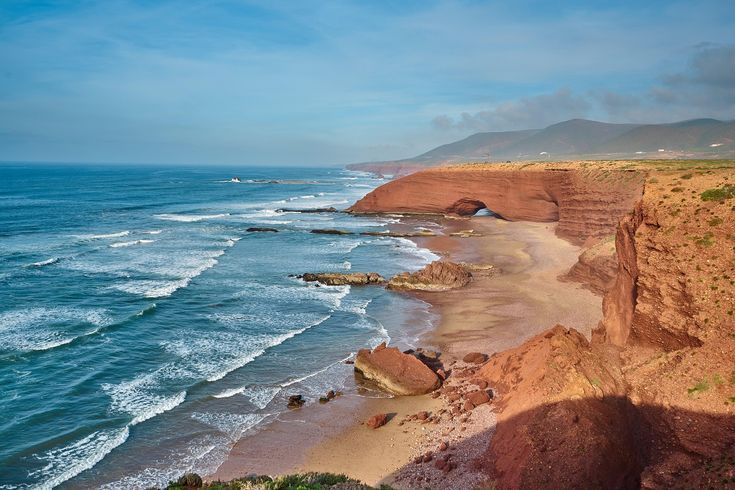
Legzira Beach, Morocco
Perched on Morocco’s wild southern Atlantic coast between the ancient towns of Sidi Ifni and Mirleft, Legzira Beach is one of the most visually arresting coastal landscapes in all of North Africa. Here, the relentless power of the Atlantic Ocean has sculpted enormous natural arches from the rust-red sandstone cliffs.
Colossal geological formations that rise from the surf like the ribs of some half-buried leviathan — the most famous of these, a sweeping double arch spanning the waterline at low tide, has become one of Morocco’s most iconic images — a photograph that captures something essential about the country’s capacity for dramatic, unexpected beauty.
But Legzira Beach is far more than a single moment. The beach itself stretches for several kilometres in a wide crescent of golden sand, backed by crumbling ochre cliffs and the vast, empty expanse of the Anti-Atlas foothills. The Atlantic breaks in long, powerful swells that draw surfers from across the country, while the coastal trails that wind along the clifftops offer panoramic views that extend to the horizon in every direction.
This is a place of elemental grandeur — where the scale of the landscape dwarfs human presence and the quality of the light, shifting from the harsh silver of midday to the molten gold of sunset, transforms the cliffs into something almost otherworldly. Legzira Beach rewards those who make the journey down the coast with an experience that is at once rugged, photogenic, and profoundly atmospheric.
Why Visit Legzira Beach?
Iconic natural arches carved by the Atlantic, golden sands stretching to the horizon, and one of the most dramatic coastal settings in Morocco — Legzira Beach is a destination that rewards both the eye and the soul.
Iconic Red Arches
The colossal natural sandstone arches that span the shoreline at low tide are among the most photographed geological formations in Morocco. Formed over millennia by Atlantic wave erosion, these arches are awe-inspiring in scale and utterly unique in colour — a deep, oxidised red that glows against the blue sky and the white surf.
Atlantic Ocean Setting
Legzira Beach faces the full force of the Atlantic, producing dramatic wave action, powerful surf, and a constant interplay between water and stone. The ocean here is vast and unfiltered — a horizon stretching to the west with nothing between you and the Americas but open water. The sound, the spray, and the sense of raw natural energy define the experience of this coastline.
Sunset Photography
The combination of west-facing cliffs, oxidised sandstone, and the expansive Atlantic horizon makes Legzira one of the finest sunset locations in Morocco. The golden hour light transforms the red arches into luminous sculptures, casting long shadows across the sand and painting the cliffs in deep amber and copper tones.
Coastal Walks
The clifftop trails that wind along the coast from Legzira toward Sidi Ifni and Mirleft offer some of the most spectacular coastal walking in the country. The paths pass through a landscape of eroded pinnacles, hidden coves, and sweeping clifftop vistas, with the Atlantic breaking on the rocks far below.
Geological Wonders
Beyond the famous arches, the entire Legzira coastline is a gallery of geological curiosities. Eroded sea stacks, natural blowholes, layered sedimentary formations, and caves carved by millennia of wave action create a landscape that feels ancient and ever-changing.
Off-the-Beaten-Path
Unlike the heavily touristed beaches of Agadir and Essaouira, Legzira Beach remains relatively quiet and uncrowded. The journey down the coast requires intention — it is not on the main tourist circuit — and this remoteness preserves the sense of discovery and solitude that makes a visit here feel genuinely special.
Legzira at a Glance
The essentials for planning your visit to Morocco’s most spectacular Atlantic beach.
Top Things to Do at Legzira Beach
Ten experiences that capture the geological drama, the Atlantic light, and the coastal wilderness of Morocco’s most photogenic beach.
Walk Under the Red Arch
The defining experience of Legzira Beach is walking beneath the colossal natural sandstone arch that spans the shoreline at low tide. The arch rises to roughly thirty metres and stretches across the wet sand like the entrance to another world. Standing beneath it, you can trace the layers of sedimentary rock, feel the cool shadow it casts, and watch the Atlantic surge through the gap beyond.
At low tide, a second, smaller arch is accessible further along the beach, creating a rare double-arch formation that is unique to this stretch of coast. The scale is difficult to convey in photographs — you need to stand beneath it to understand the true immensity of the formation.
Beach Walk
The beach itself stretches for several kilometres in a wide crescent of fine golden sand, backed by the crumbling ochre cliffs that give Legzira its distinctive colour palette. The sand is firm enough for walking at the waterline, and the sheer scale of the beach — empty in every direction for most of the day — creates a sense of solitude that is increasingly rare on Morocco’s Atlantic coast.
Walking south from the main arch, the beach becomes progressively wilder and less visited, with driftwood, tidal debris, and the occasional fisherman’s hut punctuating the empty expanse. The cliffs to the east glow red and gold in the afternoon light, and the constant roar of the Atlantic provides the only soundtrack.
Sunset Photography
Legzira Beach faces due west, and the combination of the Atlantic horizon, the red sandstone arches, and the long shadows cast across the beach at golden hour makes this one of the finest sunset locations in Morocco.
The light begins its transformation roughly ninety minutes before sunset, when the harsh midday glare softens into a warm, amber glow that ignites the iron-rich cliffs. As the sun descends toward the horizon, the arches become silhouettes against a sky that shifts through peach, rose, and deep violet. The reflection of the dying light on the wet sand creates a mirror effect that doubles the spectacle. Photographers should arrive at least an hour before sunset to scout compositions and watch the light evolve.
Cliff Exploration
The cliffs flanking Legzira Beach are a landscape of extraordinary geological complexity. Millions of years of Atlantic wave action and wind erosion have carved the sandstone into a labyrinth of pillars, overhangs, caves, and natural windows that reward close exploration. The cliff faces display clearly visible layers of sedimentary rock in varying shades of ochre, rust, and cream, each stratum representing a different epoch of geological time.
Tide pools nestled in the rock shelves at the base of the cliffs harbour small ecosystems of anemones, crabs, and seaweed. The cliff tops themselves offer elevated views across the beach and out to the Atlantic, where on clear days the horizon line is so sharp it appears etched into the sky.
Coastal Trail to Sidi Ifni
The clifftop path northward from Legzira toward the fishing town of Sidi Ifni is one of the finest coastal walks in southern Morocco. The trail follows the cliff edge for several kilometres, passing through a landscape of eroded pinnacles, hidden coves, and sweeping Atlantic vistas.
The vegetation is sparse — hardy coastal scrub, salt-resistant grasses, and the occasional wild argan tree clinging to the clifftop — but the views are extraordinary, encompassing the full sweep of the coastline from the red cliffs of Legzira to the distant white buildings of Sidi Ifni. This is a route best undertaken in the cooler hours of the morning or late afternoon, when the Atlantic breeze provides relief from the sun.
Surfing Nearby
The Atlantic swell that sculpts Legzira’s arches also produces consistent surf along the southern coast. While Legzira itself is better known for its beach breaks than for world-class waves, the surrounding coastline offers several quality surf spots that are increasingly popular with Moroccan and international surfers.
The beach break directly in front of the arches can produce fun, rideable waves on the right swell, and the point breaks further south toward Tiznit offer longer, more powerful rides. The water is cool — a wetsuit is recommended outside summer — and the surf culture here is relaxed and welcoming, far removed from the more competitive scenes further north. Several surf schools and camps operate in the Mirleft and Legzira area, offering lessons and board hire for beginners and intermediates.
Visit Mirleft
The small coastal village of Mirleft, roughly fifteen kilometres south of Legzira, has evolved into a quietly stylish retreat that perfectly complements the raw drama of the beach. The village clings to the hillside above the Atlantic, with a handful of boutique guesthouses, surf cafés, and art galleries occupying converted cliffside properties with panoramic ocean views.
Mirleft’s charm lies in its scale — it is small enough to walk in twenty minutes, yet possesses a creative energy and an international community that give it a character entirely distinct from the larger resort towns. The village’s own coastal walks, including a spectacular cliff path to the natural rock pools below the old Spanish fort, make it an excellent base for exploring the Legzira coastline over several days.
Rock Pool Discoveries
At low tide, the base of the cliffs flanking Legzira Beach reveals a network of shallow rock pools carved into the sandstone shelves. These tidal pools are miniature ecosystems — home to sea anemones, small crabs, barnacles, limpets, and various species of seaweed that cling to the rock surfaces. The pools are particularly photogenic in the late afternoon, when the low-angle sunlight catches the water and the ochre rock creates a warm, golden frame.
For children and adults alike, the rock pools offer a tangible connection to the Atlantic marine environment that shapes this coastline. The best pools are found in the sheltered coves north of the main arch, where the rock shelves are broader and the erosion patterns have created deeper, more complex formations.
Photography at Golden Hour
While sunset photography at Legzira Beach is world-renowned, the golden hour that precedes it offers equally compelling conditions with fewer crowds. The light during this period — roughly ninety minutes before sunset — has a quality that transforms the red sandstone cliffs into something almost luminous. The warm, directional light emphasises the texture and layering of the rock, creates dramatic shadows in the eroded formations, and bathes the entire beach in a rich amber glow.
The arches, in particular, benefit from this light — the iron-rich sandstone seems to absorb and re-emit the golden tones, creating a warmth that is impossible to replicate artificially. Photographers should consider shooting from multiple vantage points: beneath the arch looking seaward, from the cliff tops looking down, and from the waterline looking back at the full sweep of the cliffs.
Day Trip from Agadir
Legzira Beach makes an outstanding day trip from Agadir, the nearest major resort city, located approximately 180 kilometres to the north. The drive down the coast follows the N1 highway through the southern Moroccan landscape — a route that transitions from the busy tourist infrastructure of Agadir through the rolling argan groves and dry river valleys of the Souss-Massa region to the increasingly wild and sparsely populated terrain of the southern Atlantic coast.
The journey takes approximately two and a half hours each way, and the contrast between the resort atmosphere of Agadir and the raw, undeveloped character of Legzira is part of the experience. The coastal road passes through the small towns of Tiznit and Sidi Ifni, both worth brief stops, before reaching the Legzira access road.
The Famous Red Arch
The natural arch of Legzira Beach is not merely a photograph-worthy landmark — it is one of the most remarkable examples of coastal erosion geology accessible to the casual visitor anywhere in the world. The arch spans approximately thirty metres at its base and rises to a height of nearly thirty metres above the sand, forming a soaring, asymmetrical curve of oxidised sandstone that appears to defy the laws of structural engineering.
Its existence is the product of millions of years of geological process — a story written in the layers of sedimentary rock that compose the surrounding cliffs.
The sandstone that forms the arch is part of the broader Tamri Formation, a sequence of coastal sedimentary deposits that accumulated during the Miocene epoch, roughly five to fifteen million years ago, when this stretch of the Moroccan coastline lay beneath a shallow sea. The characteristic red colour comes from iron oxide within the rock — the same mineral that gives Mars its distinctive hue — which has oxidised over millennia to produce a palette that ranges from deep rust to warm terracotta.
The arch itself was formed through the relentless action of Atlantic waves attacking a natural weakness in the cliff face. The ocean, driven by powerful winter swells from the northwest, exploited fractures and bedding planes in the sandstone, gradually enlarging a sea cave until it broke through to the other side and formed a complete arch.
The process continues today — the arch is measurably thinner than it was a century ago, and the smaller secondary arch visible at low tide further along the beach represents an earlier stage in the same erosional sequence.
- Scale — approximately thirty metres high and thirty metres wide at the base; one of the largest accessible natural arches on the African Atlantic coast
- Geology — Miocene-era sandstone from the Tamri Formation; iron oxide produces the distinctive red colour; millions of years of Atlantic wave erosion created the arch
- Tidal access — fully accessible at low tide; partially submerged two hours either side of high tide; check local tide tables before visiting
- Double arch — a second, smaller natural arch is visible further along the beach at low tide, creating a rare double-arch formation unique to this coastline
- Photography — the most iconic compositions are from the waterline looking through the arch toward the horizon; golden hour and sunset produce the most dramatic light
- Ongoing erosion — the arch is measurably thinner than it was a century ago; geological processes that created it will eventually destroy it, making each visit a privilege
Atlantic Coast & Scenic Cliffs
The coastline around Legzira Beach is a landscape of raw, elemental power — a place where the full force of the Atlantic Ocean meets the crumbling sedimentary cliffs of southern Morocco in a confrontation that has been playing out for millions of years and shows no sign of abating.
The cliffs themselves are the defining visual feature of the coast: towering walls of sandstone in shades of ochre, rust, and cream that rise vertically from the surf, their surfaces sculpted by wind and water into an extraordinary vocabulary of forms — pillars, overhangs, caves, natural windows, and the famous arches that have made Legzira famous.
The scale of these formations is difficult to appreciate without standing at their base. The cliffs average thirty to forty metres in height, but in places they reach considerably higher, their upper edges crumbling into loose scree slopes that cascade down to the beach below. The Atlantic waves, driven by powerful winter swells from the northwest, break against the cliff base with tremendous force, sending plumes of spray high into the air and producing a constant, thundering soundtrack that underscores the entire Legzira experience.
- Cliff height — averaging thirty to forty metres; composed of Miocene-era sandstone in layers of ochre, rust, and cream; actively eroding due to Atlantic wave action
- Atlantic swells — the coast faces due west and receives the full force of the Atlantic; winter swells can exceed three metres, producing spectacular wave action against the cliffs
- Coastal erosion — the cliffs are continuously reshaped by Atlantic storms; each winter dislodges blocks of sandstone and creates new formations, making the landscape a living geological exhibit
- Clifftop trails — walking paths along the cliff tops offer panoramic views of the entire coastline; the vegetation is sparse but includes hardy coastal scrub and wild argan trees
- Sea caves — numerous caves have been carved into the cliff base by wave action; some are accessible at low tide, but exercise extreme caution as the ocean can surge without warning
- Geological layers — the exposed cliff faces reveal millions of years of sedimentary history; each stratum represents a different epoch, with visible fossils in some of the softer sandstone layers
Sunset Walks & Photography
Of all the experiences that Legzira Beach offers — the geological wonder of the arches, the solitude of the empty beach, the raw power of the Atlantic — none is more consistently described by visitors as transcendent than the sunset. There is something about the convergence of elements at Legzira — the west-facing cliffs, the iron-red sandstone, the vast ocean horizon, and the long, uninterrupted beach — that produces sunsets of an intensity and beauty that are difficult to find elsewhere on the Moroccan coast.
The transformation begins roughly ninety minutes before the sun touches the horizon, when the harsh, high-noon glare that flattens the landscape during the middle of the day begins to soften and warm. The quality of light shifts from silver to gold, and the red sandstone cliffs, which appeared almost dull in the midday sun, begin to glow with an inner luminosity that seems impossible for mere rock.
Shadows lengthen and deepen, emphasising the three-dimensional texture of the eroded formations. The arches become silhouettes, their outlines sharpening against the increasingly colourful sky.
The coastal walk at sunset is an experience that transcends photography. While the camera captures the visual splendour, it cannot convey the feeling of walking along the empty beach as the world turns to gold around you — the cool Atlantic breeze on your face, the rhythmic crash of the surf, the extraordinary silence that settles over the landscape as the day’s last light drains from the sky. It is a moment of profound, uncomplicated beauty, and it is the reason many visitors return to Legzira again and again.
- Timing — the most dramatic light begins roughly ninety minutes before sunset; the final thirty minutes before the sun touches the horizon produce the most intense colours
- Best vantage point — the waterline directly beneath or slightly south of the main arch, looking west through the arch toward the horizon; arrive at least an hour before sunset to claim the position
- Photography gear — a tripod is essential for long exposures; a polarising filter enhances the rock-to-sky contrast; a wide-angle lens captures the full sweep of the arch and the beach
- Reflection shots — the wet sand at the waterline creates mirror-like reflections of the arches and sky; look for the still pools left by the retreating tide for the sharpest reflections
- Afterglow — the show does not end when the sun disappears; the afterglow, which can last for twenty to thirty minutes, often produces the most saturated colours of the entire sunset sequence
- Evening walk — the beach at dusk, with the arches as dark silhouettes against the violet sky, is one of the most atmospheric landscapes in Morocco; allow yourself to walk slowly and absorb the silence
Best Time to Visit Legzira Beach
Legzira’s position on Morocco’s southern Atlantic coast, where the influence of the Saharan hinterland meets the cool ocean current, creates a climate that varies significantly between seasons — and each season offers a distinct experience.
Spring & Autumn
- March–May — the ideal window for most visitors. Temperatures are warm but comfortable (18–26 degrees), the Atlantic swell is moderate enough for swimming and beach walks, and the light is soft and golden — ideal for photography. The coastal wildflowers are in bloom, adding touches of colour to the cliff-top trails, and the beach is quiet enough to feel genuinely remote. This is the best season for combining Legzira with the broader southern coast, including the argan forests, the Anti-Atlas foothills, and the coastal towns of Sidi Ifni and Mirleft.
- September–November — equally rewarding. The summer heat has broken, the Atlantic water is at its warmest, and the autumn light brings an extraordinary quality to the red cliffs — a warm, amber glow that photographers prize. The sunsets during this period are among the most dramatic of the year, as dust from the Sahara occasionally creates atmospheric effects that intensify the colours of the sky. The beach is at its quietest in late November, offering a solitude that is increasingly rare on the Moroccan coast.
Summer & Winter
- June–August — warm to hot (25–38 degrees), with long days and reliable sunshine. The beach is at its busiest during this period, though “busy” at Legzira still means far fewer people than you would find at Agadir or Essaouira. The Atlantic water is at its coolest due to the upwelling of cold deep-ocean currents along the Moroccan coast — a wetsuit is recommended for swimming. The midday sun can be intense, and the cliffs lose their colour in the harsh overhead light; early morning and late afternoon are the best times for exploration and photography.
- December–February — mild by Moroccan standards (10–18 degrees), with occasional rain and powerful Atlantic swells that produce spectacular wave action against the cliffs. The beach is at its most dramatic during winter storms — the combination of dark skies, massive surf, and wind-whipped spray creates a wild, elemental spectacle that is thrilling to witness from the safety of the clifftop trails. The arches are best photographed in winter, when the low-angle light and dramatic skies produce the most compelling compositions. This is the quietest season and the most rewarding for those who prefer their coastal landscapes untamed.
Where to Stay Near Legzira Beach
Legzira’s accommodation options reflect its character — small, intimate, and deeply connected to the Atlantic coast and the southern Moroccan landscape.
Boutique Hotels
Several small, design-conscious hotels have established themselves in the Legzira and Mirleft area, offering rooms with Atlantic views, rooftop terraces for sunset watching, and the kind of personalised attention that larger properties cannot match. These tend to be contemporary in style but rooted in the local landscape, with earth-toned interiors, natural materials, and an aesthetic that complements rather than competes with the surrounding scenery.
Coastal Riads
A handful of traditional Moroccan riads have been adapted for the coastal setting, offering courtyard accommodation with ocean breezes, rooftop gardens with panoramic Atlantic views, and the distinctive southern Moroccan architectural style that combines thick adobe walls with bright zellige tilework. Staying in a coastal riad provides an intimate, local experience that connects you directly to the rhythm of the southern coast.
Mid-Range
Comfortable guesthouses and small hotels in the villages of Sidi Ifni and Mirleft offer clean, well-maintained rooms at reasonable prices. Many are family-run and provide home-cooked meals featuring the day’s catch — an experience that connects the accommodation to the fishing culture of the southern Atlantic coast. The drive between these villages and Legzira Beach is scenic and straightforward.
Budget & Camping
For those who prefer a more direct encounter with the landscape, wild camping is possible along the clifftops above Legzira Beach, where the Atlantic panorama provides a backdrop of extraordinary beauty. A few informal campsites and bivouac areas have developed in the area, offering basic facilities and a social atmosphere among fellow travellers. The star-gazing from these elevated positions, far from any light pollution, is exceptional.
Food & Nearby Villages
The southern Atlantic coast is a region where the culinary culture is shaped by the ocean, the argan forests, and the traditions of the Saharan hinterland — producing food that is fresher, simpler, and more directly connected to the land and sea than that of the imperial cities.
Sidi Ifni
- The town — Sidi Ifni, twenty kilometres north of Legzira, is a former Spanish colonial town with a distinctive Art Deco waterfront, a lively fishing port, and a character that blends Saharan, Atlantic, and Spanish influences. The town’s elevated position above the ocean provides panoramic views, and its relaxed, slightly bohemian atmosphere makes it an excellent base for exploring the Legzira coast
- Seafood — the fish market and harbour restaurants in Sidi Ifni serve some of the freshest seafood on the Moroccan coast. Grilled sardines, octopus tajine, and fish chermoula are prepared simply and served with the local bread and olive oil. The restaurants along the waterfront, where you can watch the fishing boats return with the day’s catch, offer the most authentic experience
- The souk — Sidi Ifni’s weekly market is one of the most genuine in southern Morocco, serving the Saharan and Anti-Atlas communities with fresh produce, spices, leather goods, and traditional Berber textiles. The market has a frontier quality that reflects the town’s position at the edge of the Sahara
Mirleft & Local Dining
- Mirleft — the small village fifteen kilometres south of Legzira has developed a quietly sophisticated food scene centred on a handful of clifftop restaurants and surf cafés. The emphasis is on fresh, locally sourced ingredients — grilled fish, vegetable tagines, and the homemade bread that is a staple of the southern coast. The sunset views from these restaurants, looking north toward Legzira, are the perfect accompaniment to a meal
- Argan oil — the argan forests that blanket the hills behind the coast produce the oil that is central to southern Moroccan cuisine. Local restaurants serve argan-based dishes, including amlou (a paste of argan oil, almonds, and honey) and tafarnout (traditional bread baked in an argan wood-fired oven), that provide a direct culinary connection to the landscape
- Coastal dining — the best dining experiences along the Legzira coast are simple and elemental: fresh fish grilled over charcoal on the beach, served with cumin, salt, lemon, and crusty bread, accompanied by the sound of the Atlantic. This is food that requires no restaurant — just a fisherman, a fire, and the ocean as a backdrop
Getting to Legzira Beach
Legzira’s position on the southern Atlantic coast, between the towns of Sidi Ifni and Mirleft, makes it accessible from several directions — though the journey itself, along the coastal roads of southern Morocco, is part of the experience.
- From Agadir — the most common route, approximately 180 kilometres south. The drive takes around two and a half hours via the N1 highway, passing through the argan groves of the Souss-Massa region and the small towns of Tiznit and Sidi Ifni. The landscape transitions from the developed tourist zone of Agadir to the increasingly wild and sparsely populated terrain of the southern coast — a journey that prepares you for the elemental character of Legzira itself
- From Sidi Ifni — approximately 20 kilometres south, a drive of around twenty-five minutes along the coastal road. The road passes through dramatic cliff scenery and offers several elevated viewpoints where the red arches of Legzira are visible in the distance. This is the most scenic approach and the one that best introduces the scale of the coastline
- From Mirleft — approximately 15 kilometres north, a drive of around twenty minutes. The road climbs through the hillside village of Mirleft before descending to the coastal plain, and the approach from this direction reveals the full sweep of the beach and the cliffs from the south
- Rental car — strongly recommended as the most flexible way to reach and explore Legzira. The access road from the N1 highway to the beach is unpaved for the final section and steep, but passable for most vehicles in dry conditions. A car allows you to visit the arches at different times of day, explore the coastal villages, and combine Legzira with the broader southern coast
- By bus — CTM and private bus companies operate services from Agadir to Sidi Ifni and Tiznit, from where local grand taxis or private transfers can reach Legzira. The bus journey is longer than driving but offers views of the southern Moroccan landscape that are worth the additional time
- From Tiznit — the inland town of Tiznit, roughly 80 kilometres north of Legzira, is the last major town with reliable fuel, banking, and shopping services. It is worth stopping here to stock up on supplies before continuing south to the coast
Getting Around Legzira Beach
Legzira Beach is a coastal landscape best explored at a human pace — on foot, by car along the coastal roads, and with the patience to let the tides and the light dictate your movements.
On Foot
- The beach — the beach itself is the primary walking surface; at low tide, the firm sand extends for kilometres in both directions, providing an ideal walking surface. At high tide, the beach narrows considerably and the cliff base becomes inaccessible, so plan your walks around the tidal cycle
- Clifftop trails — the coastal paths along the cliff tops are well-established but unpaved, with uneven surfaces and exposed sections that require careful footing. The trails connect Legzira to Sidi Ifni in the north and to the headlands south of Mirleft, offering elevated perspectives on the entire coastline
Vehicle & Tours
- Rental car — the most practical option for exploring the broader coastline. The roads between Sidi Ifni, Legzira, and Mirleft are paved and well-maintained, though the final descent to the beach itself is unpaved. Parking is available at the top of the access road
- Guided tours — several local operators offer guided coastal walks, photography tours, and combined itineraries that include the argan forests, the Anti-Atlas foothills, and the desert-edge villages of the interior. A knowledgeable local guide will reveal geological details, hidden coves, and the history of the Spanish colonial presence along this coast
Suggested Itineraries
Whether you are passing through on the southern coast road or dedicating several days to this remarkable landscape, here is how to make the most of your time at Legzira Beach.
Half Day
- Arrive at low tide and walk beneath the red arch
- Explore the rock pools and cliff base formations
- Walk the beach toward the secondary arch
- Photograph the arches and cliffs before departing
1 Day
- Morning: arrive at low tide; explore the main arch and rock pools
- Midday: walk the beach and cliffs; lunch at a Mirleft café
- Afternoon: clifftop trail toward Sidi Ifni for panoramic views
- Evening: return for sunset photography beneath the arches
Agadir + Legzira
- Day 1: morning in Agadir; drive south via Tiznit and argan forest
- Day 1 afternoon: arrive at Legzira for beach walk and arch exploration
- Day 1 evening: sunset at the arches; stay overnight near Mirleft
- Day 2: explore Sidi Ifni and the southern coast before returning
Southern Coast Road Trip
- Day 1: Agadir to Legzira via the N1 coastal highway
- Day 2: Legzira Beach — arches, cliffs, sunset photography
- Day 3: explore Sidi Ifni and drive to Mirleft for the evening
- Day 4: continue to Tiznit and the Anti-Atlas foothills
Destinations Across Morocco
From imperial cities to desert dunes and Atlantic coast — discover more of what Morocco has to offer.
Practical Tips for Visiting
A wild Atlantic beach backed by eroding sandstone cliffs and reached by coastal roads requires a particular kind of preparation. A few essential tips to help you make the most of your time at Legzira Beach.
- Clothing — dress for a coastal environment where the wind can be strong and the sun intense. Lightweight, breathable layers are ideal; a windproof jacket is essential for the clifftop trails. Sturdy walking shoes or sandals with good grip are recommended for the uneven cliff paths and wet sand. Bring a light layer for the evening, as temperatures drop quickly once the sun sets behind the Atlantic
- Sun protection — the southern Atlantic coast receives intense ultraviolet radiation, particularly between 10am and 3pm. A high-SPF sunscreen, a wide-brimmed hat, and UV-protective sunglasses are essential. The reflection off the wet sand and the ocean surface amplifies the sun’s intensity, so even on overcast days, protection is advisable
- Cash — there are no ATMs or card payment facilities at Legzira Beach itself. Bring sufficient Moroccan dirhams for the day, including funds for any purchases, refreshments, or taxi fares. The nearest ATMs are in Sidi Ifni and Mirleft
- Photography — Legzira Beach is one of the most photogenic locations in Morocco. Shoot at golden hour for the warmest light on the red cliffs; use a tripod for long exposures of the surf through the arches; and consider a polarising filter to enhance the contrast between the rock, sky, and water. Always check your position relative to the tide — the best compositions often require standing in the wash zone
- Safety — never turn your back on the ocean. Rogue waves, particularly during winter swells, can surge much further up the beach than expected. The cliff edges are unstable in places — stay on established paths and avoid standing too close to eroding overhangs. The access road to the beach is steep and unpaved in its final section — drive carefully and check conditions after heavy rain
- Guided vs. independent — Legzira is straightforward to explore independently for those comfortable with coastal walking and basic navigation. However, a local guide adds significant value — geological knowledge, hidden viewpoints, historical context about the Spanish colonial presence, and logistical support for the clifftop trails. For photography visitors, a guide who knows the light conditions at different times of day is particularly useful
- Family travel — Legzira is excellent for families with children who enjoy outdoor environments. The vast beach provides ample space for running and paddling, and the rock pools offer a natural playground. However, supervise children carefully near the cliff base and at the water’s edge, and be aware that the access road and cliff trails may be challenging for very young children
Related Travel Guides
Practical planning resources to help you navigate Morocco with confidence.
Frequently Asked Questions
Is Legzira Beach worth visiting?
Absolutely. Legzira Beach is one of the most visually spectacular coastal landscapes in Morocco and arguably in all of North Africa. The combination of the colossal red sandstone arches, the vast golden beach, the dramatic cliffs, and the power of the Atlantic Ocean creates an experience that is unlike anything else on the Moroccan coast.
The effort required to reach it — the drive down the southern coast, the unpaved access road — is part of what preserves its character, and the reward is a landscape of extraordinary, unmediated beauty.
How long should I spend at Legzira Beach?
A half day allows you to see the main arches, walk the beach, and take photographs, but a full day is recommended to properly explore the coastline, time your visit with the tides, and experience the sunset. If you wish to combine Legzira with the coastal walks to Sidi Ifni or Mirleft, two days provides a more complete experience of the southern Atlantic coast.
What is Legzira Beach famous for?
Legzira Beach is most famous for its colossal natural sandstone arches — enormous geological formations carved by Atlantic wave erosion that span the shoreline at low tide. The largest arch, rising to approximately thirty metres and stretching across the wet sand, is one of the most photographed natural landmarks in Morocco. The deep red colour of the oxidised sandstone, the golden beach, and the vast Atlantic backdrop make it one of the most visually arresting coastal landscapes in North Africa.
Is Legzira Beach safe?
Legzira is generally safe for visitors who exercise normal precautions. The primary safety considerations are natural: never turn your back on the ocean as rogue waves can surge unexpectedly; stay away from eroding cliff edges; and be cautious on the unpaved access road, particularly after rain. The beach is remote and undeveloped, so there are no lifeguards or rescue services — take responsibility for your own safety and that of your companions.
What is the best time to visit Legzira Beach?
Spring (March–May) and autumn (September–November) offer the best combination of comfortable temperatures, good light for photography, and manageable Atlantic swells. Summer is warm but the midday light is harsh; winter is dramatic but the ocean is powerful and the access road can be affected by rain. Check tide tables regardless of season — the arches are only fully accessible at low tide.
Can I visit Legzira as a day trip from Agadir?
Yes, though it is a substantial day trip. The drive from Agadir takes approximately two and a half hours each way via the N1 highway, so you should allow a full day. Depart early to arrive before midday, maximise your time on the beach, and ideally stay for the sunset before driving back. Alternatively, consider staying overnight in Sidi Ifni or Mirleft to experience the coast without the pressure of a return drive.
Is Legzira Beach family friendly?
Legzira is good for families with children who enjoy outdoor environments. The vast beach provides ample space for running and paddling, and the rock pools at low tide are a natural playground. However, supervise children carefully near the cliff base, at the water’s edge, and on the cliff top trails. The access road is steep and may be uncomfortable for very young children, and there are no facilities on the beach itself.
How does Legzira compare to Agadir beach?
The two are completely different experiences. Agadir offers a developed resort beach with hotels, restaurants, lifeguards, and water sports infrastructure. Legzira Beach is a wild, undeveloped natural landscape with no facilities, no crowds, and a raw beauty that Agadir’s groomed beachfront cannot match. Legzira appeals to photographers, nature lovers, and those seeking solitude; Agadir appeals to those who prefer comfort, convenience, and a resort atmosphere. Both have their place in a Moroccan itinerary.
Do I need a guide at Legzira Beach?
A guide is not essential for exploring the beach and the main arch, but it is recommended for the clifftop trails and for understanding the geology and history of the coastline. A local guide can reveal hidden viewpoints, explain the erosional processes that created the arches, provide context about the Spanish colonial presence in the area, and help you navigate the trails safely. For photography visitors, a guide who knows the light conditions at different times of day is particularly valuable.
What should I wear at Legzira Beach?
Dress for a windy, sun-exposed coastal environment. Lightweight, breathable clothing is ideal; a windproof layer is essential for the clifftop trails. Sturdy walking shoes or sandals with good grip are necessary for the cliff paths and wet sand. High-SPF sunscreen, a wide-brimmed hat, and UV-protective sunglasses are essential due to the intense southern Atlantic sun. Bring a light layer for the evening, as temperatures drop quickly after sunset.
Are there restaurants or shops at Legzira Beach?
No. Legzira Beach has no restaurants, shops, or facilities of any kind. It is a completely undeveloped natural landscape. Bring all the water, food, and supplies you need for the day. The nearest restaurants and shops are in Sidi Ifni (20 km north) and Mirleft (15 km south), both of which offer excellent local dining and can serve as base camps for your beach visit.
Can I swim at Legzira Beach?
Swimming is possible but requires caution. The Atlantic along this stretch of coast is powerful, with strong currents and significant wave action. The water is cool year-round due to the upwelling of deep ocean currents along the Moroccan coast — a wetsuit is recommended outside the warmest summer months. Swim only in calm conditions, never alone, and always be aware of the rip currents that can develop along the beach. The rock pools at the cliff base are not suitable for swimming.
Ready to Discover Legzira Beach?
From the colossal red sandstone arches and the golden crescent of beach to the Atlantic sunsets and the wild clifftop trails — Legzira Beach is where Morocco’s southern coast reveals its most dramatic and elemental beauty. Let MoroccOdyssey help you plan the rest.